
- UPSC Exam
- State PCS
- One Day Exam
- Current Affairs
- PT Quiz
- Downlaods
- About Coaching
- Blog
- Videos

| Prelims: (History & Culture + CA) Mains: (GS 1 – Freedom Struggle & Social Reform; GS 2 – Democratic Institutions; GS 4 – Ethics in Public Life) |
President Droupadi Murmu unveiled a statue of C. Rajagopalachari (Rajaji) in the central courtyard of Rashtrapati Bhavan, replacing the bust of Edwin Lutyens.
The decision, announced by Prime Minister Narendra Modi, symbolically recognises Rajaji’s legacy of public service, reformist vision, and principled politics. The move reflects a broader effort to reinterpret colonial-era symbols and honour national figures who shaped India’s democratic and moral foundations.
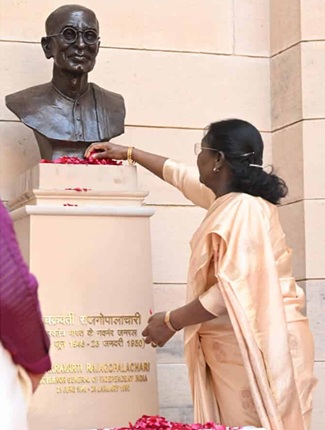
Born in December 1878 in Thorapalli (Tamil Nadu), Rajaji emerged as one of the most intellectually influential leaders of the national movement.
He attended the 1906 Calcutta and 1907 Surat sessions of the Indian National Congress, marking his early engagement with nationalist politics.
In 1919, Rajaji met Mahatma Gandhi in Madras. This encounter deepened his commitment to non-violent resistance and mass mobilisation.
Rajaji supported the 1919 Rowlatt Satyagraha and led the Non-Cooperation Movement in Tamil Nadu, giving up his lucrative legal practice.
He led the historic Trichy–Vedaranyam march as part of the Civil Disobedience Movement and faced multiple imprisonments.
While close to Gandhi, Rajaji differed during the Quit India Movement. He advocated negotiation with the Muslim League instead of immediate confrontation with the British.
To break the political deadlock between Congress and the Muslim League, Rajaji proposed a compromise formula:
In 1944, Gandhi conveyed the proposal to Muhammad Ali Jinnah, but it was rejected.
As Premier of Madras (1938), Rajaji introduced compulsory Hindi for Classes 6–8. However, during the anti-Hindi agitations of 1965, he opposed making Hindi the sole official language, defending English as a neutral link language.
His opposition was directed against coercion, not linguistic diversity.
After serving as Home Minister under Jawaharlal Nehru (1950–51), Rajaji grew critical of centralised planning and excessive state control.
In August 1959, he founded the Swatantra Party.
The party:
Though criticised as elitist, it emerged as a significant opposition force in the 1960s.
Rajaji authored accessible retellings of the Ramayana and Mahabharata, making classical texts widely readable.
Replacing a colonial-era statue with Rajaji’s image symbolises:
Rajaji’s life represents “principled flexibility” — balancing conviction with pragmatism, tradition with reform, and power with responsibility.
FAQs1. Who was C. Rajagopalachari ? An Indian freedom fighter, social reformer, Governor-General, and founder of the Swatantra Party. 2. What was the Rajaji Formula ? A proposal for a Congress–Muslim League agreement involving a plebiscite in Muslim-majority areas. 3. What role did Rajaji play in temple entry reform ? He enabled Dalit entry into temples through protective legislation in 1939. 4. Why is Rajaji considered a liberal thinker ? He opposed excessive state control and advocated constitutional democracy and economic freedom. 5. Why is the statue installation significant ? It symbolises honouring indigenous leaders and reinterpreting colonial-era symbolism in national spaces. |



Our support team will be happy to assist you!

 Contact Us
  New Batch : 9555124124/ 7428085757
  Tech Support : 9555124124/ 7428085757