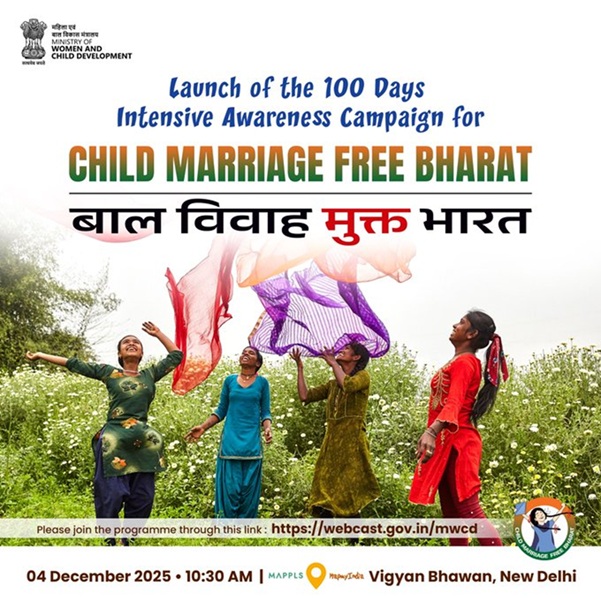
The Ministry of Women and Child Development (MoWCD) will formally launch a 100-day intensive awareness campaign on 4 December 2025 from Vigyan Bhawan, New Delhi. This campaign marks one year of the national initiative “Bal Vivah Mukt Bharat (Child Marriage Free India)”, which was initially launched on 27 November 2024.
Campaign Duration, Nature & Objectives
Duration
Key Objectives
- To enhance public awareness on the ill-effects of child marriage.
- To mobilize citizens, institutions and community leaders across India.
- To encourage local self-governance bodies (gram panchayats/wards) to declare themselves “Child Marriage Free Zones.”
Three-Phase Strategic Action Plan
1. Phase I — Education-Focused Activities
- Awareness programmes in schools, colleges and universities.
- Debates, essay competitions, dialogue sessions, and oath-taking ceremonies.
- Aimed at sensitizing adolescents and academic communities.
2. Phase II — Engaging Social & Religious Leadership
- Involvement of religious leaders, community influencers, and marriage service providers.
- Dissemination of messages on child rights, protection, and legal awareness.
3. Phase III — Strengthening Local Governance Units
- Panchayats and municipal wards will be encouraged to pass formal resolutions declaring their areas child-marriage-free.
- Effort to create localised accountability and ownership.
Launch Highlights
- National Pledge to End Child Marriage
- A special film showcasing change stories from across India
- Experience-sharing sessions by frontline workers
Background and Relevance of the Initiative
- The national “Bal Vivah Mukt Bharat” campaign was launched on 27 November 2024, aiming to create a coordinated nationwide movement against child marriage.
- In 2024–25, the initiative laid its groundwork; the 100-day campaign marks its first anniversary and provides momentum to scale it from local to national levels.
Legal Framework: Prohibition of Child Marriage Act (PCMA), 2006
The PCMA 2006 is the primary legislation to prevent child marriage and protect minors.
Minimum Age of Marriage
- Girls: 18 years
- Boys: 21 years
Validity of Child Marriage
- Child marriages are voidable, meaning they can be annulled when the child becomes an adult.
- A boy (after 21) or girl (after 18) can petition the court to nullify the marriage.
Major Provisions
1. Penalties
For anyone involved in conducting or promoting a child marriage (parents, priests, facilitators etc.):
- Imprisonment up to 2 years
- Fine up to ₹1 lakh
2. Preventive Measures
- Appointment of Child Marriage Prohibition Officers (CMPOs).
- CMPOs are empowered to intervene, gather information, and coordinate with police and district authorities.
3. Protection of Minors
- Additional punishment for abuse, exploitation or cruelty in cases related to child marriage.
Other Highlights
- Sections 11 and 12 outline procedures for prevention and penal action.
- Works in alignment with the IPC, Child Labour Act, 1986, and Hindu Marriage Act, 1955.
Expected Impact and Benefits
- Improved Adolescent Education: School-based activities can dispel myths and improve understanding among parents and children.
- Community Ownership: Involvement of religious and social influencers can reshape societal attitudes.
- Strong Local Commitment: Declarations of “child-marriage-free zones” by panchayats reflect grassroots commitment.
- Better Reporting and Monitoring: Large-scale campaigns improve case reporting, vigilance, and data availability.
Challenges and Limitations
- Deep-rooted socio-economic causes (poverty, gender discrimination, limited educational access) cannot be fully addressed in 100 days.
- Weak enforcement and social acceptance often prevent cases from coming to light.
- Sustainability issues — Campaigns need integration with economic support, scholarships, and child care services to ensure long-term impact.
Policy Recommendations
- Long-Term Integrated Strategy: Focusing on adolescent education, economic empowerment, and social safety nets.
- Targeted Interventions: Special programmes for high-risk districts, including:
- Conditional cash transfers
- Adolescent-friendly health services
- Community-Led Monitoring: Village committees and women’s groups should play a role in surveillance and early-warning.
- Inter-Departmental Convergence: Joint action among departments of education, health, WCD, labour, and local governments.
- Data-Driven Governance: Regular surveys, improved reporting, and outcome evaluation to measure campaign effectiveness.





 Contact Us
  New Batch : 9555124124/ 7428085757
  Tech Support : 9555124124/ 7428085757