New
GS Foundation (P+M) - Delhi : 05th Jan., 2026 Winter Sale offer UPTO 75% + 10% Off, Valid Till : 5th Dec., 2025 GS Foundation (P+M) - Prayagraj : 15th Dec., 11:00 AM Winter Sale offer UPTO 75% + 10% Off, Valid Till : 5th Dec., 2025 GS Foundation (P+M) - Delhi : 05th Jan., 2026 GS Foundation (P+M) - Prayagraj : 15th Dec., 11:00 AM

Current Affairs for 13 November 2025

Traditional Lepcha Musical Instruments Receive GI Tag

Why in News?

The Government of India has granted Geographical Indication (GI) tags to two traditional musical instruments of the Lepcha community of Sikkim — Tungbuk and Pumtong Pulit.
This recognition marks an important step in promoting and preserving the rich cultural heritage of the Lepcha tribe at both national and international levels.

Lepcha-community

Key Points

  1. Date of Announcement: November 5, 2025
  2. Category: Musical Instruments
  3. GI Registration Authority: Geographical Indications Registry, Chennai (Government of India)
  4. Award Ceremony: First Tribal Trade Conference held in New Delhi
    • Organized by: Ministry of Culture, Ministry of Tribal Affairs, and Ministry of Commerce & Industry
    • Chief Guests: Union Ministers Piyush Goyal and Jual Oram

Details of the Instruments

Instrument

Type

Special Feature

Cultural Significance

Tungbuk

Three-stringed instrument

Handmade string instrument

Used in traditional folk music and religious rituals

Pumtong Pulit

Bamboo flute

Made from locally sourced bamboo

Played during folk songs and social gatherings

GI Application and Contributions

  • Applicants: Ugen Palzor Lepcha (for Tungbuk) and Namgyal Lepcha (for Pumtong Pulit)
  • Supporting Organization: NABARD, Gangtok — provided both technical and financial assistance during the GI registration process.
  • Duration: Approximately two years to obtain the GI tag.

Significance of the GI Tag

  1. Provides national recognition and legal protection to these traditional instruments.
  2. Promotes cultural revival of Lepcha musical traditions.
  3. Enhances awareness among youth about indigenous art forms.
  4. Creates new livelihood opportunities for traditional artisans.  
  • Location: Primarily in Sikkim, Darjeeling (West Bengal), and parts of Bhutan.
  • Identity: Indigenous people of Sikkim.
  • Culture: Deeply nature-centric spiritual beliefs, rich traditions of folk music, and craftsmanship in traditional instruments.

Additional Information

  • Legal Framework: Governed by the Geographical Indications of Goods (Registration and Protection) Act, 1999.
  • Authority: Controller General of Patents, Designs and Trade Marks (CGPDTM), under the Ministry of Commerce and Industry.
  • Other GI Products from Sikkim: Sikkim Tea, Darjeeling Tea, and Sikkim Orange.

Coral Bleaching: Definition, Distribution, Importance, Major Threats, Conservation Efforts, and More

Corals are crucial marine invertebrates that form coral reefs through colonies of calcium carbonate-secreting polyps. They rely on symbiotic algae called zooxanthellae for nutrition. In recent years, climate change has significantly increased coral bleaching events, severely impacting global marine biodiversity.
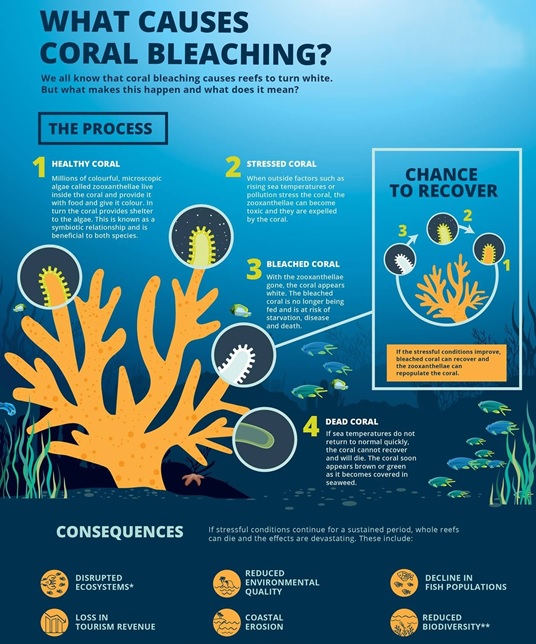
What is Coral Bleaching?

  • Coral Bleaching is an environmental phenomenon in which corals lose their color, appearing white or pale yellow.
  • The primary cause is the loss or death of their symbiotic algae, zooxanthellae, which provide corals with both color and energy through photosynthesis.
  • When the algae are expelled, corals lose their color and struggle to survive.

Coral-Bleaching

Natural Habitat of Corals

  • Latitude: Between 30°N and 30°S
  • Water: Clear, shallow, and sunlight-rich
  • Temperature: 16–32°C
  • Depth: Less than 50 meters

Global Distribution

  • Major Coral Reefs: Australia, Indonesia, Philippines
  • Coral Triangle: The richest marine biodiversity area in the world
    • Members: Indonesia, Malaysia, Philippines, Papua New Guinea, Timor-Leste, Solomon Islands

Importance of Coral Reefs

  1. Biodiversity Hotspots
    • Provide habitat and food for ~25% of all marine species.
  2. Coastal Protection
    • Act as natural breakwaters, protecting coastlines from storms, erosion, and flooding.
  3. Economic Value
    • Through tourism, fisheries, and coastal protection, coral reefs contribute approximately $10 trillion annually to the global economy.

Major Threats to Coral Reefs

  1. Coral Bleaching

  • Occurs due to thermal stress, light imbalance, and nutrient deficiencies, causing corals to expel their symbiotic algae.
  • 2024 marked the 4th Global Coral Bleaching Event (GCBE-4):
  • Over 77 coral reefs worldwide affected.
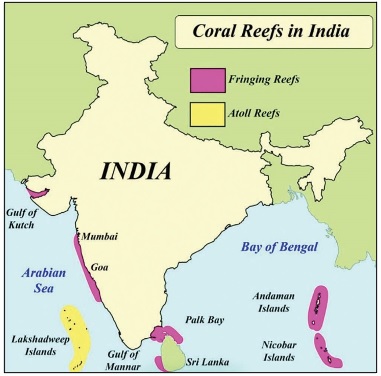
  • In India, affected areas include:
  • Andaman & Nicobar Islands
  • Lakshadweep
  • Gulf of Mannar
  • Gulf of Kutch

coral-reefs

  1. Other Threats

  • Global warming
  • Coral mining for construction
  • Aquarium trade
  • Overfishing
  • Ocean acidification
  • Coastal pollution and sedimentation
  • Offshore construction and shipping

Coral Conservation Efforts

(A) Efforts in India

  • Wildlife (Protection) Act, 1972
    • Corals listed under Schedule I (highest protection).
  • National Committee for Mangroves, Wetlands, and Coral Reefs, 1986
    • Coordinates national-level conservation strategies.
  • Environment (Protection) Act, 1986
    • Prohibits use of coral and sand for construction.
  • Local Restoration Projects
    • Gulf of Kutch: Biorock technology
    • Tamil Nadu: Artificial reefs

(B) Global Efforts

  • ICRI (International Coral Reef Initiative)
    • International collaboration for coral conservation; India is a member.
  • CITES
    • Coral species listed in Appendix II to regulate trade.
  • UNESCO World Heritage Sites
    • Recognizes significant coral reefs as world heritage sites.

Way Forward

  1. Local-level Conservation
    • Reduce nutrient-rich runoff from rainwater
    • Control coastal pollution, plastic, and sedimentation
    • Implement sustainable fishing practices and enforce Coastal Regulation Zones (CRZ)
  2. Combating Climate Change
    • Limit global temperature rise
    • Reduce greenhouse gas emissions
    • Transition to renewable energy sources
  3. Scientific Measures
    • Cryopreservation: e.g., Taronga Cryodiversity Bank for coral gametes
    • Engineering Solutions: Biorock technology, artificial reefs
    • Promote resilient coral species
  4. Community-Based Management
    • Involve coastal communities
    • Encourage sustainable tourism
    • Establish local conservation committees

Conclusion

Coral reefs are among the most productive and sensitive ecosystems on Earth. Increasing global warming and ocean acidification have accelerated coral bleaching, threatening marine biodiversity, coastal communities, and the global economy. Only strong policy interventions, climate action, scientific techniques, and community-based conservation can ensure the survival of corals.

Rare Earth Hypothesis: The Rarity of Complex Life

 (Prelims: Science and Technology)

Context

Recent data from Kepler and the James Webb Space Telescope (JWST) indicate that Earth-sized planets are not very rare in the universe. However, the conditions necessary for complex life on such planets are still considered extremely rare. This question is the root of the "Rare Earth Hypothesis."

Rare-Earth-Hypothesis

What is the Rare Earth Hypothesis?

  • This hypothesis was proposed in 2000 by paleontologist Peter Ward and astronomer Donald Brownlee.
  • Its main argument is that microbial life may be common in the universe, but complex multicellular life is extremely rare.
  • This idea is based on the assumption that the simultaneous occurrence of several factors necessary for life on a planet, such as water, atmosphere, temperature, magnetic field, and a stable climate, is extremely unlikely.

Discoveries of the Kepler and James Webb Telescopes

  • According to data from the Kepler mission (2009–2018), the Milky Way contains many Sun-like stars with Earth-sized planets around them.
  • Some studies estimate that approximately 20% of stars host Earth-like planets in their habitable zones.
  • This weakens the notion that Earth-like conditions are extremely rare.
  • The question has now shifted from "where is the planet" to "what is the planet like."

The question of the planet's true nature

  • Both Earth and Venus are in the Sun's habitable zone, but Venus's dense carbon dioxide atmosphere makes it inhospitable to life.
  • This makes it clear that distance alone is not enough; atmospheric composition and water stability are equally important.

The Challenge of M-Dwarf Stars and Planets

  • M-Dwarf stars are the most common in the universe, but they emit intense ultraviolet radiation.
  • This radiation strips water from planets' atmospheres, creating false oxygen-rich atmospheres that appear to be signs of life, but are actually the result of natural radiation.
  • Some planets, with strong magnetic fields or those far from the star, may retain their air, but such planets are rare.

The Role of the James Webb Space Telescope

The planets of the TRAPPIST-1 system studied by JWST:

  • TRAPPIST-1c was found to lack a dense CO atmosphere.
  • TRAPPIST-1b was also found to lack a substantial atmosphere.

This shows that having an Earth-like size does not equate to having an Earth-like atmosphere.

Climate Stability and Plate Tectonics

  • Plate tectonics is the primary cause of Earth's climate stability.
    • It recycles carbon from the interior to the surface.
    • It maintains long-term temperature balance.
  • But this process is not the same for all planets.
    • Some planets have a rigid crust that is not dynamic.
    • Some experience intermittent geological activity.
  • Scientists are still not agreed on whether plate tectonics is necessary for complex life.

Role of Giant Planets Like Jupiter

  • It was previously believed that Jupiter protects Earth from meteorites, but recent studies have shown that its effect depends on the circumstances.
  • In some situations, it can deflect dangerous objects,
  • and sometimes send them inward.
  • This weakens the claim that a "Jupiter-like planet" is necessary for life in any system.

Life is not rare, but complex life is still rare.

  • According to current scientific understanding, microbial life is probably common, but long-term complex ecosystems (like the combined life of land and water on Earth) may be extremely rare.
  • That is, Earth-sized planets may be abundant in habitable zones, but finding them with environments that support life like Earth's is still a rare possibility.

The Way Forward

  • Three future scientific discoveries could challenge this hypothesis:
  1. If an Earth-like planet around a cool, Sun-like star is discovered to have an atmosphere with a water cycle.
  2. If evidence of stable climate processes like plate tectonics is found.
  3. If biological (biosignatures) or technosignatures are found on a planet.
  • The James Webb Telescope and upcoming Extreme Large Telescopes (ELTs) will play a crucial role in this direction.

Forensic Expertise: Science and Justice

(Preliminary Examination: Current Affairs)
(Main Examination, General Studies Paper 2: Issues arising from government policies and interventions for development in various sectors and their design and implementation.)

Context

On November 10, 2025, a massive explosion occurred near the Red Fort complex in Delhi, killing at least 13 people. The role of forensic experts is crucial in such incidents, as their scientific analysis can determine whether the explosion was accidental or a premeditated crime.

Forensic-Expertise

Role of Forensic Experts

  • Immediately after the Red Fort explosion, experts from the Explosives Department of the Delhi Forensic Laboratory arrived at the scene with the police. Their main tasks are:
    • Scientifically investigating the cause of the explosion and collecting evidence.
    • Identifying the type of explosive used through laboratory analysis.
    • Assisting in the identification of the perpetrators.
  • Explosion investigations are more complex than ordinary crimes because everything is destroyed in an instant.
  • Despite this, experts work on "Locard's Principle of Exchange," which states that "every criminal leaves something at the crime scene and takes something with him."
  • This scientific principle forms the basis for collecting evidence from crime scenes.

Sample Collection and Analysis Process

  • Burnt debris, car parts, ashes, and other remains are collected from the scene.
  • Experts then use spectroscopic and chromatographic techniques to determine which chemicals or explosives were used.
  • If any electronic devices (such as timers or circuit boards) are found, it indicates that the explosion may have been remote-controlled.

Main Scientific Tests

  • Fourier Transform Infrared Spectroscopy (FTIR) Attenuated Total Reflectance-FTIR (ATR-FTIR): Analysis of the reaction of samples with infrared light, which determines their chemical composition.
  • Raman Spectroscopy: Used for the chemical identification of explosives.
  • Scanning Electron Microscopy (SEM): Study of the microstructure of fragments left after an explosion.
  • Energy Dispersive X-ray (EDX): Elemental analysis of residue.
  • Thermal Analysis: Study of the stability and thermal properties of explosives.
  • Laser-based Mapping and Flash Point Testing: Determining the spread, direction, and source of the fire to determine whether the explosion was an accident or a conspiracy.

Involvement of Other Forensic Branches

In such incidents, not only explosion experts but several departments work together:

  • Explosives Department: Identification of explosive materials.
  • Forensic Physics Division: Thermochemical examination of car engine and chassis numbers.
  • Cyber ​​Forensics: Examination of CCTV footage and digital evidence.
  • DNA and Biology Division: Identification of bodies and testing of biological evidence.

Constitutional and Legal Aspects

  1. Right to Scientific Investigation under the Constitution

  • Article 21: The "right to life and personal liberty" is not just a right to life, but also ensures that every person has the right to justice and a fair trial. Forensic evidence, scientific investigation, and transparency are extensions of this right.
  • Article 51A (g): Imposes responsibility on citizens to be aware of the environment and science. Forensic science is a practical example of this scientific approach, ensuring justice and security in society.
  1.  Legal Framework

  • Indian Penal Code (BNS), 2023
    • Sections 101(2), 226, 227, and 324(4) define offenses related to the improper use of explosive substances and causing damage to property.
    • Section 103(2): The offense of murder applies to death by explosion.
  • Explosive Substances Act, 1908: Regulates the manufacture, storage, and use of explosives. Forensic experts assist in the examination of chemical substances used under this Act.
  • Terrorist Activities (UAPA, 1967): If an explosion is considered a terrorist activity, forensic reports play a crucial role in gathering evidence under the UAPA.
  • Indian Evidence Act (1872): Under Section 45, “expert testimony” is recognized as valid evidence. Therefore, the reports of forensic experts are of crucial importance in the judicial process.
  • Indian Civil Supplies Code (BNSS), 2023: Sections 329 and 330 make forensic reports and the testimony of scientific officers admissible in court.

Conclusion

Investigating complex incidents like explosions is not merely a police action, but a scientific and constitutional process. Forensic experts, balancing their technical expertise with legal obligations, not only get to the bottom of the crime but also ensure that every piece of evidence is scientifically proven in court. Thus, forensic investigation is an integral part of impartial justice under Article 21 of the Constitution, where science and justice go hand in hand.

India’s Bioeconomy — A Step Toward Innovation, Growth, and Sustainable Development

mains gs paper iii – Economy & Environment

India is rapidly emerging as a “biotechnology powerhouse” of the 21st century. At the 2nd Foundation Day of the Biotechnology Research and Innovation Council (BRIC), the Union Minister of State for Science and Technology announced that India’s bioeconomy is projected to reach USD 300 billion in the coming years. On this occasion, plans for establishing a 200-acre BRIC–Bio-Enterprise Innovation Park in Faridabad were also unveiled.

BRIC was established in 2023 by merging 14 autonomous institutions under the Department of Biotechnology (DBT) to strengthen India’s biotech innovation ecosystem.
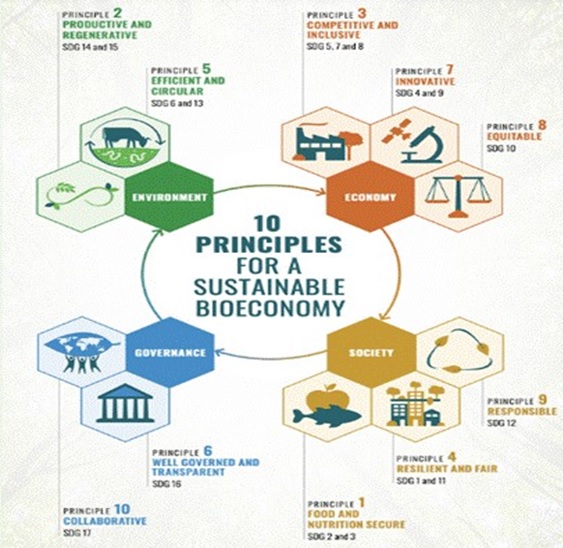
biotechnology-powerhouse

What is Bioeconomy?

Bioeconomy refers to an economic system that utilizes renewable biological resources — such as plants, animals, microorganisms, and bio-waste — to produce food, energy, industrial products, and services.

Main objectives:

  • To reduce dependence on fossil fuels.
  • To promote environmentally friendly and sustainable development.
  • To create employment and balance rural–urban growth.

In short:

“Bioeconomy is a green economic framework built at the intersection of science, innovation, and sustainability.”

Current Status of India’s Bioeconomy

Year

Size of Bioeconomy

2014

USD 10 billion

2024

USD 165.7 billion

Target (2030)

USD 300 billion

  • India’s bioeconomy has grown 16-fold in 10 years.
  • The compound annual growth rate (CAGR) is about 17–18%.
  • It contributes approximately 4.25% to India’s GDP (2024).
  • Leading States (2024): Maharashtra (1st), Karnataka (2nd).

Major Initiatives Promoting India’s Bioeconomy

(a) BioE³ Policy (Economy, Environment & Employment) – 2024

  • A new national policy approved by the Cabinet to promote high-performance bio-manufacturing.
  • Aims to address the three “E” challenges — Economy, Environment, and Employment.
  • Encourages green industries, innovation clusters, and start-ups.

(b) National Biopharma Mission (NBM) – Innovate in India (i3)

  • Implemented by BIRAC (Biotechnology Industry Research Assistance Council).
  • Supported by the World Bank with USD 250 million.
  • Has aided 100+ projects and 30+ MSMEs in the biopharma sector.

About BIRAC:

  • A not-for-profit company under Section 8 of the Companies Act, 2013.
  • A Schedule-B Public Sector Enterprise under DBT.
  • Acts as a bridge between research institutions, industry, and start-ups.

(c) Bioenergy Mission

  • India achieved the E20 (20% ethanol blending) target five years ahead of schedule, in 2025 instead of 2030.
  • This achievement reduces fossil-fuel dependence and enhances farmers’ income.

Four Major Sub-sectors of the Bioeconomy

Sub-sector

Approx. Share

Key Examples

Bio-industrial

47%

Biofuels, bioplastics, industrial enzymes

Bio-pharma

35%

Vaccines, biologics, medical devices

Bio-agriculture

8%

BT cotton, biofertilizers, precision farming

Bio-research

9%

Clinical trials, bioinformatics, biotech software

Significance of India’s Bioeconomy

  1. Environmental Protection: Reduction in carbon emissions and promotion of green industries.
  2. Employment Generation: Creation of millions of new jobs, especially in bio-manufacturing and bio-startups.
  3. Rural and Agricultural Empowerment: Bio-agriculture and biofuels enhance farmers’ income.
  4. Global Leadership: India ranks among the top countries in the Asia-Pacific in bioeconomy growth rate.
  5. Sustainable Development: Contributes to achieving SDGs 7, 9, 12, and 13 (Clean Energy, Industry-Innovation, Responsible Consumption, Climate Action).

Key Challenges

  • Limited private-sector investment in research and innovation.
  • Slow lab-to-market transition of technologies.
  • Issues of bioresource conservation and regulation.
  • Shortage of skilled manpower and specialized training.
  • Policy disparities across states.

Way Forward

  • Develop bio-clusters like the BRIC Bio-Innovation Park in every state.
  • Increase R&D investment, especially with private-sector participation.
  • Strengthen bio-policy and intellectual property (IP) frameworks to attract investment.
  • Promote education and skill development in biotechnology, bioinformatics, and biomanufacturing.
  • Foster international collaborations with countries such as the EU, USA, and Japan.

Conclusion

India’s bioeconomy is not just an economic domain but a foundation for a new green revolution. With balanced efforts in policy, research, and industrial collaboration, India can achieve its target of a USD 300 billion bioeconomy by 2030.

« »
  • SUN
  • MON
  • TUE
  • WED
  • THU
  • FRI
  • SAT
Have any Query?

Our support team will be happy to assist you!

OR