| Prelims: (Military Operations + CA) Mains: (GS 2 – International Operations; GS 3 – Security) |
For the first time, the Chief of the Army Staff (COAS) has formally paid homage to the soldiers who lost their lives during Operation Pawan, the Indian Peace Keeping Force (IPKF) mission undertaken in Sri Lanka in 1987. This marks a long-awaited official recognition of the operation and its martyrs.
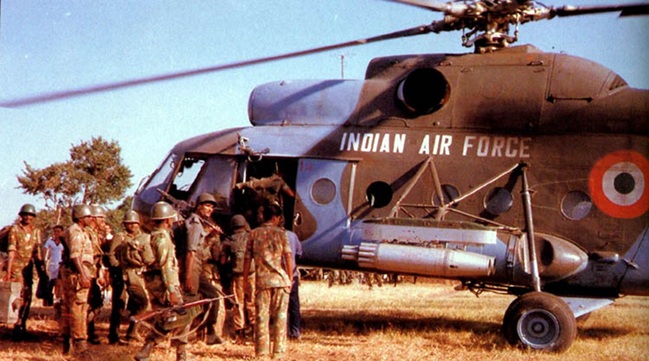
FAQsQ.1.When was Operation Pawan launched ? In 1987, following the Indo–Sri Lanka Accord. Q.2.What was the purpose of Operation Pawan ? To deploy the IPKF in Sri Lanka to disarm militant groups, mainly the LTTE, and restore peace. Q.3.Which government initiated the operation ? The Rajiv Gandhi-led government. Q.4.Which major militant group was involved ? The Liberation Tigers of Tamil Eelam (LTTE). Q.5.Who is the most notable martyr from the operation ? Major Ramaswamy Parameswaran, a Param Vir Chakra awardee. Q.6.When did Operation Pawan end ? In 1990, with the withdrawal of the IPKF. |
| Prelims: (Science + CA) Mains: (GS 3 – Science & Technology, Economy) |
The Union Cabinet has cleared a ₹7,280-crore Rare Earth Magnet Scheme to establish India’s first integrated manufacturing ecosystem for Sintered Rare Earth Permanent Magnets (REPMs)—critical components used in EVs, wind turbines, defence systems and advanced electronics.
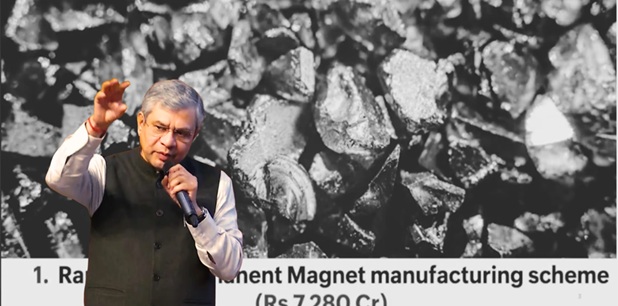
1. ₹7,280-Crore Outlay with Dual Incentive System
2. Selection of 5 Global Manufacturers
3. End-to-End Integrated REPM Manufacturing
Beneficiaries must create full value-chain facilities:
A. Supporting EV & Renewable Energy Transition
B. Strengthening Defence & Aerospace Capacities
C. Alignment with Net Zero & Critical Minerals Strategy
Automotive Sector Reaction
China’s Dominance
Geostrategic Dimension
India’s scheme is not just economic—it is a strategic shield against external supply shocks.
Implementation Challenges
Experts highlight that success depends on:
FAQs1. What is the Rare Earth Magnet Scheme? A ₹7,280-crore initiative to build India’s first fully integrated ecosystem for rare earth permanent magnet manufacturing. 2. Why are REPMs important? They are crucial for EVs, wind turbines, electronics, and defence systems. 3. How many manufacturers will be selected? Five, through global competitive bidding. 4. What is the total planned production capacity? 6,000 MTPA, with each manufacturer eligible for up to 1,200 MTPA. 5. Why does India need domestic REPM capability? To reduce import dependence, counter Chinese supply disruptions, and support clean-tech and defence sectors. 6. What incentives does the scheme offer? Sales-linked incentives and capital subsidies for establishing integrated REPM facilities. 7. How does the scheme support Net Zero goals? By securing supply of key components needed for renewable energy and electric mobility. |
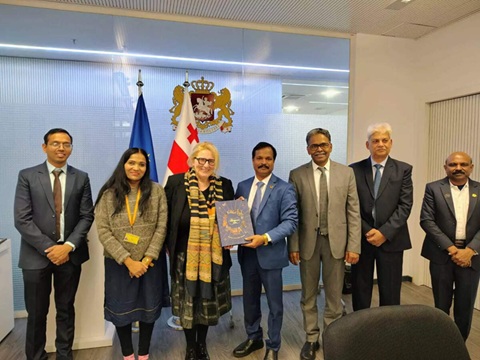
India participated in the 11th BACSA International Conference – CULTUSERI 2025 held in Georgia, where India showcased its progress, research, and innovation in the silk sector.
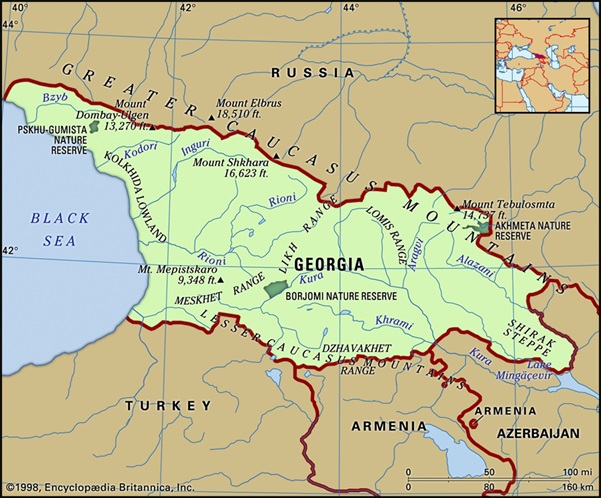
Georgia: A Brief Introduction
|
| (Preliminary Examination: Current Affairs) (Mains Examination, General Studies Paper 1: Important Geophysical Events, Geographical Features, Such as Earthquakes, Tsunamis, Volcanic Activity, Cyclones, etc.) |
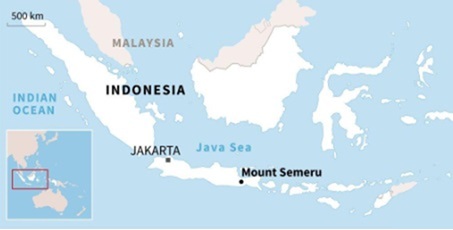
Recently, a massive cloud of ash from the Hayli Gubbi volcano eruption in Ethiopia reached northwestern India due to strong winds. This ash cloud disrupted flights in Delhi-NCR, Rajasthan, Gujarat, Maharashtra, and Punjab for several hours.
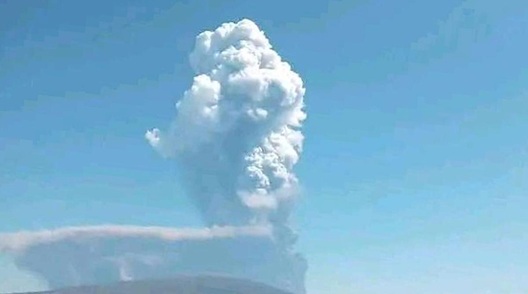
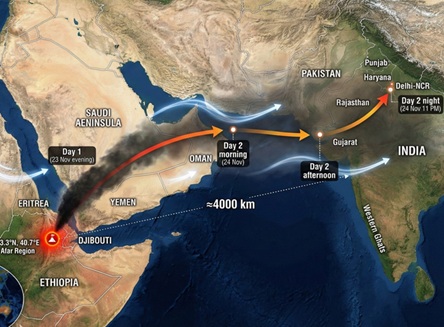
Sumeru Volcano Eruption
|
|
Know this too!
|
|
Did You Know? Ol Doinyo Lengai volcano in Tanzania is the only active volcano in the world with natrocarbonatite lava. Natrocarbonatite lava is a highly viscous type of magma rich in sodium, potassium, and calcium carbonate, but low in silicon. Carbonatite magma flows like normal water. This volcano has more than one active center. Ol Doinyo Lengai's fertile lower reaches are home to grape and citrus plantations. |
| Prelims: (Polity + CA) Mains: (GS 2 – Governance, Constitution) |
The Supreme Court has revisited the issue of custodial torture after noting poor compliance with its 2020 directive mandating installation of CCTV cameras in police stations and central investigative agencies. The concern has intensified following 11 custodial deaths in Rajasthan within eight months.
Note: In Paramvir Singh Saini vs. Baljit Singh (2020), the SC ordered CCTV installation in all police stations, later extending it to agencies such as CBI, NIA, ED, NCB, DRI, and others empowered to arrest and interrogate individuals. The Court emphasized that these safeguards are vital to protect the right to dignity and life.
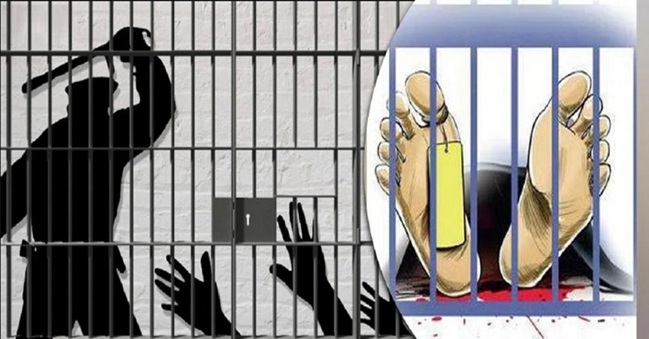
Data: NHRC recorded 2,346 judicial custody deaths and 160 police custody deaths in 2023–24.
A. Constitutional Provisions
B. Statutory Provisions
C. International Safeguards
D. Judicial Directives
1. Weak Legal Framework
2. Poor Accountability
3. Colonial Policing Culture
4. Capacity Gaps & Corruption
5. Weak Oversight Mechanisms
1. Define Custodial Violence & Ratify CAT
2. Use Technology for Transparency
3. Build Professional Capacity
4. Strengthen Human Rights Institutions
5. Expand Public Awareness
FAQs1. What is custodial violence ? Custodial violence refers to physical, psychological, or sexual harm inflicted on individuals in police or judicial custody, including torture, harassment, extortion, and custodial deaths. 2. Which constitutional provisions safeguard individuals from custodial torture?
3. What was the significance of the Supreme Court’s 2020 judgment on CCTV cameras ? In Paramvir Singh Saini vs. Baljit Singh (2020), the SC mandated CCTV cameras in all police stations and extended this to central agencies like CBI, ED, NIA, NCB, DRI to deter torture and increase transparency. 4. What are the main causes behind custodial violence in India ? Key reasons include outdated colonial laws, weak accountability mechanisms, coercive policing culture, lack of forensic capacity, and poor compliance with oversight directives. 5. Has India ratified the UN Convention Against Torture (UNCAT) ? No. India signed UNCAT in 1997 but has not ratified it, meaning it is not legally bound by international anti-torture obligations |
| Prelims: (Polity + CA) Mains: (GS 2 – Governance, polity) |
The Supreme Court has agreed to review a petition challenging the rule that allows political parties to accept anonymous cash donations below ₹2,000. Petitioners argue that this provision enables opaque and untraceable political funding, undermining transparency and citizens’ right to information.
Total Ban on Cash Donations

Violation of Fundamental Rights
Directions Sought for Oversight of Form 24A
Suggested Reforms
Representation of the People Act (RPA), 1951
Companies Act, 2013
Income Tax Act, 1961

Foreign Contributions Regulation Act (FCRA), 2010
Electoral Trusts Scheme, 2013
Informed Political Choice
Institutional Probity
National Security
Anonymous donations can enable foreign influence, affecting defence procurement and strategic policymaking.
Preventing Market Distortion
Preserving Egalitarian Democracy
Aligning with Global Standards
1. End Anonymous Cash Donations
2. Enforce Transparent Accounting
3. Strengthen Institutional Enforcement
4. Real-Time Disclosure Mechanisms
5. Systemic & Long-Term Reforms
FAQs1. What rule is being challenged in the Supreme Court? The rule allowing anonymous cash donations below ₹2,000 to political parties under Section 13A(d), Income Tax Act. 2. Why is this rule considered problematic? It creates a loophole for untraceable political funding, reducing transparency. 3. Which fundamental right is cited in the petition? Article 19(1)(a) – the voter’s Right to Information on political funding. 4. What action is sought from the Election Commission of India (ECI)? Strict scrutiny of Form 24A and action against parties that do not disclose donor details. 5. What reforms are proposed for political funding? Ban anonymous cash donations, mandate digital payments, strengthen audit and reporting systems. |
| Prelims: (Military Operations + CA) Mains: (GS 2 – International Relations; GS 3 – Security) |
The 19th edition of Exercise SURYAKIRAN (SURYAKIRAN XIX – 2025) has officially begun at Pithoragarh, Uttarakhand, marking the continuation of one of the largest Indo–Nepal joint military initiatives.
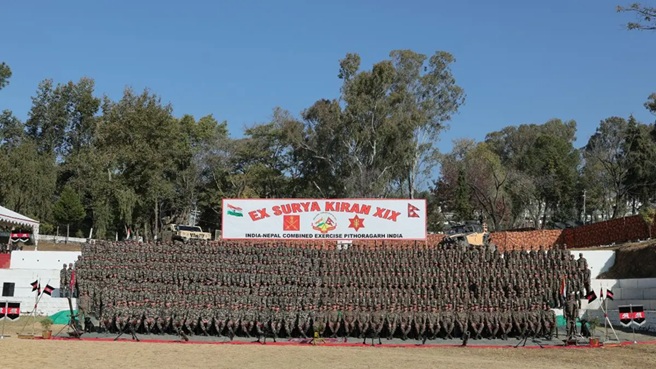
FAQsQ.1.Which countries participate in Exercise SURYAKIRAN ? India and Nepal. Q.2.Where is the 2025 edition being held? At Pithoragarh, Uttarakhand. Q.3.Which Indian regiment is leading participation this year? The ASSAM Regiment. Q.4.How often is the exercise held? Annually, alternating between the two countries. Q.5.What is the main aim of Exercise SURYAKIRAN? To rehearse sub-conventional operations under the UN mandate and enhance joint operational capabilities. Q.6.What technologies are being used in SURYAKIRAN XIX? UAS, drone-based ISR, AI-driven decision tools, and autonomous logistic platforms. |

Our support team will be happy to assist you!


 Contact Us
  New Batch : 9555124124/ 7428085757
  Tech Support : 9555124124/ 7428085757