(Preliminary Examination: Current Events of National Importance)
(Main Examination, General Studies Paper 3: Major Crops and Related Topics and Constraints; Conservation, Environmental Impact Assessment) |
Context
The Forest College and Research Institute (FCRI) in Mulugu, Telangana, has recently been compelled to initiate a comprehensive scientific investigation into the devastating dieback disease following the death of thousands of neem trees. There is virtually no known cure for this disease, posing a serious threat to India's ecosystem and rural economy.
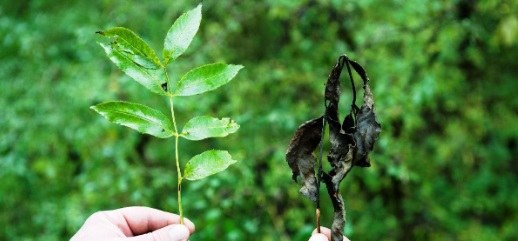
Nature of Dieback Disease
- What it is: It is a serious fungal disease that can affect many types of plants.
- Symptoms: This disease causes wilting and browning of leaves at the branch tips, stem disease, and fruit rot.
- Pathogen: The dieback fungus belongs to the genus Phytophthora.
- History: The first report of this disease in India occurred in the 1990s near Dehradun, Uttarakhand.
Disease Transmission and Life Cycle
This disease thrives in warm and humid conditions and spreads rapidly, making it difficult to control:
- Mode of Transmission: The fungus spreads primarily through the movement of soil and mud, especially by vehicles and shoes. It also spreads in free water and through direct root-to-root contact between plants.
- Favorable Conditions: The fungus survives in susceptible plant tissues and soil and spreads and reproduces best in warm and humid conditions.
- Disease Mechanism: When roots become infected, they are unable to provide the water and nutrients necessary for survival, resulting in plant death from dehydration.
Disease Severity
- Plants often begin to show symptoms with the onset of the rainy season and become increasingly severe during the latter part of the rainy season and early winter.
- The effects of dieback disease are not limited to trees; it can have widespread ecological consequences.
Ecological and Economic Threats
- Yield Loss: Severely infected trees can suffer nearly 100% fruit production loss, impacting rural livelihoods dependent on neem.
- Ecological Destruction: The disease can completely destroy the local vegetation in an area where it spreads, severely impacting the ecosystem structure. However, some species may be driven to extinction.
- Difficulty in Detection: The disease is difficult to detect because infected plants often appear to be dying due to drying out, hampering initial prevention efforts.
- Treatment issues: The biggest concern is that there is no known cure for this disease, leaving prevention and transmission control as the only effective strategies. Indeed, FCRI's investigations aim to understand this devastating pathogen and develop effective strategies for its management.






 Contact Us
  New Batch : 9555124124/ 7428085757
  Tech Support : 9555124124/ 7428085757