| (Prelims: Current Affairs) |
Why in News
Recently, more than 40 new species, including a new snake and a possible new bird species, have been discovered in the Great Nicobar Mega Infrastructure Project area.
About the New Discoveries
- New snake species: Lycodon irwini
- Named after Australian zookeeper Steve Irwin.
- Only four recordings of this snake have been found so far, highlighting its rarity.
- Due to its extremely limited regional distribution, it has been recommended for "Endangered" status on the IUCN Red List.
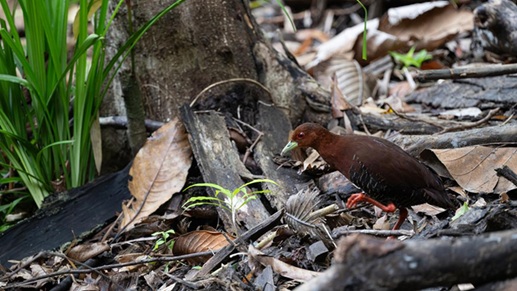
- New bird species: Great Nicobar Crake (Rallina group)
- It has been camera-recorded only three times in the last 10 years.
- Its unique physical characteristics may make it a species new to science.
- Little information is available about its biology, distribution, population, etc.
- Other Discoveries (2021–2025)
- Approximately 40 new species: 2 frogs, 4 crabs, 2 geckos, and several insects: flies, moths, beetles, etc.
- Nearly half of these species were discovered in 2025 alone.
Key Findings
- The Great Nicobar Island region is home to 650 plant species and over 1,800 animal species.
- Approximately 24% endemism has been recorded, meaning many species are found only here.
- Continuous new discoveries make it clear that this region is one of India's richest tropical rainforests.
- The scientific community believes that this area is highly sensitive and its protection should be a top priority.
- According to Asad Rahmani, former director of the Bombay Natural History Society, Great Nicobar is India's "finest tropical rainforest" and needs complete protection.
Significance
- Biodiversity Conservation: The discovery of new species demonstrates that this region is extremely important for scientific study and conservation.
- Ecologically Sensitive Zone: The rarity and endemism of its flora and fauna make it of national and global significance.
- Infrastructure vs. Environment: These discoveries have provided a stronger basis for environmental impact assessment (EIA) amid ongoing mega projects.
- Scientific Research: The continued discovery of new species makes this region a hotspot for biology, ecology, and conservation science.






 Contact Us
  New Batch : 9555124124/ 7428085757
  Tech Support : 9555124124/ 7428085757