New
GS Foundation (P+M) - Delhi : 20th Nov., 11:30 AM Winter Sale offer UPTO 75% + 10% Off, Valid Till : 5th Nov., 2025 GS Foundation (P+M) - Prayagraj : 03rd Nov., 11:00 AM Winter Sale offer UPTO 75% + 10% Off, Valid Till : 5th Nov., 2025 GS Foundation (P+M) - Delhi : 20th Nov., 11:30 AM GS Foundation (P+M) - Prayagraj : 03rd Nov., 11:00 AM

IMF Flags Concerns Over India’s GDP Data Quality in 2025 Review

Prelims: (Economy + CA)
Mains: (GS 2 - Governance, GS 3 - Economic Development)

Why in the News ?

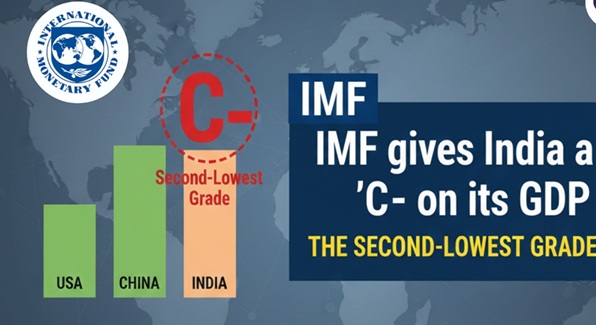
The International Monetary Fund (IMF), in its 2025 Article IV Staff Report, has once again awarded India’s national accounts—including GDP statistics—a C-grade, indicating the presence of methodological or coverage-related shortcomings that hinder effective economic surveillance.

This comes even as India reported a stronger-than-expected 8.2% GDP growth in July–September 2025, reviving long-standing debates about the credibility, consistency, and interpretation of the country’s GDP figures.
Why the IMF Assesses India’s Economic Data

Article IV Consultations

  • Each year, an IMF team reviews India’s macroeconomic conditions, statistical systems, and economic policies.
  • As part of this, the Fund conducts a Data Adequacy Assessment to determine whether India’s data is reliable enough to support global and domestic policymaking.

IMF’s 2025 Assessment: Key Observations

Recommendations from the IMF

The Fund called for improvements in the quality, availability, and timeliness of macroeconomic datasets. It recommended:

  • Regular revision of national accounts and price indices
  • Prioritising the long-delayed population census
  • Timely publication of combined Centre–State fiscal data
  • Enhancing coverage, consistency, and methodological clarity

India’s Response

  • India argued that significant upgrades are already underway.
  • New GDP and CPI series will be introduced in February 2026, which, according to India, merit a higher rating.
  • However, IMF retained its earlier grades.

IMF Ratings for India (2025)

  • National Accounts: C
  • All Other Categories: B
  • Overall Rating: B (unchanged from 2024)

What the IMF Grades Mean

  • A: Fully adequate for surveillance
  • B: Broadly adequate but with some gaps
  • C: Noticeable shortcomings that somewhat hamper surveillance
  • D: Serious issues that significantly hinder analysis

India’s C rating indicates perceived gaps in GDP coverage, methodology, and consistency, even though most other datasets are considered broadly acceptable.

How India’s Data Was Rated Before 2024

  • The four-tier grading system was introduced only in 2024.
  • From 2017–2023, India’s data was described as “broadly adequate”.
  • In 2016, it was termed “adequate for surveillance.”

Overall Trend:

A gradual decline in confidence in statistical credibility over time.

Why 2015 Became a Key Turning Point

India updated its GDP base year in 2015 to 2011–12. The revised data:

  • Produced large back-series revisions
  • Covered a relatively short time period
  • Displayed major discrepancies between GDP by activity and GDP by expenditure

These inconsistencies made interpretation harder and became a recurring subject of scrutiny among economists and IMF staff.

Factors Behind the IMF’s Data Downgrade

  • Outdated GDP base year (2011–12)
  • Reliance on Wholesale Price Index (WPI) instead of a Producer Price Index (PPI) to deflate nominal GDP
  • Concerns over coverage, sampling, and reconciliation of key datasets
  • Recommendations for an urgent overhaul repeatedly not enacted until recently

The use of WPI—which does not fully represent producer-level prices—has long been viewed as a methodological weakness in real GDP estimation.

What Lies Ahead for India’s Official Statistics

New GDP Series (2022–23 Base Year)

To be introduced on 27 February 2026, including:

  • Updated methodologies
  • New administrative and survey databases
  • Contemporary sectoral weights

Initial release will include:

  • Q3 2025–26 GDP
  • Second Advance Estimates for FY 2025–26

Updated CPI Series

Launching on 12 February 2026, based on:

  • 2023–24 Household Consumption Expenditure Survey
  • 2024 as the new base year

This replaces the existing CPI series based on the 2011–12 consumption pattern.

Other Key Updates

  • New Index of Industrial Production (IIP) (base 2022–23)
  • Expanded and modernised datasets in multiple sectors
  • Revisions to align with India’s current economic structure

More Frequent BoP Statistics

  • RBI plans to shift from quarterly to monthly Balance of Payments publication.
  • Enables real-time monitoring of external accounts, especially the current account balance.

FAQs

1. What grade did India receive for its GDP data in the IMF 2025 report ?

C grade, indicating notable shortcomings.

2. Why does the IMF evaluate India’s statistics ?

As part of its Article IV consultations, to ensure data is reliable for economic surveillance.

3. Why has confidence in India’s GDP data weakened since 2015 ?

Due to large revisions, methodological issues, and discrepancies after switching to the 2011–12 base year.

4. What major updates are coming in 2026 ?

A new GDP series, a new CPI series, a revised IIP, and monthly BoP data.

5. Why is the WPI–PPI issue important ?

Using WPI to deflate GDP can distort real growth estimates; a PPI is considered more accurate.

Have any Query?

Our support team will be happy to assist you!

OR
X