
- UPSC Exam
- State PCS
- One Day Exam
- Current Affairs
- PT Quiz
- Downlaods
- About Coaching
- Blog
- Videos

| Prelims: (Polity & Governance + CA) Mains: (GS 2 – Federalism; Constitutional Provisions; Centre–State Relations; Identity Politics) |
The Union Cabinet has approved the proposal to rename the State of Kerala as Keralam, reflecting the linguistic and cultural identity of the Malayalam-speaking population.
The proposed Kerala (Alteration of Name) Bill, 2026 will now be referred to the Kerala Legislative Assembly under Article 3 of the Constitution, after which Parliament will consider amending the First Schedule.
The move follows unanimous resolutions passed by the Kerala Assembly in 2023 and 2024 and is viewed as an assertion of linguistic identity and historical continuity.
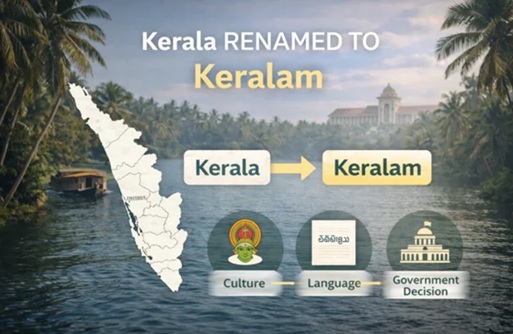
The State of Kerala was formed on 1 November 1956 following the linguistic reorganisation of states. While the English name “Kerala” is used in the Constitution, the name in Malayalam is “Keralam.”
The First Schedule of the Constitution lists the state as “Kerala,” creating a linguistic discrepancy between constitutional nomenclature and native usage. The Kerala Legislative Assembly passed resolutions seeking correction of this name to reflect historical and cultural authenticity.
A similar renaming attempt was made in 2023, but technical discrepancies required a fresh resolution in 2024, leading to the present proposal.
Article 3 of the Constitution empowers Parliament to:
Kerala was created during the linguistic reorganisation of states. “Keralam” is the original Malayalam name. Kerala Piravi Day commemorates the formation of the state on 1 November 1956.
The Assembly resolutions sought to align the constitutional name with local linguistic usage.
The 2023 resolution attempted modifications across all Eighth Schedule languages, which led to procedural discrepancies. A revised resolution in 2024 corrected these issues.
Several theories exist:
The name change was approved at the first Cabinet meeting held at Seva Teerth (new PMO complex). The decision is projected as reflecting the “will of the people” and has received cross-party support within Kerala.
The Cabinet adopted a governance pledge inspired by “Nagrik Devo Bhava,” emphasising:
Reinforces linguistic federalism and strengthens regional identity within the Union.
Demonstrates cooperative federalism:
Aligns constitutional nomenclature with historical and linguistic traditions.
FAQs1. Under which Article can a state’s name be changed ? Article 3 of the Constitution empowers Parliament to change a state’s name. 2. Does the State Legislature have veto power ? No. Its views are sought, but Parliament has the final authority. 3. Why is the change from Kerala to Keralam significant ? It aligns the constitutional name with the Malayalam linguistic identity. 4. Will the Constitution need amendment ? Yes, amendment of the First Schedule is required, though it does not require a special majority under Article 368. 5. Is this the first such renaming ? No. States like Odisha (formerly Orissa) and Tamil Nadu (formerly Madras State) have undergone similar changes. |



Our support team will be happy to assist you!

 Contact Us
  New Batch : 9555124124/ 7428085757
  Tech Support : 9555124124/ 7428085757