Prelims: (Environment + CA)
Mains: (GS Paper 3 – Ecology & Environment, Conservation of Environment, Climate Change) |
Why in News?
A recent study published in Current Biology has uncovered the cellular and evolutionary mechanisms that enable mangroves to survive extreme salinity. The findings have important implications for developing salt-tolerant crops in the context of climate change, sea-level rise, and increasing soil salinisation.
Background and Context
Climate change is intensifying coastal flooding, sea-water intrusion, and soil salinity—posing serious risks to agriculture and food security, especially in low-lying coastal regions. Mangroves, which thrive in highly saline and waterlogged environments, have long been recognised for their ecological role as coastal buffers. However, the precise biological mechanisms behind their salt tolerance were not fully understood.
The Current Biology study bridges this gap by providing cell-level insights, opening new avenues for climate-resilient agriculture and nature-based solutions.

How Do Mangroves Survive Saltwater?
1. Unique Cellular Adaptations
- Mangroves possess smaller epidermal pavement cells and exceptionally thick cell walls.
- These features provide mechanical strength to withstand low osmotic potential caused by high salt concentrations.
2. Specialised Salt Management Strategies
Mangroves use two broad strategies:
- Salt Exclusion:
- Some species prevent salt entry through a waxy root barrier, allowing selective uptake of freshwater.
- Salt Secretion:
- Other species accumulate salt internally and expel it through specialised salt glands on leaves.
3. Evolutionary Plasticity
- Mangroves have independently evolved over 30 times in the last 200 million years, demonstrating remarkable evolutionary adaptability to saline environments.
4. Distinct from Other Drought-Tolerant Plants
- Unlike typical drought-resistant plants, mangroves do not rely on stomatal modifications (such as reduced stomatal size or increased density) to manage water loss.
Implications of the Study
Climate-Resilient Agriculture
- Insights into mangrove cell wall structure and salt regulation can guide the development of salt-tolerant crop varieties.
- Particularly relevant for rice, wheat, pulses, and coastal agriculture affected by salinity ingress.
Policy and Research Alignment
- Supports objectives of the National Mission on Sustainable Agriculture (NMSA).
- Contributes to SDG 13 (Climate Action) and SDG 2 (Zero Hunger) by strengthening food security under climate stress.
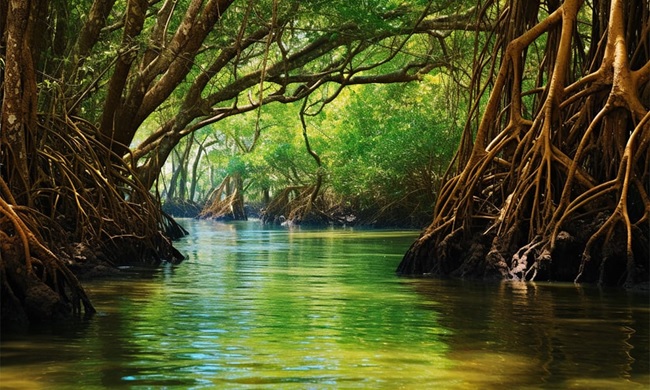
Mangroves: Key Facts
What are Mangroves?
- Mangroves are salt-tolerant trees and shrubs (halophytes) found in intertidal zones of tropical and subtropical regions.
Habitat Conditions
- High rainfall (1,000–3,000 mm)
- Temperature range: 26°C–35°C
- Saline, anaerobic, slow-moving waters with high silt deposition
Key Characteristics
Physiological Adaptations
- Pneumatophores (e.g., Avicennia) for respiration
- Prop roots (e.g., Rhizophora) for stability
- Salt-secreting glands and lenticellated bark
Reproductive Adaptation
- Viviparity: Seeds germinate on the parent tree, enhancing survival in saline environments.
Distribution of Mangroves
Global
- Restricted to tropical and subtropical latitudes near the equator.
- Major mangrove regions:
- South & Southeast Asia
- South America
- Africa
- Oceania
Mangroves in India
- Mangrove cover (ISFR 2023): 4,991.68 sq. km (0.15% of India’s geographical area)
- State-wise share:
- West Bengal: 42.45%
- Gujarat: 23.32%
- Andaman & Nicobar Islands: 12.19%
- Legal and Regulatory Protection in India
- Environment (Protection) Act, 1986:
- Declares mangroves as Ecologically Sensitive Areas (ESAs)
- Restricts activities within a 50-metre buffer
- Mandates 3:1 compensatory afforestation
- Additional protection under:
- Wildlife (Protection) Act, 1972
- Indian Forest Act, 1927
- Biological Diversity Act, 2002
Significance of Mangroves
1. Climate Change Mitigation
- Act as blue carbon sinks, storing 7.5–10 times more carbon per acre than tropical forests.
2. Disaster Risk Reduction
- Reduce wave energy by 5–35%
- Lower flood depths by 15–20%, and up to 70% in some regions
- Provide protection against cyclones, storm surges, and tsunamis.
3. Biodiversity Conservation
- Serve as nursery grounds for fish and crustaceans.
- Support birds, reptiles, and endangered species.
4. Livelihood Support
- Sustain coastal livelihoods through fisheries, honey collection, fuelwood, and eco-tourism.
5. Nature-Based Solutions
- Represent a cost-effective ecosystem-based adaptation strategy for sustainable development.
FAQs
Q1. Why are mangroves important for climate change adaptation?
Mangroves reduce coastal erosion, absorb carbon, and buffer extreme weather events, making them vital for climate resilience.
Q2. How do mangroves tolerate high salinity?
Through thick cell walls, selective salt exclusion at roots, and salt excretion via specialised leaf glands.
Q3. What is blue carbon?
Carbon stored in coastal ecosystems like mangroves, seagrasses, and salt marshes, which have high carbon sequestration potential.
Q4. Which Indian state has the largest mangrove cover?
West Bengal, primarily due to the Sundarbans delta.
Q5. How can mangrove research help Indian agriculture?
It can guide the development of salt-tolerant crops for saline-prone regions affected by sea-level rise and climate change.
|






 Contact Us
  New Batch : 9555124124/ 7428085757
  Tech Support : 9555124124/ 7428085757