
- UPSC Exam
- State PCS
- One Day Exam
- Current Affairs
- PT Quiz
- Downlaods
- About Coaching
- Blog
- Videos

| Prelims: (Internantional Relations + CA) Mains: (GS 2 – India and its Neighbourhood & West Asia; Bilateral Relations; Strategic Affairs) |
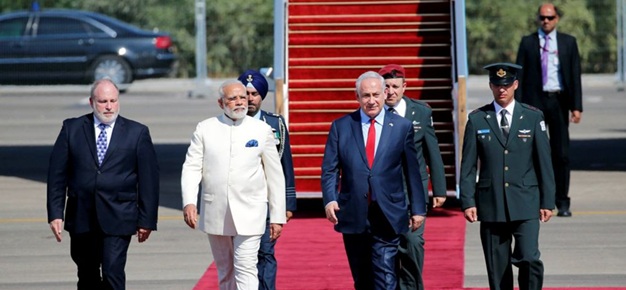
Prime Minister Narendra Modi is on an official visit to Tel Aviv, marking his first trip to Israel since his landmark 2017 visit — the first-ever by an Indian Prime Minister after diplomatic ties were established in 1992.
However, the present visit unfolds amid a volatile regional context, including tensions involving the United States and Iran and a fragile ceasefire in Gaza. The visit highlights both the evolution and the growing strategic weight of India–Israel relations.
India recognised the state of Israel in 1950, soon after its creation in 1948. However, full diplomatic relations were delayed for over four decades due to:
In January 1992, during Yasser Arafat’s visit, Prime Minister P. V. Narasimha Rao conveyed that establishing ties with Israel could enhance India’s diplomatic leverage on Palestine.
On January 29, 1992, India formally established full diplomatic relations with Israel — a decisive turning point.
Even before formal ties:
This established Israel as a reliable defence partner.
After assuming office in 2014, PM Modi brought relations into the open.
PM Modi’s 2017 visit marked:
This signalled India’s confidence in pursuing an independent West Asia policy.
Under the Abraham Accords signed during Donald Trump’s presidency, Israel normalised ties with several Arab nations, reshaping West Asia’s diplomatic architecture.
The October 7, 2023 Hamas attack triggered a prolonged Gaza conflict. A fragile truce now holds, but regional tensions remain high.
In June 2025, a 12-day Israel–Iran confrontation heightened instability. U.S. military actions targeting Iranian nuclear facilities further escalated tensions.
The regional security environment is thus significantly more fragile than during Modi’s 2017 visit.
India must balance:
Any perceived tilt could impact India’s energy security and diaspora interests.
FAQs1. When did India establish diplomatic relations with Israel ? On January 29, 1992. 2. Why were ties delayed despite early recognition ? Due to support for Palestine, Cold War dynamics, and regional sensitivities. 3. What changed after 2014 ? Political engagement became open and strategic cooperation expanded visibly. 4. What is the significance of the 2017 visit ? It was the first visit by an Indian PM and marked a shift toward independent diplomatic positioning. 5. Why is the current visit diplomatically sensitive ? It occurs amid Gaza tensions and rising Iran–US–Israel friction, requiring careful diplomatic balancing. |



Our support team will be happy to assist you!

 Contact Us
  New Batch : 9555124124/ 7428085757
  Tech Support : 9555124124/ 7428085757