Prelims: (Environment + CA)
Mains: GS 3 - Environment & Ecology |
Why in News ?
The Supreme Court has settled a uniform definition of the Aravalli hills and ranges, paused fresh mining leases across Delhi, Haryana, Rajasthan, and Gujarat, and issued comprehensive directions for sustainable mining and ecological restoration of the region.
Background and Context
The Aravalli range has faced decades of ecological stress due to unregulated mining, urban expansion, and weak enforcement of environmental laws. The absence of a uniform legal definition allowed States and private entities to exploit regulatory gaps. Given the Aravalli’s critical role in preventing desertification and protecting the National Capital Region (NCR), judicial intervention became necessary to ensure coordinated, science-based conservation.
Aravalli Mountain Range: Geographic & Ecological Significance
- One of the oldest mountain systems in the world, dating back nearly 2 billion years
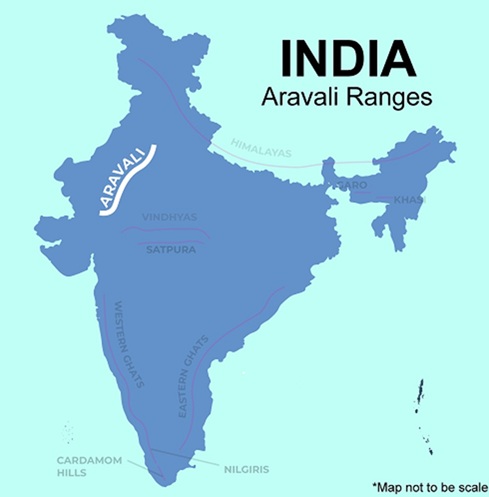
- Extends over 650 km from Delhi to Gujarat, passing through Haryana and Rajasthan
- Acts as a natural barrier against the eastward spread of the Thar Desert
- Plays a key role in:
- Climate regulation
- Groundwater recharge
- Biodiversity conservation
- Source or support system for rivers such as Chambal, Sabarmati, and Luni
- Rich in minerals like limestone, marble, sandstone, copper, zinc, and tungsten
Environmental Impact of Mining: Excessive quarrying has led to forest loss, falling water tables, increased air pollution, and rising temperatures—especially affecting the NCR.
Mining, Degradation, and Judicial Intervention
- Mining restrictions have existed since the early 1990s, but enforcement remained weak
- In 2009, the Supreme Court imposed a mining ban in parts of Haryana (Faridabad, Gurugram, Mewat)
- Illegal and unregulated mining continued, undermining conservation efforts
- With India’s commitments under the UN Convention to Combat Desertification, the Court revisited the issue to adopt a long-term ecological approach
Uniform Definition of the Aravallis
The Core Problem
- States used different criteria (slope, buffer zones, revenue records) to define Aravalli land
- This led to regulatory loopholes and selective exclusions
Supreme Court’s Solution
- A multi-institutional committee was formed, including:
- Environment Ministry
- Forest Survey of India (FSI)
- Geological Survey of India (GSI)
- State Forest Departments
- Central Empowered Committee (CEC)
- Accepted Definition (2025):
- All hills above 100 metres in height qualify as part of the Aravalli range
The Court held this definition to be practical, inclusive, and enforceable, compared to earlier ambiguous criteria.
Central Empowered Committee (CEC): Key Recommendations
- Scientific mapping of the Aravalli range across all States
- Macro-level Environmental Impact Assessment (EIA) of mining activities
- Complete prohibition of mining in:
- Wildlife corridors
- Aquifer recharge zones
- Water bodies and ecologically sensitive habitats
- No new mining leases or renewals until mapping and assessments are completed
- Strict regulation of stone-crushing units to curb air pollution
These recommendations were accepted by the Supreme Court in November 2025.
Sustainable Mining and the Aravalli Green Wall
- The Court avoided a total mining ban to prevent the rise of illegal mining mafias
- Existing legal mining may continue under stringent environmental safeguards
- Fresh leases remain paused until scientific assessments are completed
Aravalli Green Wall Project (2025)
- Launched by the Centre to restore degraded landscapes
- Covers a 5-km buffer zone across 29 districts in Delhi, Haryana, Rajasthan, and Gujarat
- Aims to restore 26 million hectares of degraded land by 2030
- Supports India’s goal of land degradation neutrality
FAQs
Q1. Why are the Aravalli hills important ?
They prevent desertification, recharge groundwater, regulate climate, and support biodiversity.
Q2. What uniform definition has the Supreme Court adopted ?
All hills above 100 metres in height are considered part of the Aravalli range.
Q3. Has mining been completely banned in the Aravallis ?
No. Existing legal mining may continue under strict regulation, but fresh leases are paused.
Q4. What is the Aravalli Green Wall Project ?
A landscape restoration initiative to increase green cover and restore degraded land across Aravalli districts.
Q5. How does this ruling help environmental governance ?
It closes legal loopholes, strengthens enforcement, and balances development needs with ecological protection.
|






 Contact Us
  New Batch : 9555124124/ 7428085757
  Tech Support : 9555124124/ 7428085757