(Prelims: Current Events of National and International Importance, General Science)
(Mains, General Studies Paper 3: Achievements of Indians in Science and Technology; Indigenous Development of Technology and Development of New Technology, Space) |
Context
Recently, ISRO stated that India's first solar observatory, Aditya-L1, played a key role in helping scientists understand why the most powerful solar storm in more than two decades, expected to hit Earth in May 2024, was behaving so unusually.
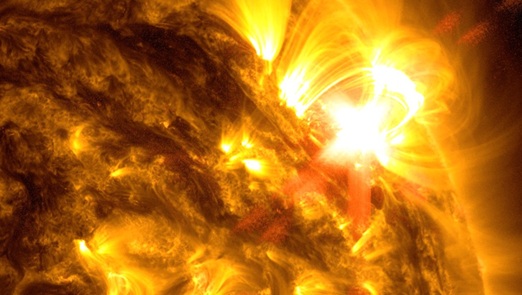
About Solar Storms
- A solar storm is a sudden burst of particles, energy, magnetic fields, and matter from the Sun into the solar system.
- The Sun produces a complex network of magnetic fields. These magnetic fields are distorted by the Sun's rotation, as the equator rotates faster than its poles.
- Solar storms often begin when these distorted magnetic fields on the Sun become so distorted and expanded that they separate and reconnect (a process called magnetic reconnection), releasing large amounts of energy.
- These powerful explosions can produce any or all of the following:
- Intense bright light (flare) as in a 'solar flare'
- A 'radiation storm' or 'plume of solar particles' projected into space at high speed
- A massive cloud of solar material ejected from the Sun as in a 'coronal mass ejection'
Effects of a Solar Storm
- When a solar storm is directed toward Earth, it can cause a major disruption in Earth's magnetic field, called a geomagnetic storm. This can produce effects such as radio blackouts, power outages, and aurora borealis.
- However, these storms do not directly harm anyone on Earth because the Earth's magnetic field and atmosphere shield them from the worst effects.
About Solar Flares
- A solar flare is an intense burst of radiation or light on the Sun.
- These flashes cover all parts of the electromagnetic spectrum, including X-rays, gamma rays, radio waves, ultraviolet, and visible light.
- Solar flares are the most powerful explosions in the solar system, and the largest solar flares can have the energy equivalent of a billion hydrogen bombs.
About Radiation Storms
- Solar eruptions can accelerate charged particles (electrons and protons) into space at incredibly high speeds, triggering a radiation storm.
- The fastest particles travel so fast that they can cover the distance of approximately 93 million miles from the Sun to Earth in about 30 minutes or less.
About Coronal Mass Ejection (CME)
- A CME is a massive cloud of electrically charged gas called plasma ejected from the Sun.
- A single CME can blast billions of tons of material into the solar system at once.
- CMEs occur in the Sun's outer atmosphere, called the corona, and often appear as giant bubbles erupting from the Sun.
Aditya-L1
- It is the first space-based observatory-class Indian solar mission to study the Sun.
- It was launched by the Indian Space Research Organisation (ISRO) on September 2, 2023.
- The spacecraft is placed in a halo orbit around Lagrangian point 1 (L1) of the Sun-Earth system, approximately 1.5 million km from Earth.
- The major advantage of a satellite placed in a halo orbit around the L1 point is that it can observe the Sun continuously without any obstruction/eclipse.
- This provides greater advantage in continuously observing solar activities.
- The spacecraft is carrying seven payloads using electromagnetic and particle detectors to observe the Sun's photosphere, chromosphere, and outermost layers.
|





 Contact Us
  New Batch : 9555124124/ 7428085757
  Tech Support : 9555124124/ 7428085757