| (GS Paper – III: Energy and Environment) |
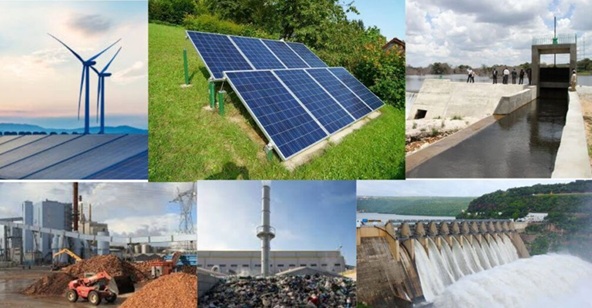
Under its Nationally Determined Contributions (NDCs) as per the Paris Agreement, India has set the following key targets:
|
Source |
Installed Capacity (GW) |
Share in Total (%) |
|
Solar Energy |
110 |
23.1% |
|
Wind Energy |
51 |
10.7% |
|
Hydropower |
46 |
9.7% |
|
Biomass & Waste-to-Energy |
10.5 |
2.2% |
|
Total Renewable Capacity (including Hydro) |
226 |
43.7% |
| (GS Paper – III: Energy and Environment) |
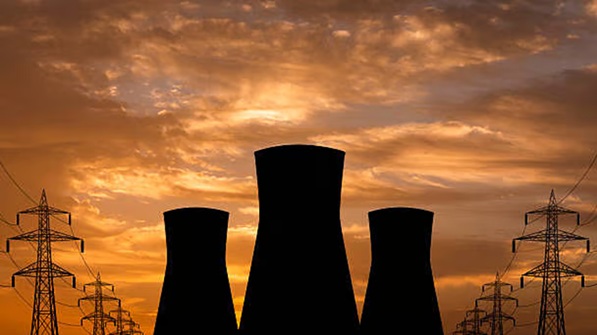
In the Union Budget 2025–26, the Government of India announced an ambitious “Nuclear Energy Mission” with the goal of achieving 100 GW of nuclear power capacity by 2047. This mission forms a vital part of India’s long-term energy transition strategy and the “Viksit Bharat @2047” vision, aimed at ensuring sustainable, secure, and self-reliant energy growth.
|
Component |
Status / Target |
|
Current Installed Capacity (2025) |
8.18 GW (from 22 reactors) |
|
Target by 2031–32 |
22.48 GW |
|
Long-Term Target by 2047 |
100 GW |
|
Key Agencies |
BARC (Bhabha Atomic Research Centre), NPCIL (Nuclear Power Corporation of India Ltd), DAE (Department of Atomic Energy) |
|
Major Technological Focus |
BSRs (Bharat Small Reactors) and SMRs (Small Modular Reactors) |
| (GS Paper 3 — Environment & Economy) |
|
Aspect |
Details |
|
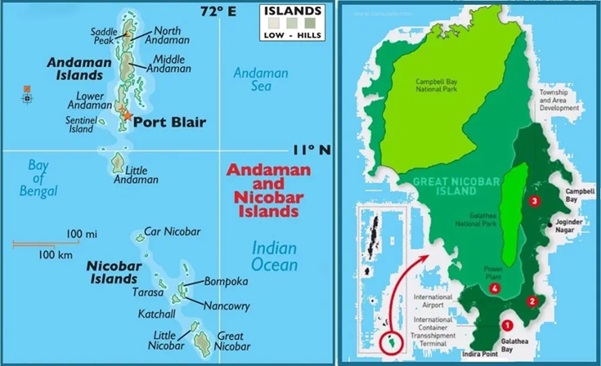
Location |
Southern tip of the Bay of Bengal, ~180 km from Sumatra (Indonesia) |
|
Area |
910 sq. km |
|
Coordinates |
6°45′ N – 7°15′ N and 93°38′ E – 93°56′ E |
|
Notable Point |
Indira Point — India’s southernmost landmass (remained intact even after the 2004 Tsunami) |
|
Administrative Centre |
Campbell Bay |
|
Tribe |
Characteristics |
Population (Est. 2021) |
|
Shompen |
Semi-nomadic, hunter-gatherer, isolated from external contact |
250 |
|
Nicobarese |
Settled, engaged in agriculture and fishing |
1,500 |
Both tribes are classified as Scheduled Tribes and protected under the Andaman & Nicobar (Protection of Aboriginal Tribes) Regulation, 1956.
|
Dimension |
Analysis |
|
Geographical |
Represents India’s southernmost frontier in the Indian Ocean. |
|
Ecological |
High risk to biodiversity, coral reefs, marine life, and tropical ecosystems. |
|
Strategic |
Crucial for India’s Indo-Pacific strategy and maritime dominance. |
|
Economic |
Potential to establish India as a major transshipment hub. |
|
Social |
A test case for balancing development and conservation — tribal rights vs. national interest. |
The Great Nicobar Island is a region of immense strategic value, ecological sensitivity, and unique cultural heritage. India must strike a fine balance between development, ecology, and indigenous protection. Sustainable development here must mean growth with responsibility — safeguarding nature, culture, and national security alike.
“Great Nicobar is not just an island — it is a test of India’s maritime self-reliance and ecological wisdom.”
|
Possible UPSC Questions
|
| (UPSC Mains — GS Paper 3: Environment) |
The Indian Himalayan Region (IHR) is not only the ecological backbone of India but also the lifeline of Asia. Stretching from the high altitudes of the Himalayas to the hilly terrains of the northeastern states, this region sustains millions of lives, cultures, and water resources. However, climate change, unplanned development, tourism pressure, and ecological imbalance have emerged as serious threats.
In recent times, some landmark Supreme Court judgments have introduced new hope in this direction. The Court has declared that freedom from the adverse effects of climate change is a fundamental right, protected under Article 14 (Right to Equality) and Article 21 (Right to Life) of the Constitution.
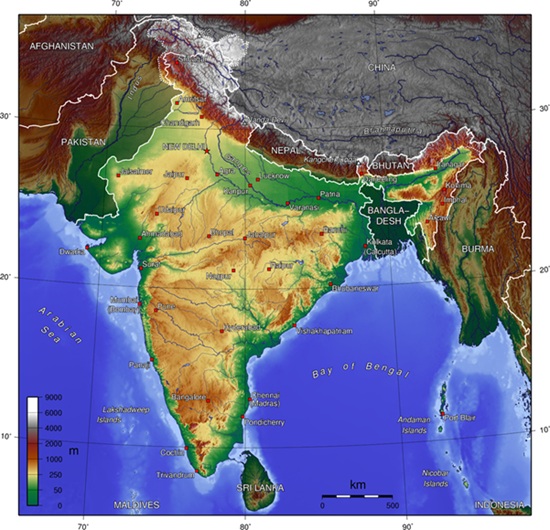
Deforestation and Habitat Loss: Between 2019–2021, Himalayan states lost around 1,072 sq km of forest cover.
Rapid Glacier Retreat:
Tourism Pressure: Around 100 million tourists visit IHR annually; projected to reach 240 million by 2025. Towns like Joshimath, Shimla, and Mussoorie are already exceeding their carrying capacity.
Unsustainable Infrastructure Growth: Unscientific construction on fragile slopes, reckless road widening, and tunnel projects have intensified landslides, water scarcity, and subsidence.
National Initiatives:
Global Initiatives:
Conclusion
The Indian Himalayan Region is the ecological soul of India. Land-use changes, illegal mining, forest fires, wildlife trafficking, and climate change are critically destabilizing this region’s balance. Judicial interventions have now reinforced that climate justice and environmental rights are permanent fixtures within India’s constitutional framework.
Hence, it is imperative to:
“Protecting the Himalayas is protecting India.” The preservation of the Himalayas is not just an environmental issue — it is a question of the very survival of future generations.

Our support team will be happy to assist you!

 Contact Us
  New Batch : 9555124124/ 7428085757
  Tech Support : 9555124124/ 7428085757