New
GS Foundation (P+M) - Delhi : 05th Jan., 2026 Winter Sale offer UPTO 75% + 10% Off, Valid Till : 5th Dec., 2025 GS Foundation (P+M) - Prayagraj : 15th Dec., 11:00 AM Winter Sale offer UPTO 75% + 10% Off, Valid Till : 5th Dec., 2025 GS Foundation (P+M) - Delhi : 05th Jan., 2026 GS Foundation (P+M) - Prayagraj : 15th Dec., 11:00 AM

Current Affairs for 26 November 2025

Constitution Day (26 November): Celebrating India’s Constitutional Legacy

Prelims: (Polity + CA)
Mains: (GS 2 – Indian Constitution, Governance)

Why in the News ?

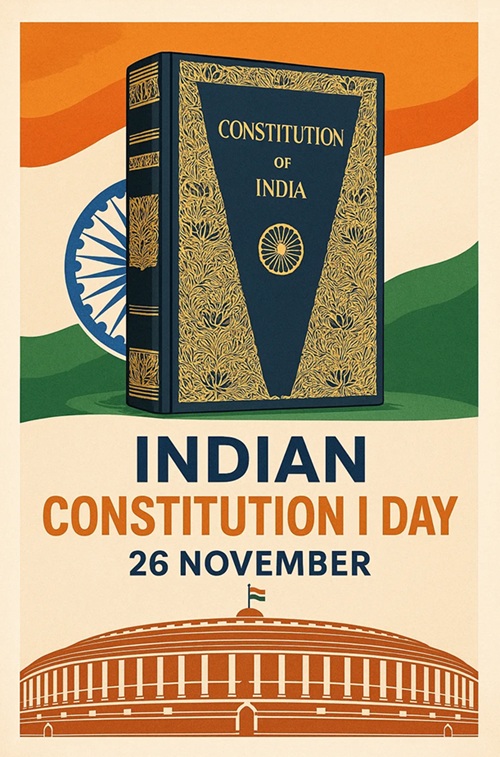
India is celebrating Constitution Day (Samvidhan Divas) on 26 November to mark the adoption of the Constitution of India in 1949. The day is observed to honour the values, vision, and architects of the Constitution, especially Dr. B. R. Ambedkar.
Background

  • Constitution Day was first celebrated in 2015, following a Government of India notification.
  • It commemorates the adoption of the Constitution on 26 November 1949, though it came into force on 26 January 1950.
  • The day highlights India’s commitment to constitutional morality, democratic governance, and rule of law.

Journey of the Indian Constitution

Formation of the Constituent Assembly

  • The Constituent Assembly was formed in 1946, via Cabinet Mission Plan.
  • Total members: 389 (reduced to 299 after Partition).
  • Key committees included:
    • Drafting Committee (Chairman: Dr. B. R. Ambedkar)
    • Union Powers Committee (Jawaharlal Nehru)
    • Fundamental Rights & Minorities Committee (Vallabhbhai Patel)
    • Rules of Procedure Committee (Dr. Rajendra Prasad)

Drafting and Adoption

  • Drafting took 2 years, 11 months, 18 days.
  • Adopted on: 26 November 1949
  • Enforced on: 26 January 1950 (to honour the 1930 Purna Swaraj Declaration).

Key Features of the Constitution

1. Lengthiest Written Constitution

  • Contains provisions from:
    • Government of India Act, 1935
    • British, Irish, U.S., Canadian constitutions
    • Indian socio-cultural context

2. Blend of Rigidity and Flexibility

  • Article 368 enables different modes of amendment.

3. Federal System with Unitary Bias

  • Strong Centre, but flexible cooperative federalism.

4. Parliamentary System

  • Inspired by the British model.

5. Independent Judiciary

  • Ensures judicial review, constitutional supremacy, and protection of fundamental rights.

6. Fundamental Rights, Duties, and DPSPs

  • Rights: Articles 12–35
  • Duties: Article 51A
  • DPSPs: Articles 36–51

Significance of Constitution Day

  • Reinforces citizens’ commitment to:
    • Constitutional values
    • Democracy and equality
    • Liberty, justice, fraternity
  • Promotes awareness about:
    • Role of the Constituent Assembly
    • Importance of responsible citizenship
    • Safeguarding democratic institutions and rights
  • Strengthens civic responsibility and constitutional culture among students, institutions, and public servants.

Legacy and Inspirations

Constitution Day is a tribute to:

  • Dr. B. R. AmbedkarChief Architect of the Constitution
  • Jawaharlal NehruVision of democratic nation-building
  • Sardar Patel – Integration of India and federal structure
  • Rajendra PrasadLeadership of the Constituent Assembly

The day reflects India’s journey towards becoming a sovereign, socialist, secular, democratic republic.

FAQs

1. Why is Constitution Day celebrated on 26 November ?

It marks the adoption of the Indian Constitution by the Constituent Assembly on 26 November 1949.

2. When was Constitution Day first observed ?

In 2015, as per a Government of India notification.

3. Who is known as the Chief Architect of the Constitution ?

Dr. B. R. Ambedkar.

4. When did the Constitution come into force ?

On 26 January 1950, celebrated as Republic Day.

5. How long did it take to draft the Constitution ?

2 years, 11 months, and 18 days.

G20 Johannesburg Summit 2025: Advancing Global South Priorities

Prelims: (G20 Summit + CA)
Mains: (GS 2 – International Relations, Governance, Multilateralism)

Why in the News?

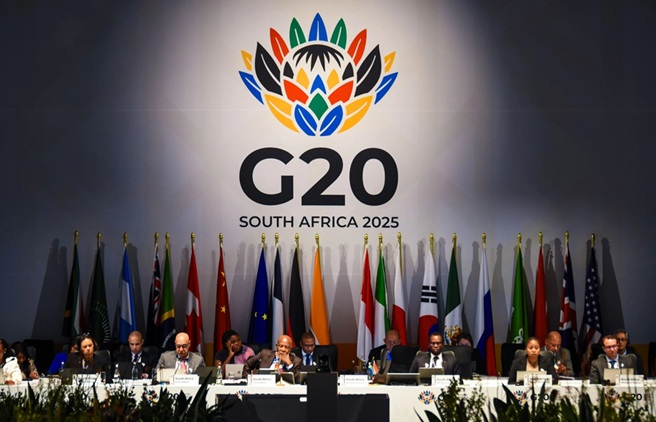
The 20th G20 Summit 2025 was convened in Johannesburg, South Africa—the first G20 summit ever held on African soil. Under the theme “Solidarity, Equality, Sustainability,” the meeting highlighted Global South concerns and culminated in the adoption of the G20 Johannesburg Leaders’ Declaration.
Key Highlights of the G20 Johannesburg Summit 2025

G20 Johannesburg Leaders’ Declaration

  • Consensus was reached on a 122-paragraph declaration covering climate action, multilateral reforms, inclusive growth, and global governance.

Ubuntu and Multilateralism

  • The declaration drew on the African philosophy of Ubuntu—emphasising shared responsibility and human interconnectedness.
  • Leaders called for renewed multilateral cooperation to tackle conflicts, inequality, and humanitarian crises.

UN Security Council Reform

  • Supported restructuring the UNSC to reflect contemporary geopolitical realities.
  • Advocated enhanced representation for Africa, Asia-Pacific, and Latin America.

Counterterrorism

  • Firm condemnation of terrorism in every form—aligning with India’s long-standing stance.

Climate Action Commitments

  • Pledged a shift from “billions to trillions” in global climate finance.
  • Endorsed a more equitable implementation of the Paris Agreement.

Women’s Empowerment

  • Reaffirmed the need to:
    • Remove structural barriers
    • Ensure equal participation in decision-making
    • Recognise women as agents of peace and development

Debt Crisis & Global Financial Architecture Reform

  • Launched a Cost of Capital Commission to correct unfair global credit rating systems and reduce the African risk premium.
  • Highlighted Africa’s rising debt burden (USD 1.8 trillion), with many countries spending more on interest payments than public services.

Mission 300

  • Endorsed Mission 300—a World Bank–AfDB initiative to provide electricity to 300 million people in Sub-Saharan Africa by 2030.

Critical Minerals Framework

  • Welcomed the G20 Critical Minerals Framework to build sustainable and resilient mineral supply chains.
  • Stressed investment in exploration and value addition in developing countries.

Youth & Gender Targets

  • Adopted the Nelson Mandela Bay Target:
    • Reduce youth NEET (Not in Employment, Education, or Training) rate by 5% by 2030.
  • Committed to 25% gender parity in global labour force participation by 2030.

Troika

  • The current G20 Troika: Brazil (past), South Africa (current), United States (incoming).

The Spirit of Ubuntu

About Ubuntu

  • Ubuntu represents the African idea of shared humanity, expressed as “I am because you are.”
  • Embodies compassion, collective responsibility, and mutual upliftment.
  • Nelson Mandela championed Ubuntu in guiding South Africa’s peaceful transition post-apartheid.

Relevance to Global Goals

  • Sustainability: Encourages development that protects ecosystems and future generations.
  • Equitable Growth: Promotes fair access to knowledge, technology, and opportunities—especially for Global South nations.
  • Global Security: Supports collective international action against threats such as organised crime and the drug-terror nexus.
  • Cultural Preservation: Stresses protection of indigenous knowledge and cultural heritage.

What is the G20 and Its Significance?

About

  • Established after the 1997–98 Asian Financial Crisis as a forum for Finance Ministers and Central Bank Governors.
  • Expanded over time to include issues like climate change, digital governance, health, agriculture, and energy security.
  • Upgraded to Leaders’ level during the 2008 Global Financial Crisis.

Composition

  • 19 major economies + European Union + African Union.
  • Together they represent:
    • 85% of global GDP
    • 75%+ of world trade
    • of the global population

Mandate

  • Premier platform for global economic and financial governance—covering:
    • Growth and trade
    • Financial stability
    • Climate action
    • Development cooperation
    • Digital economy
    • Health and food security

Structure

  • No permanent headquarters; presidency rotates annually.
  • Operates through the Troika system for continuity.

Significance of the G20

  • Global Economic Governance: Shapes norms on financial regulations, tax reforms, debt sustainability, climate finance, and digital public infrastructure.
  • Driver of Sustainable Development: Coordinates international action on climate commitments, food security, and energy transitions.
  • Amplifies Global South Voice: Enhances influence of emerging economies like India, Brazil, Indonesia, and South Africa.
  • Development Finance Catalyst: Pushes reforms in IMF and World Bank, including better representation such as the proposal for a 25th IMF Board seat for Africa.

How India is Shaping the Global Development Agenda at G20

1. Countering the Drug-Terror Nexus

  • Warned about the rise of drug trafficking, especially fentanyl, as a source of terrorism financing.
  • Proposed a G20 Initiative focused on financial tracking, border coordination, and enforcement cooperation.

2. Africa-Centric Development Vision

  • Emphasised Africa’s centrality in global development frameworks.
  • Proposed the G20–Africa Skills Multiplier Initiative to train 1 million certified trainers in 10 years.

3. Leadership in Health, Knowledge & Space

India proposed:

  • G20 Global Healthcare Response Team
  • Global Traditional Knowledge Repository
  • Open Satellite Data Partnership for agriculture, fisheries, and disaster management

4. Critical Minerals & Sustainable Transitions

  • Introduced the Critical Minerals Circularity Initiative—promoting recycling, urban mining, and resilient supply chains.
  • Called for transparent and diversified mineral sourcing.

5. Responsible and Secure AI Governance

  • Advocated a Global Compact on AI based on:
    • Human oversight
    • Safety-by-design
    • Transparency
    • Prevention of misuse (deepfakes, cybercrime, terrorism)
  • Invited global participation at the AI Impact Summit 2026 in India.

6. Support for a Just Global Order

  • Strong push for UNSC reform to ensure representation for Africa, Latin America, and Asia-Pacific.
  • Reaffirmed commitment to multilateralism and a rules-based international system.

Significance of the G20 Johannesburg Summit 2025

  • First G20 summit hosted in Africa—symbolically empowering the Global South.
  • Reinforced equitable climate finance and sustainable transitions.
  • Highlighted Africa’s development, energy, and resilience priorities.
  • Strengthened global governance dialogue on UNSC reform, AI, debt sustainability, and multilateralism.

FAQs

1. Why was the G20 Summit 2025 significant?

It was the first G20 summit held in Africa and centred Global South priorities through the Johannesburg Declaration.

2. What is the Spirit of Ubuntu?

A philosophy of shared humanity, compassion, and collective responsibility central to African cultural thought.

3. Which major reforms were highlighted at the summit?

UNSC reform, fairer global financial systems, expanded climate finance, and critical minerals cooperation.

4. What were the youth and gender targets adopted?

A 5% reduction in youth NEET rates and 25% gender parity in labour force participation by 2030.

5. What initiatives did India propose?

A G20 initiative against the drug-terror nexus, Africa Skills Multiplier, Healthcare Response Team, Traditional Knowledge Repository, and Critical Minerals Circularity Initiative.

Draft Seeds Bill 2025: Understanding the Proposed Overhaul of India’s Seed Regulation Framework

Prelims: (Agriculture + Polity + Current Affairs)
Mains: (GS 2 – Governance; GS 3 – Agriculture, Food Security)

Why in the News ?

The Union Ministry of Agriculture has published the Draft Seeds Bill 2025 and has sought public feedback until 11 December. The Bill seeks to update, consolidate, and modernise India’s seed laws by amending the Seeds Act, 1966 and the Seeds (Control) Order, 1983, aiming to ensure quality seeds for farmers while simplifying regulatory burdens on the seed industry.
What’s in Today’s Article?

Context and Rationale Regulatory ArchitectureRegistration & Quality Control Offences & Penalties Farmers’ Rights Concerns FAQs

Background and Need for the Seeds Bill 2025

  • India’s seed sector has evolved dramatically since the 1960s with advancements in biotechnology, hybrid seed technology, processing systems, and international seed trade.
  • As per Agriculture Ministry data (2023–24):
    • National seed requirement: 462.31 lakh quintals
    • Available seeds: 508.60 lakh quintals
    • Surplus: 46.29 lakh quintals
  • Experts argue that the 1966 law is outdated, lacking provisions to manage modern genetic technologies, private sector participation, and global competitiveness.
  • The need for a robust, transparent, and science-driven regulatory system has pushed the drafting of a new Bill.

Institutional Structure Proposed Under the Bill

Clarified Roles Across the Seed Value Chain

The Bill categorises participants into:

  • Farmer
  • Dealer
  • Distributor
  • Producer

This helps streamline regulatory responsibilities across production, distribution, and sale.

Central and State-Level Seed Committees

Two statutory bodies are planned:

  1. Central Seed Committee – 27 members Responsible for recommending standards relating to:
    • Minimum germination
    • Genetic & physical purity
    • Trait performance and seed health
    • Additional quality norms
  2. State Seed Committees – 15 members Will advise State governments on the registration of:
    • Producers
    • Dealers
    • Nurseries
    • Seed-processing units

Quality Control and Registration Mechanisms

Mandatory Registration of Processing Units

  • All seed-processing units must secure registration from State authorities.
  • Ensures traceability and quality assurance, though may raise compliance costs for smaller producers.
  • A Centralised Accreditation Mechanism is being considered to ease processes for multi-State seed businesses.

National Seed Variety Register

  • The Bill establishes a Registrar under the Central Seed Committee.
  • Maintains a National Register of Seed Varieties.
  • Standardises VCU (Value for Cultivation and Use) trials to ensure varieties are tested for performance and suitability.

Strengthening Seed Testing Infrastructure

  • Central and State laboratories will be upgraded to assess:
    • Germination
    • Seed health
    • Genetic purity
  • These labs will support compliance verification for seed companies.

Enhanced Enforcement Powers

  • Seed Inspectors will be empowered with search-and-seizure authority under the Bharatiya Nagarik Suraksha Sanhita, enabling stronger action against seed malpractice.

Offences and Penal Provisions

  • The 2025 draft reworks the penalty structure when compared to the 2019 version.
  • Offences are grouped into:
    • Trivial
    • Minor
    • Major
  • Penalties escalate depending on severity to curb misbranding, substandard seed supply, and fraudulent practices.
  • The new framework signals a tougher stance against seed quality violations.

Safeguards and Farmers’ Rights

  • The Bill reaffirms farmers’ traditional rights to:
    • Save
    • Use
    • Exchange
    • Sell farm-saved seeds (except under a brand name)
  • Aligns with the PPV&FR Act 2001, ensuring consistency between:
    • Seed quality norms
    • Plant variety protection
    • Farmers’ entitlements
  • Attempts to create a balanced system where innovation and farmers’ welfare coexist.

Concerns Flagged by Farmers’ Organisations

Several farmers’ unions—including the All India Kisan Sabha—have raised objections:

  • Fear of price escalation and market domination by large seed companies.
  • Concerns over seed sovereignty, as greater centralisation could disadvantage small producers.
  • Worries that biodiversity safeguards may be weakened, potentially conflicting with:
    • Convention on Biological Diversity (CBD)
    • International Treaty on Plant Genetic Resources for Food & Agriculture
  • Criticism that the Bill may create a corporate-heavy regulatory structure overshadowing the farmer-centric PPV&FR Act.
  • They demand that the Bill must strengthen, not undermine, India’s biodiversity and farmers’ rights frameworks.

Significance

  • Offers updated governance for a rapidly advancing seed sector.
  • Attempts to balance innovation, quality, and farmer protection.
  • Has major implications for agricultural productivity, food security, and private sector participation.

FAQs

1. What is the main objective of the Draft Seeds Bill 2025 ?

To modernise India’s seed regulatory system, ensure quality seeds for farmers, and update outdated provisions of the 1966 law.

2. Does the Bill restrict farmers from using their own seeds ?

No. Farmers may save, use, exchange, and sell farm-saved seeds, except under a brand name.

3. What is the National Seed Variety Register ?

A central database of all registered seed varieties, maintained by the Registrar under the Central Seed Committee.

4. Why are farmers’ groups opposing the Bill ?

They fear increased seed costs, corporate dominance, biodiversity risks, and weakening of farmer rights frameworks.

ICDS Programme: Five Decades of India’s Flagship Child Development Initiative

Prelims: (ICDS, Poshan Abhiyan + CA)
Mains: (GS 2 – Government Policies & Interventions, Social Development)

Why in the News ?

The Integrated Child Development Services (ICDS) programme has completed 50 years since its inception as a pilot in Karnataka. Over time, ICDS has evolved into the world’s largest community-based early childhood development programme, delivering nutrition, health, and pre-school services across India.

What is the Integrated Child Development Services (ICDS) Programme?

About

  • Launched on 2 October 1975, ICDS is a centrally sponsored flagship scheme under the Ministry of Women and Child Development (MoWCD).
  • Aims to improve nutrition, health, and early learning outcomes for:
    • Children aged 0–6 years
    • Pregnant women
    • Lactating mothers
  • The programme has now been restructured and integrated under Mission Saksham Anganwadi & Poshan 2.0.

Objectives

  • Enhance health and nutritional status of children (0–6 years).
  • Provide a foundation for psychological, physical, and social development.
  • Reduce child mortality, morbidity, malnutrition, and school dropout rates.
  • Promote interdepartmental coordination for holistic child development.

Services Delivered Through ICDS

  • Supplementary nutrition
  • Immunisation support
  • Health check-ups
  • Referral services
  • Non-formal pre-school education
  • Nutrition & health education for women

Significance of ICDS

  • Acts as a critical pillar for early childhood development by reducing malnutrition and improving maternal–child health outcomes.
  • Supports pregnant and lactating mothers, helping decrease maternal and infant mortality.
  • Integrates nutrition, healthcare, and education services at the community level through Anganwadi Centres.
  • Strengthens human capital formation, reduces inter-generational poverty, and enables women’s workforce participation.

Mission Saksham Anganwadi & Poshan 2.0

About

  • Launched in FY 2021–22 as India’s unified Integrated Nutrition Support Programme.
  • Combines major schemes including:
    • ICDS
    • Poshan Abhiyaan
    • Scheme for Adolescent Girls (SAG)
    • National Crèche Scheme
  • Approved for implementation during the 15th Finance Commission cycle (2021–26).
  • Focuses on strengthening nutrition delivery, early childhood care, and support for mothers, children, and adolescents.

Major Verticals

  • Supplementary Nutrition: For children (6 months–6 years), pregnant women, lactating mothers, and adolescent girls (14–18 years), especially in Aspirational Districts and the Northeast.
  • Early Childhood Care & Education (ECCE): Pre-school education for 3–6 years and early stimulation for 0–3 years.
  • Infrastructure Upgradation: Creation of modern, upgraded Saksham Anganwadi Centres.
  • Poshan Abhiyaan: National mission to achieve a malnutrition-free India through convergence and behaviour change.

Special Focus Areas

  • Maternal nutrition and Infant & Young Child Feeding (IYCF) practices.
  • Adoption of treatment protocols for Severe Acute Malnutrition (SAM) and Moderate Acute Malnutrition (MAM), supported by AYUSH-based wellness interventions.
  • Real-time nutrition monitoring via the Poshan Tracker.
  • Focus on adolescent girls’ nutrition through SAG, prioritising high-burden districts and age group 14–18 years.

FAQs

1. When was ICDS launched ?

It was launched on 2 October 1975 as a centrally sponsored scheme.

2. Which ministry implements ICDS ?

The Ministry of Women and Child Development (MoWCD).

3. Who are the beneficiaries of ICDS ?

Children aged 0–6 years, pregnant women, and lactating mothers.

4. What is Mission Saksham Anganwadi & Poshan 2.0 ?

It is India’s integrated nutrition programme combining ICDS, Poshan Abhiyaan, SAG, and the Crèche Scheme.

5. What tool is used for nutrition monitoring under Poshan 2.0 ?

The Poshan Tracker.

India’s Q2 Growth Momentum Set to Outpace RBI Estimates

Prelims: (Indian Economy + CA)
Mains: (GS 3 – Economy, Growth & Development)

Why in the News ?

Economists project that India’s GDP growth for Q2 of FY26 will exceed the RBI’s estimate of 7%, potentially touching 7.3%—slightly below Q1’s strong 7.8% expansion.
Despite the late-August 50% U.S. tariff hike, India’s economic momentum remains resilient.

The uptrend is driven by:

  • A broad-based rural recovery, supported by good harvest output and improving labour markets
  • Rising urban demand, particularly in consumer durables, following GST rate cuts
  • Positive spillovers expected to continue into Q3 FY26

Nominal Growth Trends • GDP vs GVA • Private Consumption Surge • Corporate Profitability • Public & Private Investment

Nominal Growth Softens, Creating Fiscal Pressures

  • April–June data shows nominal GDP growth at 8.8%—a three-quarter low and below the Finance Ministry’s 10.1% budget assumption.
  • Nominal growth = growth at current prices, incorporating inflation.
  • Real growth reflects only changes in output, excluding price effects.

Economists warn that nominal GDP for Q2 and FY26 could drop below 8%, which may:

  • Slow tax revenue growth
  • Raise concerns over fiscal deficit management
  • Push up the debt-to-GDP ratio

Fiscal Deficit: Gap between government expenditure and revenue (excluding borrowings).
Debt-to-GDP Ratio: Measures government debt relative to economic output; a rising ratio signals fiscal stress.

Thus, monitoring nominal GDP becomes critical for budget planning and deficit control.

GDP Expected to Trail GVA Owing to Weak Tax Growth

  • In Q2 FY26, GDP growth is likely to be slightly below GVA growth, which is projected at around 8%.
  • GDP = GVA + Net Indirect Taxes (GST – subsidies)
  • GVA indicates total production and performance across all sectors.

During Q2:

  • Net indirect taxes dipped year-on-year
  • In contrast, these taxes had risen 10% in Q1
  • This lower tax momentum explains why GDP may grow slower than GVA

Private Consumption Rebounds Strongly in Q2

Private consumption is expected to grow 8%—its fastest pace since Q3 FY25.

Key drivers include:

  • Late-September GST reductions that boosted durable goods demand
  • Low retail inflation at 1.7%, improving purchasing power
  • Rural wage growth (~6%)
  • Personal income tax cuts
  • Listed companies reported a 7.8% rise in employee costs, supporting household spending

Consumption growth would have been even stronger had households not deferred purchases ahead of the GST cut.
(Recall: Q1 FY26 consumption already improved to 7%, up from 6% in Q4 FY25.)

Corporate Sector Posts Strongest Quarter in Two Years

Q2 FY26 has been the best-performing quarter for India Inc in nearly 24 months:

  • Sales increased 6% YoY
  • Profits rose 13% YoY
  • Supported by:
    • Low retail inflation (1.7%)
    • Zero wholesale inflation, reducing input pressure
    • Limited impact of U.S. tariff measures

Healthy profitability is expected to support value-added growth, keeping FY26 GDP close to 7%, above the RBI’s 6.8% projection.

Government Capital Expenditure Surges; Private Capex Revives

  • Central government capital expenditure climbed 31% YoY in Q2 to ₹3.06 lakh crore, sustaining investment momentum.
  • Private sector participation in new investments strengthened—
    • 71% of fresh investments in H1 FY26 came from private players, up from 61% last year.
  • Gross Fixed Capital Formation in Q1 grew 7.8%
    • Lower than 9.4% in Q4 FY25
    • Higher than 6.7% in Q1 FY25

This signals early signs of a private investment revival, complementing strong public capex.

FAQs

1. Why is India’s Q2 FY26 GDP expected to surpass the RBI’s projection?

Economists anticipate stronger growth due to a broad rural recovery, robust labour markets, improved crop output, and higher urban consumption following GST rate cuts.

2. Why is nominal GDP growth important for fiscal planning?

Nominal GDP influences tax revenue calculations, fiscal deficit projections, and debt-to-GDP ratios. Slower nominal growth can strain public finances even if real growth remains strong.

3. Why is GDP growth likely to be lower than GVA growth in Q2 FY26?

Because net indirect tax collections declined year-on-year in Q2 (after rising in Q1). Lower tax receipts reduce GDP relative to GVA.

4. What factors led to an 8% surge in private consumption?

Lower inflation, GST cuts, better rural wages, personal income tax relief, and higher employee compensation by firms contributed to the surge.

5. What explains strong corporate profitability in Q2 FY26?

Low retail and wholesale inflation, subdued input costs, and minimal impact from U.S. tariffs enabled companies to expand profit margins.

Mekedatu Dam Project Controversy

(Preliminary Exam: Current Affairs)
(Main Exam, General Studies Paper 2: Functions and Responsibilities of the Union and States, Issues and Challenges Related to the Federal Structure)

Context

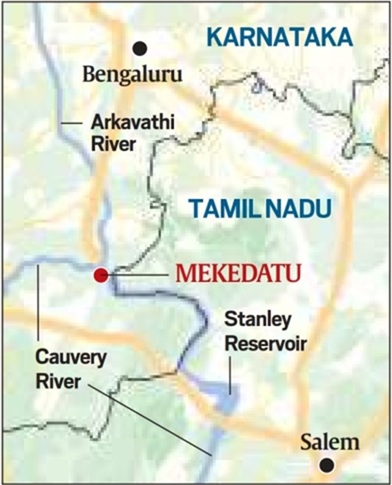
The Karnataka government recently decided to submit a revised Detailed Project Report (DPR) for the Mekedatu Reservoir Project to the Central Government. The Supreme Court dismissed the challenge petition filed by the Tamil Nadu government as "inconsistent," paving the way for a preliminary investigation of the project. This issue is deeply intertwined with the Cauvery River water-distribution dispute.
What is the Mekedatu Project?

  • The Karnataka state government wants to build a 'balancing reservoir' at Mekedatu at a cost of ₹9,000 crore.
  • A balancing reservoir is a storage tank that regulates the flow of water into water distribution systems.
  • This reservoir will store 67.16 TMC of water and will also have the capacity to generate approximately 400 MW of hydropower.
  • The project will submerge approximately 4,996 hectares of land, including 4,800 hectares of forestland.
  • The project is expected to help meet the growing drinking water demand in Bengaluru.
  • The idea was mooted in 1948, but the project has gained momentum in recent years due to water shortages in Bengaluru.

Cause of Dispute

  • The historical background of the Cauvery River water dispute has created distrust between the two states.
  • Tamil Nadu alleges that Karnataka often does not release the stipulated amount of water between June and September.
  • Tamil Nadu fears that after the dam is built, Karnataka will hold back excess water and release it as per its convenience.
  • Karnataka says the project will help it utilize the 4.75 TMC of additional water awarded by the Supreme Court and also make it easier to supply the agreed amount of water to Tamil Nadu.

Importance of the Project

  • Bengaluru faced a severe water crisis in 2024.
  • The city needed 2,600 megaliters per day (MLD) of water, while only 2,100 MLD was available.
  • Currently, Bengaluru receives 1,450 MLD from the Cauvery and 650 MLD from groundwater.
  • The city's population is projected to grow from 13 million to 20 million in six years. The water requirement will then increase to 4,000 MLD.
  • However, the Supreme Court has only allocated 370 MLD (4.75 TMC) of water for Bengaluru.

Other Options

  • Experts from the Indian Institute of Science, T.V. Ramachandra says that Bengaluru receives 700–850 mm of annual rainfall, which could provide approximately 15 TMC of water.
  • Recycled water could provide an additional 16 TMC. Thus, solutions to the water crisis are also possible through other means.

Central Government's Stand

  • Karnataka submitted the DPR to the Central Water Commission (CWC) in 2019.
  • The Environment Ministry's expert committee stated that this is an inter-state matter, requiring an amicable solution between the two states.
  • In February 2024, the CWMA, after discussing the project, returned it to the CWC for further scrutiny.

Conclusion

The Mekedatu Dam project is not merely a matter of reservoir construction but a sensitive part of the decades-old Cauvery water distribution dispute. While Karnataka is supporting it, considering Bengaluru's future water needs, Tamil Nadu fears that it will increase water storage capacity and impact its share. Ultimately, the resolution of this dispute is possible only through trust, transparency between the two states and mediation by the Centre.

Russia-Ukraine War: 28-Point Peace Plan

(Preliminary Exam: Current Events)
(Mains Exam, General Studies Paper 2: Bilateral, Regional, and Global Groups, Important International Institutions, Organizations, and Forums)

Context

The United States has secretly submitted a 28-point peace proposal to Ukrainian President Volodymyr Zelensky to end the Russia-Ukraine war.
What is the 28-Point Peace Plan ?

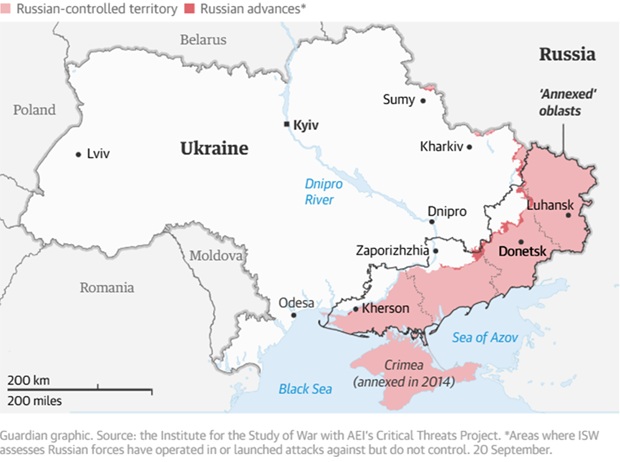
It is a peace roadmap prepared by the United States that aims to end the Russia-Ukraine war through negotiations. It includes conditions such as security guarantees, constitutional changes, economic assistance, and agreements on territorial boundaries.

Key Goals

  • Freeze the war at its current borders
  • Reduce tensions between Russia and NATO and limit NATO expansion
  • Mobilize Western investment for Ukraine's reconstruction

Key Features

  1. Security Framework
    • Ukraine must abandon its pursuit of joining NATO.
    • This policy will be incorporated into Ukraine's constitution.
    • The size of Ukraine's army will be reduced to 600,000 troops.
    • NATO will also have to add to its rules that Ukraine will not be granted membership in the future.
    • The deployment of NATO troops will be restricted on Ukrainian soil.
  2. Territorial and Political Agreements
    • Regions such as Crimea, Luhansk, and Donetsk will be recognized as "practically under Russian control."
    • The existing line of control in the Kherson and Zaporizhzhia regions will be frozen.
    • Russia will withdraw from the occupied territories except for five administrative divisions (Oblasts - a type of administrative division or region).
    • Talks will be held between the two countries to "resolve 30 years of ambiguities."
  3. Economic Mechanism for Ukraine's Reconstruction
    • A Ukraine Development Fund will be created, which will invest in technology, energy, AI, infrastructure, and mineral resources development.
    • According to the US plan, $100 billion in Russian assets will be used to rebuild Ukraine.
    • The US will receive 50% of the profits from this investment.
    • The European Union will also contribute $100 billion.
  4. Russia's Global Reintegration
    • If peace prevails, sanctions on Russia will be gradually lifted.
    • Russia may be re-admitted to the G8 group.
    • Long-term US-Russia cooperation on energy, rare minerals, Arctic projects, and artificial intelligence will be enhanced.
  5. Security Guarantees
    • The US has also shared a separate 3-point security plan.
    • It states that Ukraine will receive NATO-level security assistance for the next 10 years.
    • If Russia attacks Ukraine again, joint military action, intelligence support, economic sanctions, and diplomatic measures will be immediately implemented, and all benefits will be withdrawn.

Russia and Ukraine's Response

  • Russia's Response
    • The Kremlin has described the proposal as positive.
    • Russia views the proposal as a viable option, given its economic re-entry and regional recognition.
  • Ukraine's Situation
    • Ukraine would have to cede its territory and leave NATO, which seems difficult to accept.
    • Zelensky has not yet publicly taken a final stance.

Significance of the Plan

  • This is the most comprehensive and detailed peace proposal from the United States since the war began.
  • It could have long-term implications for European security, Russia-NATO relations, and Ukraine's sovereignty.
  • Critics say the proposal is heavily biased in favor of Russia and undermines Ukraine's sovereignty and territorial integrity.

Potential Benefits for India

  • The lifting of sanctions on Russia will provide India with easier access to cheap and stable crude oil and gas, strengthening its energy security.
  • The reduction of tariffs and restrictions on India-Russia trade will rapidly increase Indian exports in the pharmaceutical, agriculture, machinery, and IT sectors.
  • Defense cooperation will be streamlined; spare parts, joint production, and projects like the S-400/Su-30 will be able to proceed without interruption.
  • Banking and payment systems will be simplified, and rupee-ruble trade will revive, reducing transaction costs.
  • India's increased access to Russia's minerals, energy, Arctic projects, and the Northern Sea Route will significantly benefit both the economy and logistics.

Conclusion

The 28-point peace plan is an important but controversial document toward ending the war. It could alter the geopolitical dynamics of Russia-Ukraine-US-Europe, but Ukraine may have to pay the price in the form of territorial sacrifices and the abandonment of security options like NATO. The question now is whether Ukraine can accept such a compromise.

Custodial Deaths in India — Causes, Statistics, Judicial Decisions, Constitutional Provisions, Challenges & Solutions

UPSC GS–II (Governance, Polity, Welfare, Human Rights)
GS–I (Modern Indian Society & Social Issues)

Custodial deaths raise serious concerns about India’s law-enforcement system, human rights protection, and constitutional values.  Despite Article 21 ensuring the right to life and personal liberty, repeated deaths in custody indicate that urgent reforms are necessary in policing and prison administration.
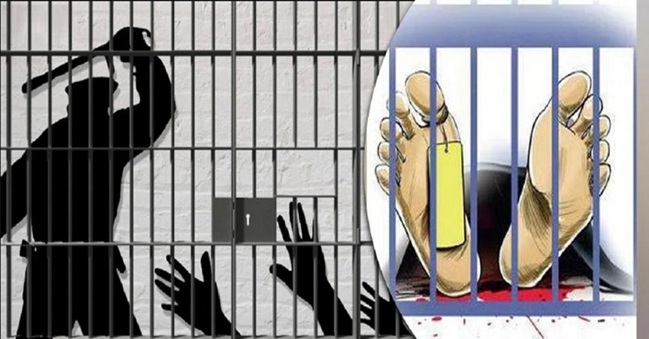
Meaning and Types of Custodial Deaths

(A) Police Custody Death

  • During arrest, interrogation, transfer, torture, illegal detention, or due to medical negligence.

(B) Judicial Custody Death

  • Inside prisons due to disease, suicide, violence, overcrowding, lack of medical care, psychological stress, etc.

Major Causes of Custodial Torture and Death

  1. Reliance on forced confessions
  2. Absence of a comprehensive Anti-Torture Law
  3. Prison overcrowding & poor medical facilities
  4. Lack of independent investigation mechanisms
  5. Inadequate CCTV coverage and technological oversight
  6. Poor access to lawyers and legal aid
  7. Systemic targeting of socially and economically weaker sections

Statistics and Current Situation

  • 1,754 custodial deaths in prisons in 2023
    (as per the Supreme Court’s Centre for Research & Planning)
  • 1,237+ inquiries pending for more than one year → delayed justice & accountability issues
  • 11,656 custodial deaths reported between 2016–2022 (data provided in Parliament)
  • India signed the UN Convention Against Torture (UNCAT) in 1997 but has not ratified it yet
  • → No strong national legislation criminalizing torture

Major Judicial Decisions Related to Custodial Violence

(1) Paramvir Singh Saini vs. Baljit Singh (2020)

  • Mandatory installation of CCTV cameras in:
    • Police stations, NIA, CBI & other law enforcement offices
  • Required features: audio recording, night vision, proper storage
  • Mandatory state and district-level oversight committees
  • Ensures improved transparency and accountability

(2) D.K. Basu vs. State of West Bengal (1997)

Landmark judgment for human rights safeguards:

  • Arrest memo, family notification
  • Medical examination every 24 hours
  • Legal counsel access
  • Mandatory diary entries and custody records
  • SOPs against torture

(3) Prakash Singh vs. Union of India (2006)

  • State-level Police Complaints Authorities for independent investigation
  • Structural police reforms

(4) Shafhi Mohammad vs. State of Himachal Pradesh (2018)

  • Mandatory videography of crime scenes
  • Creation of a Central Oversight Body (COB)

Constitutional Safeguards

Provision

Purpose

Article 14

Equality before law

Article 20(3)

Protection against self-incrimination

Article 21

Right to life and personal liberty

Article 22

Article 22 of the Indian Constitution provides protection to individuals against arrest and detention.

It ensures that the arrested person is informed of the reasons for arrest, has the right to consult a lawyer of their choice, and is produced before a magistrate within 24 hours.

It also applies to cases of preventive detention, which have some additional rules, such as requiring the approval of an advisory board for detention exceeding three months.

NHRC Guidelines (1993 Onwards)

  • Mandatory reporting of custodial death/rape within 24 hours
  • Post-mortem, videography & magisterial inquiry
  • Compensation and accountability measures

Government Measures and Reforms

  1. Mandatory CCTV implementation (following SC directives)
  2. SMART Policing Model (ethical & technology-driven policing)
  3. Model Police Act, 2006
  4. Prison reforms (Mulla Committee, Krishna Iyer Committee)
  5. Fast-track courts for custodial crimes
  6. Forensic-based investigations
  7. Human rights sensitization in police training

Persisting Challenges

  • CCTV not fully functional across states
  • Police Complaints Authorities remain weak
  • No dedicated Torture Prevention Law
  • High undertrial population in prisons
  • Overcrowded and poorly equipped prisons
  • Political interference in policing
  • Staff shortages & stressful working conditions
  • Inadequate forensic infrastructure

The Way Forward

  1. Ratify UNCAT and enact a stringent Torture Prevention Law
  2. Full coverage of CCTV & body-worn cameras in custody areas
  3. Strengthen independent oversight authorities
  4. Make forensic-based investigation mandatory
  5. Incorporate human dignity principles in training
  6. Bail as the norm → reduce undertrial population
  7. Upgrade prison infrastructure & healthcare facilities
  8. Ensure swift action and accountability in custodial violence cases

Conclusion

Custodial deaths are not merely a law-and-order problem — they strike at the core of democracy, human dignity, and justice. Without robust reform in policing, prison administration, technological surveillance, and accountability systems, these deaths will continue to undermine Article 21. India must adopt a human-rights-oriented policing model to ensure that the right to life is meaningful, respected, and protected for every individual — even inside custody.
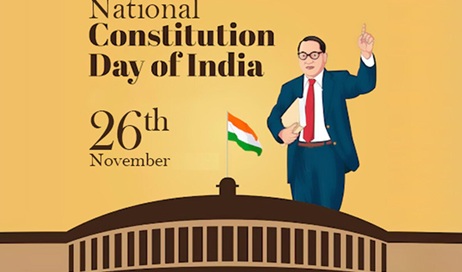
Constitution Day

Constitution Day

  • Indian Constitution Day is celebrated every year on November 26.
    • The Indian Constitution was adopted on November 26, 1949.
  • Celebration of Constitution Day began in 2015.
  • This year was the 125th birth anniversary of Dr. Bhimrao Ambedkar, the architect of the Constitution.
  • To pay tribute to him, it was decided to celebrate Constitution Day this year.
  • This decision was taken by the Ministry of Social Justice and Empowerment.

Significance

  • This day is celebrated to honor the efforts made in the making of the Constitution and the fundamental principles of democracy.
  • This day reminds us of constitutional values ​​such as justice, liberty, equality, and fraternity.
  • It makes citizens aware of their fundamental rights and duties.

Important Facts About the Indian Constitution

  • Formation of the Constituent Assembly
    • Under the Cabinet Mission Plan (1946)
    • Established: December 6, 1946
    • First Meeting: December 9, 1946
    • Total Members: 389 (British India: 292, Princely States: 93, Chief Commissioner's Territories: 4)
    • After the partition of Pakistan, the number of members decreased to 299
  • Constitution-making Period: December 9, 1946, to November 26, 1949 (2 years, 11 months, and 18 days)
  • Date of Adoption of the Constitution: November 26, 1949
  • Last Meeting of the Constituent Assembly: January 24, 1950
  • Date of Full Implementation of the Constitution: January 26, 1950
  • Father of the Constitution: Dr. Bhimrao Ambedkar
  • Author of the Constitution : Prem Bihari Narayan Raizada (two original copies in Hindi and English)
  • Illustrator of the Constitution : Nandalal Bose
  • Establishment of the Basic Structure Doctrine : Kesavananda Bharati Case (1973)
  • The Indian Constituent Assembly originally consisted of 15 women, 26 Scheduled Castes, and 33 Scheduled Tribes. 

Indian Constitution - MCQs

Q.1. Under which plan was the Indian Constituent Assembly formed ?

(a) Mountbatten Plan

(b) Cabinet Mission Plan

(c) Wavell Plan

(d) August Proposal

Q.2. When was the Constituent Assembly established?

(a) 9 December 1946

(b) 26 January 1950

(c) 6 December 1946

(d) 15 August 1947

Q.3. When did the Constituent Assembly first meet?

(a) 6 December 1946

(b) 9 December 1946

(c) 11 November 1949

(d) 26 November 1949

Q.4. What was the total period of the Constitution's creation?

(a) 2 years 10 months and 18 days

(b) 3 years 1 month

(c) 2 years 11 months and 18 days

(d) 2 years 5 months


Q.5. When was the Indian Constitution adopted ?

(a) 26 January 1950

(b) 15 August 1947

(c) 24 January 1950

(d) 26 November 1949

Q.6. When did the Indian Constitution fully come into effect?

    (a) 9 December 1946

    (b) 15 August 1947

    (c) 24 January 1950

    (d) 26 January 1950

    Q.7.Who is called the Father of the Constitution?

    (a) Jawaharlal Nehru

    (b) Sardar Patel

    (c) Dr. Bhimrao Ambedkar

    (d) Rajendra Prasad

    Q.8. Who was the (calligrapher) of the Indian Constitution?

    (a) Nandalal Bose

    (b) Prem Bihari Narayan Raizada

    (c) B. N. Rao

    (d) D. H. V. Kamath

    Q.9. Who illustrated the original copies of the Constitution?

    (a) Amrita Shergil

    (b) Nandalal Bose

    (c) Abanindranath Tagore

    (d) Ravi Varma

    Q.10. What was the total number of women members in the Constituent Assembly ?

    (a) 10

    (b) 12

    (c) 15

    (d) 20

    Answers 

    1. 2. 3. 4.5. D  6. D  7.8. 9. B 10. C

    « »
    • SUN
    • MON
    • TUE
    • WED
    • THU
    • FRI
    • SAT
    Have any Query?

    Our support team will be happy to assist you!

    OR