Prelims: (Geography + CA)
Mains: (GS 3 - Cropping Patterns, Sustainable Agriculture, Environmental Pollution & Degradation) |
Why in News ?
In 2025, India overtook China to become the world’s largest rice producer and now accounts for around 40% of global rice exports, with shipments crossing 20 million metric tonnes.
While this underscores India’s central role in global food security, it has also renewed concerns over rice being a highly water-intensive crop, leading to groundwater depletion, environmental degradation, and the phenomenon of “virtual water exports”, especially from water-stressed regions.
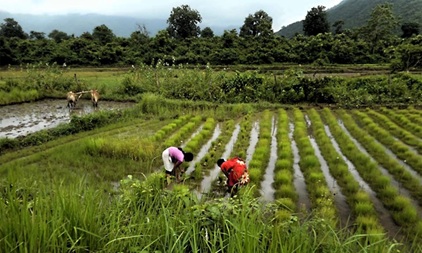
Background & Context: Rice, Food Security and the Green Revolution Legacy
Rice has been at the heart of India’s food security strategy since the Green Revolution. Supported by:
- Assured Minimum Support Price (MSP)
- Free or subsidised electricity
- Fertiliser subsidies
- Public procurement and distribution under NFSA
rice cultivation expanded rapidly, particularly in north-western India (Punjab, Haryana, western Uttar Pradesh).
While this model ensured food self-sufficiency and price stability, it has also created structural distortions, locking farmers into water-intensive monocropping systems ill-suited to local agro-ecological conditions. With climate change intensifying water stress, this rice-centric model is increasingly seen as ecologically unsustainable.
Key Facts Regarding Rice
About Rice
- Staple food for nearly 65% of India’s population
- Occupies about 25% of India’s total cropped area
- India ranks 1st globally in rice production and exports, followed by China and Bangladesh
Climatic and Soil Requirements
- Kharif crop: Sown in June–July, harvested in September–October
- Requires:
- Temperature above 25°C (optimal: 30°C day / 20°C night)
- High humidity and rainfall above 100 cm
- Thrives in soils with:
- pH of 5.5–6.5
- High water-holding capacity and proper drainage
Cropping Intensity
- Multiple crops annually in regions like southern India and West Bengal
- West Bengal grows Aus, Aman, and Boro rice in a single year
- Top producing states (2025–26): Uttar Pradesh, Punjab, West Bengal
Rice Cultivation Techniques
Traditional Transplantation
- Seedlings raised in nurseries and transplanted after 25–35 days
- Highly water- and labour-intensive (25–27 irrigations)
- Maximises yield but stresses groundwater resources
Direct Seeded Rice (DSR)
- Seeds directly drilled into fields using machines
- Saves water, labour, and energy
- Best suited for heavy and medium-textured soils with good iron availability
Government Initiatives for Sustainable Rice Production
Water-Smart Agriculture
- Promotion of DSR, micro-irrigation, and crop diversification
- Focus on Punjab–Haryana under PMKSY and state action plans
Climate-Resilient Varieties
- ICAR developing drought-, heat-, and salinity-tolerant varieties under NICRA
Policy Push Towards Diversification
- Post International Year of Millets (2023), greater emphasis on millets and pulses in water-stressed regions
Nutritional Security
- Nationwide rollout of fortified rice under NFSA and PM-POSHAN to address anaemia
Methane Mitigation
- Promotion of Alternate Wetting and Drying (AWD) to cut methane emissions from paddy fields
Key Concerns Associated with Rice Cultivation
Groundwater Depletion
- Producing 1 kg of rice consumes 3,000–4,000 litres of water
- Groundwater levels in Punjab and Haryana have fallen from ~30 feet to 80–200 feet
- Many aquifers are classified as over-exploited or critical
Environmental Degradation
- Flooded paddies generate methane, contributing 10–20% of agricultural GHG emissions
- Residue burning worsens air pollution, releasing particulate matter and carbon monoxide
Health Risks
- Rice grown using arsenic-contaminated groundwater absorbs toxic metals
- Linked to cancers and chronic diseases, especially in Bihar’s hotspot districts
Economic Stress
- Rising costs of borewells, pumps, fertilisers, and electricity push farmers into debt
- Punjab spends nearly ₹39,000 per hectare annually on fertiliser and power subsidies for rice
Climate Vulnerability
- Rising temperatures and erratic rainfall could reduce yields by 6–10%
- North-west India faces a vicious energy–water–climate cycle
Global Food Security Risks
- As India supplies 40% of global rice exports, production shocks could destabilise global markets
Steps Needed for Sustainable Rice-Based Agriculture
Reforming Subsidies
- Shift from input subsidies to direct income and ecosystem service payments
- Ensure MSP and procurement for millets, pulses, and oilseeds
Technological and Water Efficiency
- Scale up SRI, DSR, drip and sprinkler irrigation
- Fast-track genome-edited crops like drought-tolerant rice
- Use AI-based advisories and soil moisture sensors
Policy and Institutional Strengthening
- Ban new borewells in critical zones
- Promote community-led groundwater governance
- Strengthen FPOs and cooperatives
Climate Resilience
- Encourage diversification, agroforestry, and residue management
- Use Soil Health Cards for precision nutrient application
Farmer Income Protection
- Expand PMFBY, affordable credit, and rural agro-processing
- Improve storage, cold chains, and value addition
FAQs
Q1. Why is rice considered environmentally unsustainable in India ?
Because it is highly water-intensive and contributes to groundwater depletion and methane emissions.
Q2. What is virtual water export in rice trade ?
Exporting rice effectively exports the large quantities of water used to produce it.
Q3. How does Direct Seeded Rice help sustainability ?
It reduces water use, labour costs, and methane emissions.
Q4. Why is diversification away from rice necessary ?
To reduce water stress, improve soil health, and enhance climate resilience.
Q5. What role can genome-edited crops play ?
They can deliver drought- and heat-tolerant varieties without yield loss.
|







 Contact Us
  New Batch : 9555124124/ 7428085757
  Tech Support : 9555124124/ 7428085757