
- UPSC Exam
- State PCS
- One Day Exam
- Current Affairs
- PT Quiz
- Downlaods
- About Coaching
- Blog
- Videos

| Prelims: (Economics + CA) Mains: (GS-3 – Energy Security, Infrastructure, Indian Economy) |
India may face a potential Liquefied Petroleum Gas (LPG) supply shortage due to rapidly rising consumption and heavy reliance on imports without adequate strategic storage capacity.
A significant portion of India’s LPG imports passes through the Strait of Hormuz, making supply chains vulnerable to geopolitical disruptions in West Asia.
Energy analysts and the International Energy Agency have highlighted that India’s LPG system is designed mainly for continuous operational flow rather than long-term stockpiling, exposing the country to supply risks during disruptions.
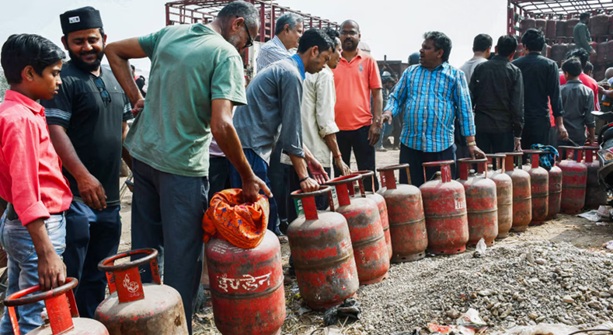
Liquefied Petroleum Gas has become one of the most important household fuels in India, replacing traditional fuels such as firewood, dung cakes, and kerosene.
Government initiatives aimed at clean cooking and improved public health have significantly expanded LPG access across the country.
The most notable initiative has been the Pradhan Mantri Ujjwala Yojana, which provided deposit-free LPG connections to poor households.
While these efforts improved energy access and environmental outcomes, they also rapidly increased LPG demand and import dependence.
India’s LPG imports have increased sharply over the past decade.
India consumes roughly 3 million tonnes of LPG every month, making it the second-largest LPG consumer globally.
However, the country’s existing storage facilities can meet less than half of the monthly requirement, leaving the system vulnerable to supply disruptions.
Most storage is located at import terminal tanks, such as those at Ennore Port, which are designed mainly for short-term operational storage rather than long-term reserves.
Unlike crude oil, where India maintains strategic reserves covering about two months of consumption, LPG storage capacity is extremely limited.
India currently has only two underground LPG storage caverns:
Together, these caverns can store around 1.4 lakh tonnes of LPG, which is equivalent to less than two days of national consumption.
The Mangaluru cavern, with a capacity of 80,000 tonnes, alone equals approximately one day’s consumption.
This limited reserve makes the LPG supply system highly vulnerable to disruptions in global supply routes.
India’s daily LPG consumption is estimated at around 80,000 tonnes.
More than 85% of LPG is used by households for cooking purposes.
Currently, the country has about 33 crore domestic LPG connections, including around 10 crore connections added since 2017.
This rapid expansion reflects the government’s push for clean cooking energy and improved living standards.
The Pradhan Mantri Ujjwala Yojana has been one of the most transformative social welfare schemes in India’s energy sector.
Key Objectives
While the scheme has significantly improved energy access and environmental outcomes, it has also contributed to the rapid increase in LPG demand and import dependence.
Several countries have developed extensive underground gas storage infrastructure.
In Europe, underground storage facilities play a crucial role in maintaining energy security.
Key features include:
After the Russia–Ukraine War began in 2022, the European Union mandated that gas storage facilities must be filled to at least 90% capacity before winter to prevent shortages.
Expanding underground storage in India requires suitable geological formations.
The Peninsular Shield is considered the most suitable region for underground LPG storage.
It consists mainly of stable granite and gneiss rock formations, which are ideal for constructing storage caverns.
Existing LPG caverns at Visakhapatnam and Mangaluru demonstrate the feasibility of such infrastructure.
The Deccan Traps, a vast basalt plateau across western and central India, also offers potential for storage.
However, basalt formations present greater engineering challenges for cavern construction.
Some projects designed by Engineers India Limited have faced difficulties due to geological complexities.
Salt formations in the Bikaner–Barmer Basin in Rajasthan present another promising option.
Salt caverns have several advantages:
To develop this technology, Engineers India Limited has partnered with the German firm DEEP.KBB GmbH.
Another potential option involves using depleted natural gas reservoirs for LPG storage.
Possible locations include:
These reservoirs can store large volumes of gas once extraction activities end.
India’s growing LPG demand highlights the need for stronger energy infrastructure and supply resilience.
Developing large-scale underground storage facilities could:
Given the country’s expanding LPG consumption, strengthening storage capacity will be essential for maintaining reliable and affordable energy access.
FAQs1. Why is India facing a potential LPG supply shortage ? India’s LPG consumption has increased rapidly while import dependence and limited storage capacity have made supply chains vulnerable to disruptions. 2. How much LPG does India import ? India imports around 60% of its LPG requirements, amounting to roughly 20 million tonnes annually. 3. What role does the Strait of Hormuz play in LPG supply ? More than 85% of India’s LPG imports pass through the Strait of Hormuz, making it a critical energy chokepoint. 4. What is the Pradhan Mantri Ujjwala Yojana ? It is a government scheme that provides deposit-free LPG connections to poor households, promoting clean cooking energy. 5. What is the solution to India’s LPG storage problem ? Experts suggest expanding underground storage caverns and using depleted gas reservoirs to build strategic LPG reserves and improve energy security. |



Our support team will be happy to assist you!

 Contact Us
  New Batch : 9555124124/ 7428085757
  Tech Support : 9555124124/ 7428085757