Why in News ?
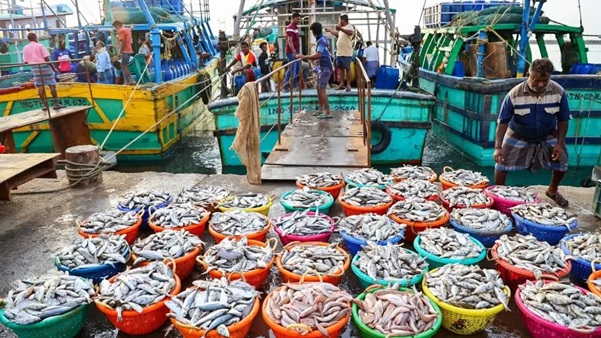
India’s seafood exports touched an all-time high in both volume and value during FY 2025–26, despite challenging global market conditions. The sector continues to play a vital role in food security, employment generation, export earnings, and sustainable livelihoods.
Key Highlights
All-Time High Exports
India exported 19,72,018 metric tonnes (MT) of seafood valued at USD 8.46 billion (₹73,890.46 crore) during FY 2025–26, registering the highest-ever export performance in terms of both quantity and value.
Frozen Shrimp Remained the Leading Export Item
- Frozen shrimp continued to dominate India’s seafood exports, accounting for 40.19% of the total export quantity and 66.52% of total export earnings in US dollar terms. During the year, India exported 7,92,647 MT of frozen shrimp valued at USD 5,624.48 million (₹49,037.93 crore). Shrimp exports recorded a growth of 13.16% in rupee value and 8.64% in dollar value compared to the previous year.
- The United States remained the largest importer of Indian frozen shrimp, importing 2,56,128 MT, followed by China (1,69,505 MT), the European Union (1,35,599 MT), Southeast Asia (83,810 MT), Japan (40,776 MT), the Middle East (30,478 MT), and other countries (76,351 MT). Exports of Litopenaeus vannamei (L. vannamei) and Black Tiger shrimp recorded growth in both volume and value.
Other Major Export Items
- Frozen fish emerged as the second-largest exported seafood product, generating USD 643.70 million (₹5,658.37 crore) in export earnings. It was followed by dried seafood products, which earned USD 577.44 million (₹5,079.09 crore) and registered an impressive growth of 78.05% in rupee value terms.
- Exports of frozen squid reached 1,02,060 MT, generating USD 513.84 million (₹4,493.80 crore). Frozen cuttlefish exports also recorded positive growth, increasing by 13.32% in quantity and 16.25% in dollar value, with exports totaling 67,157 MT valued at USD 331.96 million.
- Chilled seafood products earned USD 71.27 million, while exports of live seafood products reached USD 62.43 million, registering a growth of 11.46% in dollar value terms.
Top Export Destinations
- The United States and China remained the principal importers of Indian seafood during FY 2025–26.
- The United States was the largest importer in value terms, importing seafood worth USD 2,328.74 million (₹20,263.27 crore) and a total volume of 2,79,193 MT. Frozen shrimp accounted for 93.55% of the value of India’s seafood exports to the United States. However, exports to the US declined by 10.82% in rupee value, 14.22% in dollar value, and 19.51% in volume.
- China emerged as the largest destination in terms of quantity, importing 4,90,369 MT of Indian seafood valued at USD 1,611.32 million.
- The European Union remained the third-largest destination in value terms, importing 2,97,518 MT worth USD 1,592.09 million. It was followed by Southeast Asia, which imported 4,51,756 MT valued at USD 1,348.97 million. Japan continued to be the fifth-largest importer with 1,05,228 MT worth USD 452.91 million, while the Middle East imported 76,743 MT valued at USD 283 million.
Top Ports Handling Seafood Exports
The top three ports handling seafood export cargo during FY 2025–26 were:
- Visakhapatnam Port
- Jawaharlal Nehru Port
- Cochin Port
Key Policy Recommendations to Enhance Sector Competitiveness
To strengthen the competitiveness of India’s seafood sector, several policy measures have been recommended:
- Central Scheme for Development of Indigenous Broodstock to reduce dependence on expensive and pathogen-prone imported broodstock.
- Central Scheme for Meeting Global Quality Standards for Seafood Products to ensure Indian seafood products comply with international quality and safety requirements.
- Ease of Export Measures to address country-specific export restrictions and mitigate rising freight costs.
- Creation of an umbrella body such as the Seafood Sector Governing Council (SSGC) to improve collaboration, infrastructure support, policy coordination, and sectoral development.
Key Measures Taken by the Government
- The Marine Products Export Development Authority, under the Ministry of Commerce and Industry, continues to serve as the dedicated agency for promoting seafood exports from India.
- The government has also implemented flagship initiatives such as the Pradhan Mantri Matsya Sampada Yojana and the Fisheries and Aquaculture Infrastructure Development Fund to strengthen fisheries and aquaculture infrastructure.
Additional measures include:
- Enhanced duty-free import limits for specified inputs used in seafood processing.
- Promotion of SHAPHARI certification to improve quality assurance and traceability.
Key Challenges Persisting in India’s Seafood Sector
Despite its strong performance, the sector continues to face several challenges.
Non-Tariff Measures
- Stringent quality regulations in importing countries remain a major hurdle. For instance, the United States rejected three seafood products from India in 2023 due to violations of Maximum Residue Level (MRL) standards.
Trade Duties
- Anti-Dumping Duties (ADD) and Countervailing Duties (CVD) imposed by importing countries continue to affect the competitiveness of Indian seafood exports.
Raw Material Constraints
- Exporters often face difficulties in sourcing quality raw materials due to seasonality and inconsistent supply.
Inadequate Cold Storage Infrastructure
- Seafood products require strict temperature control throughout the supply chain. Even minor deviations can compromise freshness, texture, quality, and shelf life, making cold-chain infrastructure a critical requirement for the sector.






 Contact Us
  New Batch : 9555124124/ 7428085757
  Tech Support : 9555124124/ 7428085757