Prelims: Environment & Ecology, Government Schemes.
GS Paper III – Infrastructure (Energy), Environment, Renewable Energy & Climate Change. |
Why in News?
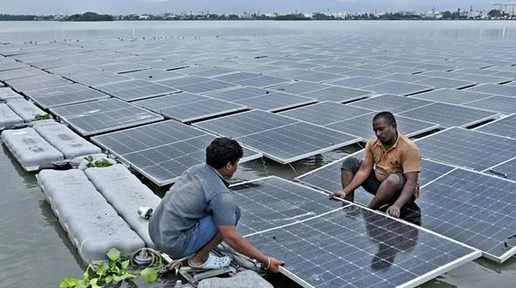
The Union Cabinet on 31 July 2026 approved the Pradhan Mantri Surya Sarovar Yojana (PM-SSY) to accelerate the development of floating solar power projects in India. The scheme aims to install 5,000 MW of floating solar capacity by 2030-31.
What is Pradhan Mantri Surya Sarovar Yojana (PM-SSY)?
- PM-SSY is a Central Financial Assistance (CFA)-based scheme aimed at promoting floating solar projects.
- It focuses on installing solar power plants on:
- Reservoirs
- Dams
- Lakes
- Other water bodies
- The scheme will be implemented by the Solar Energy Corporation of India (SECI).
- Total financial outlay of the scheme: ₹5,070 crore.
- Financial support of up to ₹1 crore per MW will be provided for eligible projects.
What is Floating Solar?
- Floating solar refers to the installation of solar photovoltaic (PV) panels on floating platforms over water bodies instead of traditional land-based installations.
Major Components
- Solar PV panels
- Floating platforms
- Anchoring and mooring systems
- Power transmission infrastructure
- Battery Energy Storage Systems (BESS)
Key Features of PM-SSY
|
Feature
|
Details
|
|
Scheme Name
|
Pradhan Mantri Surya Sarovar Yojana (PM-SSY)
|
|
Objective
|
Promote floating solar energy projects
|
|
Target
|
5,000 MW capacity by 2030-31
|
|
Financial Outlay
|
₹5,070 crore
|
|
Implementing Agency
|
Solar Energy Corporation of India (SECI)
|
|
Financial Assistance
|
Up to ₹1 crore/MW
|
|
Battery Storage Requirement
|
Minimum 2 hours storage
|
|
Total Storage Capacity
|
Around 10,000 MWh
|
Current Status of Floating Solar in India
- India currently has around 0.7 GW of installed floating solar capacity.
- However, its estimated technical potential is around 102 GW.
- According to the National Institute of Solar Energy (NISE), India has significant potential due to its large number of reservoirs and water bodies.
States with High Floating Solar Potential
- Maharashtra
- Madhya Pradesh
- Karnataka
- Odisha
- Telangana
Major Floating Solar Project in India
- Omkareshwar Floating Solar Park
- Location: Khandwa district, Madhya Pradesh
- River: Narmada River
- Current Capacity: 278 MW
- Planned Expansion: 600 MW
- It is among India's largest floating solar projects.
Advantages of Floating Solar
1. Reduces Land Requirement
- Conventional solar projects require large tracts of land.
- Floating solar uses existing water bodies, reducing land acquisition challenges.
2. Reduces Water Evaporation
- Solar panels covering water surfaces reduce evaporation losses from reservoirs.
3. Higher Efficiency
- The cooling effect of water can improve solar panel performance by reducing operating temperatures.
4. Protects Agricultural Land
- It avoids competition between energy projects and agricultural land use.
5. Supports Energy Storage
- Integration with battery storage improves the reliability of renewable energy.
Challenges Associated with Floating Solar
1. Higher Cost
- Floating solar projects are approximately 25% more expensive than ground-mounted solar projects.
Estimated cost:
- Floating solar: ₹4.9-5.2 crore/MW
- Ground-mounted solar: Lower cost compared to floating systems
2. Engineering Challenges
- Maintenance of floating structures
- Durability of anchoring systems
- Cable failures and wear issues
3. Battery Storage Cost
- Mandatory battery storage increases the overall project cost.
Importance for India’s Energy Goals
The scheme supports India’s renewable energy objectives:
500 GW Non-Fossil Fuel Capacity Target (2030)
- India aims to achieve 500 GW of non-fossil fuel-based electricity capacity by 2030.
Diversification of Solar Energy Development
- Solar capacity in India is currently concentrated mainly in Rajasthan and Gujarat.
- Floating solar will enable states with fewer land resources but large water bodies to participate.
Energy Security
- Battery-backed floating solar can provide more reliable and dispatchable renewable electricity.
Employment and Economic Impact
- According to government estimates, the scheme will:
- Generate around 16,000–17,000 employment opportunities.
- Encourage domestic manufacturing of specialised floating solar components.
- Promote investment in the renewable energy sector.
Conclusion
The Pradhan Mantri Surya Sarovar Yojana is a significant step towards expanding India's solar energy capacity. By utilising water bodies, reducing land dependency, integrating energy storage, and promoting domestic manufacturing, the scheme can contribute significantly to India's goal of achieving 500 GW of non-fossil fuel energy capacity by 2030 and advancing its clean energy transition.
Prelims Question
Q. Consider the following statements regarding the Pradhan Mantri Surya Sarovar Yojana (PM-SSY):
- It aims to promote floating solar power projects on reservoirs and other water bodies.
- The scheme is implemented by the Solar Energy Corporation of India (SECI).
- It targets the installation of 5,000 MW of floating solar capacity by 2030-31.
Which of the statements given above is/are correct?
-
1 and 2 only
-
2 and 3 only
-
1 and 3 only
-
1, 2 and 3
Mains Question
"Discuss the significance of the Pradhan Mantri Surya Sarovar Yojana in achieving India's renewable energy targets. Highlight its opportunities and implementation challenges."
|
FAQs: Pradhan Mantri Surya Sarovar Yojana (PM-SSY)
Q1. What is the Pradhan Mantri Surya Sarovar Yojana (PM-SSY)?
Answer: PM-SSY is a Central Government scheme aimed at promoting floating solar power plants on reservoirs and other water bodies by providing financial assistance to eligible projects.
Q2. What is the objective of PM-SSY?
Answer: The scheme aims to install 5,000 MW of floating solar capacity by 2030-31, reduce dependence on land-based solar projects, and support India's clean energy transition.
Q3. Which agency will implement the PM-SSY?
Answer: The scheme will be implemented by the Solar Energy Corporation of India (SECI).
Q4. What is a floating solar power plant?
Answer: A floating solar power plant is a solar photovoltaic (PV) system installed on floating platforms over reservoirs, lakes, dams, or other water bodies instead of on land.
Q5. What financial assistance is provided under PM-SSY?
Answer: The scheme provides Central Financial Assistance (CFA) of up to ₹1 crore per MW for eligible floating solar projects.
|






 Contact Us
  New Batch : 9555124124/ 7428085757
  Tech Support : 9555124124/ 7428085757