Why in News?
Karnataka Chief Minister D.K. Shivakumar reiterated that the state would pursue the Mekedatu Balancing Reservoir Project across the Cauvery. He said Karnataka would honour Tamil Nadu’s water entitlement, seek the required clearances and explain the project’s benefits to a delegation from the neighbouring state.
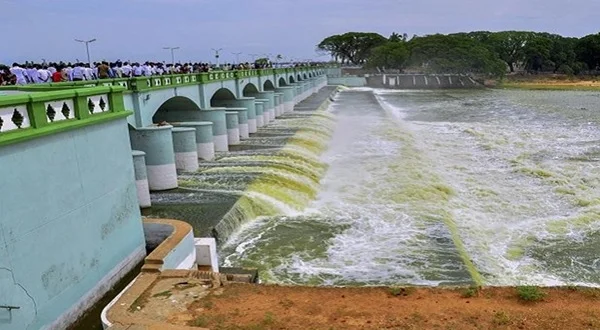
The Cauvery Water Dispute
The Cauvery basin extends across Karnataka, Tamil Nadu, Kerala and Puducherry. The dispute primarily concerns how river water should be shared and how downstream deliveries should be maintained when monsoon rainfall falls short.
- 2007 — The Cauvery Water Disputes Tribunal (CWDT) issued its final award on water sharing.
- 2018: The Supreme Court modified the award. Karnataka’s stipulated delivery to Tamil Nadu at Biligundlu in a normal year fell from 192 TMC to 177.25 TMC, with a month-wise delivery schedule.
- 2018: The Centre notified the Cauvery Water Management Scheme, establishing the Cauvery Water Management Authority (CWMA) and the Cauvery Water Regulation Committee (CWRC) to implement and monitor the water-sharing arrangements.
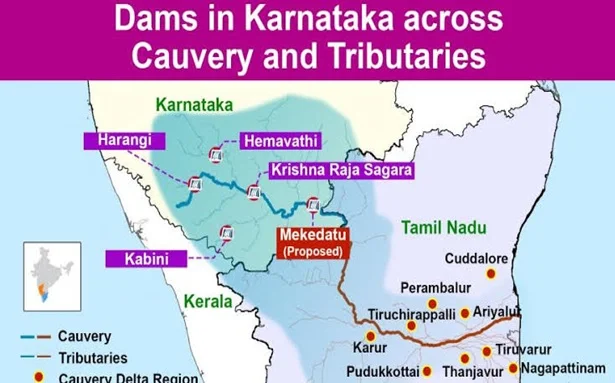
What Is the Mekedatu Project?
Mekedatu is the site of a proposed balancing reservoir across the Cauvery River in Karnataka, upstream of the Biligundlu monitoring point. A balancing reservoir stores water when inflows are high so that it can be released in a controlled manner later.
|
Feature
|
Details
|
|
River
|
Cauvery
|
|
Project type
|
Balancing reservoir with drinking water and hydropower components
|
|
Proposed storage capacity
|
67.16 TMC in Karnataka’s pre-feasibility report
|
|
Proposed hydropower capacity
|
400 MW in the pre-feasibility report
|
|
Main drinking water objective
|
Augment supply to Bengaluru and its metropolitan region
|
|
Downstream monitoring point
|
Biligundlu, where delivery to Tamil Nadu is measured
|
The capacity figures come from Karnataka’s pre-feasibility report and describe the project as proposed at that stage.
Why Do Karnataka and Tamil Nadu Disagree?
|
Karnataka’s position
|
Tamil Nadu’s concern
|
|
Bengaluru needs additional drinking water as urban demand grows.
|
Additional upstream storage could reduce or delay flows reaching the Cauvery delta.
|
|
The reservoir could store water during high-flow periods and help regulate downstream releases.
|
Even if the annual delivery is met, delayed releases can disrupt sowing and irrigation schedules.
|
|
Karnataka says it will comply with the Supreme Court’s water-sharing directions.
|
Tamil Nadu wants the project’s design and operating rules to demonstrate compliance before approvals are granted.
|
The dispute turns on when stored water would be released, especially during a weak monsoon. For delta farmers, a release that arrives after the sowing window can have less value even if the annual delivery eventually reaches the stipulated volume.
Key Developments and Project Status
- Supreme Court proceedings: In late 2025, the Court dismissed Tamil Nadu’s challenge concerning the preparation of the Detailed Project Report (DPR). The order concerned the DPR stage. Construction approval and statutory clearances are separate steps.
- Technical scrutiny: In July 2026, the Central Water Commission (CWC) reportedly returned Karnataka’s revised DPR and sought a fresh submission. A key issue was the proposal’s higher consumptive use, which the CWC found inconsistent with the tribunal award and the 2018 judgment.
- November 2026 position: Karnataka said it would pursue the necessary environmental and forest clearances, while Tamil Nadu continued to oppose approval unless compliance with the existing water-sharing framework was demonstrated.
Significance and Relevance for India
- Urban water security: The proposal illustrates the challenge of ensuring reliable drinking water for growing cities within a river basin already serving extensive agricultural demand.
- Agricultural livelihoods: The timing of freshwater flows affects irrigation planning in the Cauvery delta. Month-wise deliveries are therefore important alongside the annual entitlement.
- Cooperative federalism: Article 262 empowers Parliament to provide for the adjudication of interstate river water disputes. Parliament enacted the Inter-State River Water Disputes Act, 1956 under this constitutional framework. The Cauvery case shows how water-sharing decisions also depend on measurement and coordination across states.
Key Challenges
- Sharing shortages in dry years: Lower inflows sharpen the conflict between reservoir storage for drinking water and timely downstream releases.
- Measuring additional water use: The revised DPR must show how much water the project would consume and how releases would be maintained under the applicable allocation.
- Assessing environmental costs: Appraisal must examine forest submergence, wildlife habitat and the river flows needed to sustain downstream ecosystems.
- Building trust between states: Both states need access to dependable data on rainfall, reservoir levels, inflows and releases to assess compliance.
Way Forward
- Test the revised DPR under normal and drought conditions: A basin-wide assessment should estimate how the reservoir would affect monthly flows at Biligundlu and irrigation schedules in the delta.
- Agree on operating rules before approval: These should specify when the reservoir can store water, when it must release water and how shortages would be shared in a dry year.
- Share real-time river data: Common access to inflow, storage and release data would help the two states and the CWMA verify compliance.
- Reduce pressure on the Cauvery: Bengaluru can supplement its supply through leakage control, rainwater harvesting and the use of treated wastewater for suitable non-drinking purposes.
Conclusion
The Mekedatu proposal brings Bengaluru’s drinking water needs and the Cauvery delta’s irrigation needs into the same decision. Its viability depends on whether the revised design and operating rules can meet binding downstream delivery obligations during both normal and deficient monsoons, while satisfying environmental requirements.
Prelims Practice Question
Biligundlu, which is often mentioned in the context of the Cauvery water dispute, is significant because it is the point where:
A. The Kabini River joins the Cauvery
B. Karnataka’s stipulated Cauvery water delivery to Tamil Nadu is measured
C. The proposed Mekedatu hydropower station will be located
D. The Cauvery divides into its delta distributaries
Mains Practice Question
The Mekedatu dispute highlights the challenge of reconciling urban drinking water needs with downstream irrigation rights. Discuss how reservoir operating rules and interstate cooperation can address this challenge.
|
Frequently Asked Questions
1. On which river is the Mekedatu Dam proposed?
It is proposed across the Cauvery River in Karnataka.
2. What is the main objective of the project?
It aims to augment drinking water supply for Bengaluru.
3. Why does Tamil Nadu oppose the project?
It fears upstream storage could delay downstream irrigation releases.
4. What is the normal-year delivery at Biligundlu?
The stipulated normal-year delivery there is 177.25 TMC.
5. Which constitutional article deals with interstate water disputes?
Article 262 deals with adjudication of interstate water disputes.
|