Majuli Island: Geography, Culture, Tribes and Climate History
Why in News ?
A recent scientific study has reconstructed nearly 4,000 years of climate and vegetation history of Majuli Island, providing valuable insights into long-term environmental changes in the Brahmaputra floodplain.
The findings help researchers understand how climate variability, monsoon patterns, and river dynamics have shaped the island's ecosystem and human settlements over millennia.
Geographical Importance
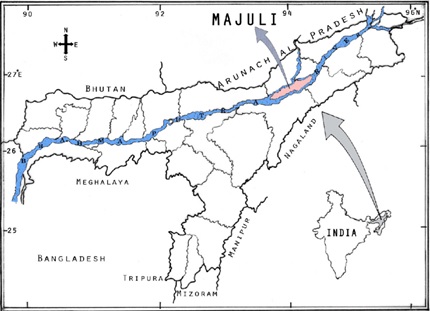
Majuli is situated in the middle of the mighty Brahmaputra River in the state of Assam.
It is widely recognized as the world's largest inhabited river island.
Covering a vast floodplain landscape, Majuli serves as an important ecological zone supporting wetlands, grasslands, and riverine biodiversity.
In 2016, Majuli was officially declared the first island district of Assam.
Formation and Physical Features
The island was formed through centuries of sediment deposition and channel migration by the Brahmaputra and its tributaries.
The Brahmaputra River forms its southern boundary, while the Kherkutia Xuti channel and the Subansiri River define its northern side.
Majuli's landscape consists of fertile alluvial soils, marshlands, oxbow lakes, and seasonal floodplains.
The island faces severe challenges from riverbank erosion, frequent flooding, and shifting river courses, leading to significant land loss over the past century.
These geomorphological changes continue to influence settlement patterns and agricultural practices.
Society and Economy
Agriculture remains the backbone of Majuli's economy, with rice cultivation being the primary occupation.
Traditional rice varieties such as Komal Saul (soft rice) and Bao Dhan (deep-water rice) are well adapted to the flood-prone environment.
Fishing, livestock rearing, handloom weaving, pottery, and handicrafts also contribute significantly to local livelihoods.
The island's economy reflects a close relationship between local communities and the river ecosystem.
Tribes and Communities
Majuli is home to diverse ethnic groups, creating a rich multicultural society.
The major indigenous communities include the Mishing, Deori, Sonowal Kachari, Ahom, and Koch groups.
The Mishing tribe, one of the largest communities on the island, is known for its stilt houses (Chang Ghar), traditional weaving, and vibrant festivals such as Ali-Aye-Ligang.
These communities have developed unique flood-adaptive lifestyles and sustainable resource-use practices over generations.
Cultural Heritage
Majuli is regarded as the spiritual and cultural heartland of Assamese Neo-Vaishnavism.
The Bhakti movement in Assam was led by Srimanta Sankardeva and his disciple Madhavdeva during the 15th–16th centuries.
The island is renowned for its Satras (Vaishnavite monasteries), which function as centres of religion, art, literature, education, and social reform.
Prominent Satras include Auniati Satra, Kamalabari Satra, and Dakhinpat Satra.
Majuli is famous for traditional mask-making (Mukha Shilpa), pottery without the use of a potter's wheel, boat-building craftsmanship, folk music, and the classical Sattriya Dance, which is recognized as one of India's eight classical dance forms.
Climate and Environmental History
The recent climate reconstruction study indicates that Majuli has experienced significant shifts in rainfall intensity, vegetation cover, and flood regimes over the last 4,000 years.
Variations in monsoon strength influenced forest expansion, grassland development, and agricultural potential across different periods.
The study highlights the close relationship between climate change, river dynamics, and human adaptation in the Brahmaputra valley.
Understanding this long-term environmental history is crucial for developing strategies to address contemporary challenges such as erosion, flooding, and climate change.




 Contact Us
  New Batch : 9555124124/ 7428085757
  Tech Support : 9555124124/ 7428085757