Why in News?
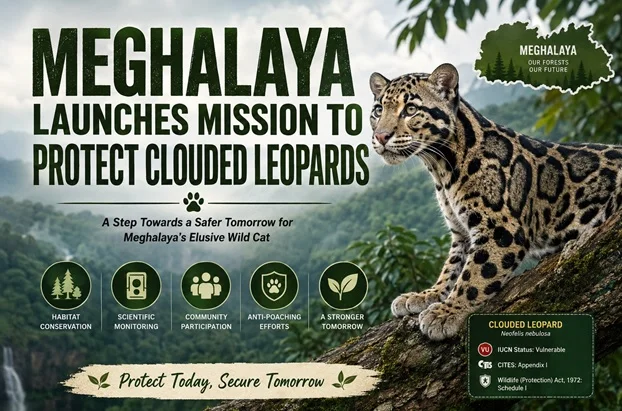
- Meghalaya Chief Minister Conrad K. Sangma launched Mission Clouded Leopard, a flagship conservation programme dedicated to safeguarding the Clouded Leopard (Neofelis nebulosa), the official State Animal of Meghalaya.
- The mission is intended to provide a comprehensive, long-term framework for the protection of the species and its habitat, and positions Meghalaya among the few Indian states to roll out a species-specific conservation programme of this kind.
What is the Clouded Leopard Mission?
The initiative focuses on:
- Conserving critical forest ecosystems.
- Conducting scientific population monitoring.
- Reducing human-wildlife conflict.
- Strengthening anti-poaching surveillance.
- Promoting community-based conservation.
- Enhancing public awareness about wildlife protection.
What Is the Clouded Leopard?
- Scientific Name: Neofelis nebulosa
- Family: Felidae (Cat family)
- Common Name: Clouded Leopard (It is known for its distinctive cloud-shaped markings, from which it derives its name.)
- Habitat: Dense tropical and subtropical forests.
- Distribution: India (Northeast), Nepal, Bhutan, Bangladesh, Myanmar, Thailand, Malaysia, Southern China and other parts of Southeast Asia.
- It is an excellent tree climber and spends much of its time in the forest canopy. It hunts deer, monkeys, birds, wild pigs and other small mammals.
- It is considered one of the most elusive and least-studied big cats in Asia.
- Locally, the species is known by different names among Meghalaya's communities — Maccha Pheng in Garo, Lakrong in Khasi, and Khla in Jaintia.
- The species is classified as Vulnerable on the IUCN Red List, is included in Appendix I of CITES, and enjoys the highest level of legal protection in India under Schedule I of the Wild Life (Protection) Act, 1972.
What Does Mission Clouded Leopard Involve?
- The mission will be guided by the Meghalaya Clouded Leopard Action Plan, currently being prepared by the state's Forest and Environment Department, which will serve as the strategic roadmap for the species' long-term conservation.
- As part of the programme, an ongoing scientific assessment in the Balpakram landscape has already identified 21 individual Clouded Leopards.
- Officials have described these as preliminary findings, and the survey is now being extended to other major habitats across the state to produce Meghalaya's first comprehensive population estimate of its State Animal.
Objectives of the Mission
- It aims to protect and restore the natural habitat of the Clouded Leopard across the state's forest landscapes.
- It seeks to strengthen scientific research and long-term population monitoring of the species.
- It will reinforce anti-poaching and protection measures to curb illegal hunting and habitat loss.
- It aims to improve landscape connectivity between fragmented forest patches to support the species' movement.
- It focuses on building the capacity of frontline forest staff involved in conservation work.
- It encourages community participation and public awareness, given that the species is found in community-managed forests as well.
- It promotes collaboration with neighbouring north-eastern states for landscape-level conservation.
Why Is This Mission Important for Meghalaya?
- As Meghalaya is home to some of India's richest and most biodiverse forest landscapes, protecting an apex predator like the Clouded Leopard has a cascading effect on the health of the wider ecosystem.
- Since the species depends on healthy, connected forest cover, its conservation indirectly protects watersheds, other wildlife, and the livelihoods of communities dependent on these forests.
- The mission also strengthens the scientific understanding of the species, since reliable population data on the Clouded Leopard has so far been extremely limited across its range due to its elusive and nocturnal nature.
Major Components of the Mission
- Habitat Conservation
- Protection and restoration of degraded forests.
- Conservation of wildlife corridors connecting fragmented habitats.
- Scientific Monitoring
- Camera trap surveys.
- GPS mapping.
- Population estimation.
- Behavioural research.
- Community Participation
- Involvement of local communities in forest conservation.
- Awareness campaigns in villages and schools.
- Promotion of sustainable livelihoods to reduce dependence on forests.
- Anti-Poaching Measures
- Increased forest patrols.
- Better surveillance.
- Intelligence-based wildlife crime monitoring.
- Coordination among enforcement agencies.
Ecological and Strategic Importance
- As an apex predator, the Clouded Leopard helps regulate prey populations and maintain ecological balance within forest ecosystems.
- The mission strengthens India's compliance with international commitments under CITES and supports the broader national agenda on wildlife conservation.
- It encourages coordinated, landscape-level conservation with neighbouring north-eastern states, since wildlife corridors do not respect administrative boundaries.
- It supports Meghalaya's identity and heritage, as the Clouded Leopard is the state's official animal and holds cultural significance among local communities.
Why is the Clouded Leopard Threatened?
Major threats include:
- Habitat loss due to deforestation.
- Infrastructure development.
- Shifting cultivation in some regions.
- Illegal hunting.
- Wildlife trafficking.
- Decline in prey population.
- Human-wildlife conflict.
Significance of the Mission
- Strengthens conservation efforts in Northeast India.
- Protects one of Asia's rarest wild cats.
- Enhances biodiversity conservation.
- Supports India's commitments under the Convention on Biological Diversity (CBD).
- Encourages community-led wildlife conservation.
- Improves scientific knowledge of an elusive species.
Dedicated Conservation Action Plan for the Wild Cat
- On the occasion of International Clouded Leopard Day (4 August), India launched the Clouded Leopard Conservation Action Plan (CAP) under the Government of India–GEF–UNDP initiative.
- Released during the 91st SCNBWL meeting in Coimbatore, the plan identifies 14 priority conservation landscapes across Northeast India and focuses on habitat restoration, wildlife corridors, scientific monitoring (camera traps, genetics, eDNA), anti-poaching, community participation, M-STrIPES-based monitoring, climate resilience, and transboundary cooperation for long-term conservation.
Challenges to Clouded Leopard Conservation
- Habitat loss and fragmentation due to shifting cultivation, logging, and infrastructure development threaten the species' forest corridors.
- The elusive, nocturnal and arboreal nature of the Clouded Leopard makes population monitoring and scientific study extremely difficult.
- Poaching and illegal wildlife trade remain concerns for a species valued for its pelt and body parts in some illegal markets.
- Much of the species' habitat lies in community-managed forests outside formal protected areas, requiring sustained cooperation with traditional institutions.
Way Forward
- Expand habitat restoration programmes.
- Strengthen wildlife corridors.
- Increase use of drones, camera traps and GIS mapping.
- Improve coordination between forest departments and research institutions.
- Enhance community incentives for conservation.
- Promote long-term ecological monitoring and awareness campaigns.
PRELIMS MCQ
Q. With reference to the Clouded Leopard (Neofelis nebulosa), consider the following statements:
- It is listed as Vulnerable on the IUCN Red List.
- It is included in CITES Appendix I.
- It is protected under Schedule I of the Wildlife (Protection) Act, 1972.
Which of the statements given above is/are correct?
A. 1 and 2 only
B. 2 and 3 only
C. 1 and 3 only
D. 1, 2 and 3
MAINS PRACTICE QUESTION
Q. The conservation of apex predators is essential for maintaining ecological balance. Discuss the significance of Meghalaya's Clouded Leopard Mission in protecting biodiversity and strengthening community-based wildlife conservation.
|
FAQs
What is the Clouded Leopard Mission?
It is a wildlife conservation initiative launched by the Meghalaya Government to protect clouded leopards through habitat conservation, scientific research, anti-poaching measures, and community participation.
What is the scientific name of the Clouded Leopard?
The scientific name of the Clouded Leopard is Neofelis nebulosa.
Why is Meghalaya important for clouded leopard conservation?
Meghalaya has extensive evergreen and subtropical forests that provide ideal habitat for clouded leopards, making it one of India's key strongholds for the species.
What are the major threats faced by clouded leopards?
The major threats include habitat loss, deforestation, illegal hunting, wildlife trafficking, declining prey populations, infrastructure development, and human-wildlife conflict.
What is the conservation status of the Clouded Leopard?
- IUCN Red List: Vulnerable
- CITES: Appendix I
- Wildlife (Protection) Act, 1972: Schedule I
|






 Contact Us
  New Batch : 9555124124/ 7428085757
  Tech Support : 9555124124/ 7428085757