GS Paper II: International Relations, Bilateral and Multilateral Relations, Global Governance
GS Paper III: Energy Security, Economic Development, Nuclear Security
Keywords: APEC Summit 2026, Trump–Xi–Putin Trilateral Meeting, China–Russia–US Relations, Nuclear Arms Control, New START Treaty, International Criminal Court, Global Energy Security, India’s Strategic Autonomy, Multipolar World Order |
Why in News?
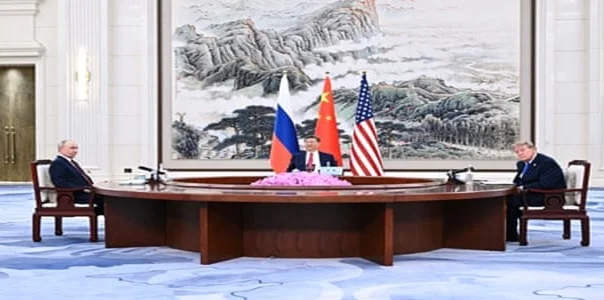
- On 19 November 2026, US President Donald Trump, Chinese President Xi Jinping and Russian President Vladimir Putin held a historic trilateral meeting on the sidelines of the Asia-Pacific Economic Cooperation (APEC) Summit in Shenzhen, China.
- The meeting marked an unprecedented diplomatic engagement among the serving leaders of three major nuclear powers amid geopolitical tensions, energy disruptions and growing concerns over nuclear security.
- The three leaders issued a four-point peace declaration addressing United Nations reform, global petroleum supplies, the jurisdiction of the International Criminal Court (ICC), and nuclear risk reduction.
Why Was the Trilateral Summit Significant?
- The international system is experiencing heightened strategic competition between major powers.
- The United States and China are competing for technological, economic and military influence, while Russia's confrontation with Western countries has intensified since the full-scale invasion of Ukraine in February 2022.
- The Shenzhen meeting brought these competing powers together at a time when diplomatic communication is particularly important.
Three major developments shaped the summit:
- Growing US–China Rivalry: Trade restrictions, advanced semiconductor technologies, Taiwan and military activities in the Indo-Pacific continue to influence relations between Washington and Beijing.
- Russia–West Confrontation: The Ukraine conflict, Western sanctions and disputes over European security have increased Russia's strategic dependence on non-Western partnerships, particularly China.
- Uncertainty Over Nuclear Arms Control: The expiration of the New START Treaty in February 2026 left the United States and Russia without its bilateral framework for limiting deployed strategic nuclear weapons. This increased international attention on possible future arms-control arrangements involving China.
What Is APEC?
The Asia-Pacific Economic Cooperation (APEC) is a regional economic forum established in 1989 to promote trade, investment and economic cooperation across the Asia-Pacific region.
|
Feature
|
Details
|
|
Established
|
1989
|
|
Headquarters of Secretariat
|
Singapore
|
|
Membership
|
21 member economies
|
|
APEC 2026 Host
|
China
|
|
Summit Venue
|
Shenzhen, Guangdong Province
|
|
Summit Dates
|
18–19 November 2026
|
|
Decision-making
|
Consensus-based, voluntary and non-binding commitments
|
|
India’s Status
|
Not a member
|
Major Outcomes of the Trump–Xi–Putin Summit
The leaders issued a four-point declaration following their meeting at Kylin Villa in Shenzhen.
1. Reform of the United Nations
The three countries recognised the need to improve the effectiveness of the United Nations in responding to global challenges.
- The declaration emphasised improving international peace and security mechanisms.
- It highlighted the responsibilities of the three countries as permanent members of the UN Security Council.
- However, it did not establish a specific timetable for Security Council expansion.
- It also did not explicitly endorse India's longstanding demand for permanent membership.
2. Global Oil and Energy Security
The leaders expressed support for increasing the production and supply of refined petroleum products.
- Stable global energy flows were identified as an important international priority.
- The discussions came amid disruptions affecting energy supplies and maritime trade routes.
- The Strait of Hormuz remained a significant concern because of the Iran conflict.
- No binding production quotas or immediate supply commitments were established.
3. International Criminal Court
The declaration stressed state consent and respect for the immunities of government officials.
- The three leaders questioned potential overreach by international judicial institutions.
- Their statement raised broader questions about national sovereignty and international accountability.
- The ICC's jurisdiction was a politically sensitive issue, particularly because of its arrest warrant against President Putin.
- The declaration did not itself change the legal authority or treaty framework of the ICC.
4. Nuclear Risk Reduction
The leaders reaffirmed that nuclear war must never occur and supported dialogue on reducing nuclear risks.
- They agreed to pursue discussions on nuclear risk reduction.
- Nuclear non-proliferation was identified as a shared objective.
- The announcement did not specify numerical reductions in nuclear arsenals.
- No binding trilateral arms-control treaty was concluded.
New START Treaty
- The New START Treaty was signed by the United States and Russia in 2010 and entered into force in 2011.
- It established limits on deployed strategic nuclear warheads and associated delivery systems.
- The treaty was extended in 2021 for five years.
- Its expiration on 5 February 2026 increased uncertainty regarding future strategic arms-control arrangements.
The Shenzhen declaration may provide a diplomatic opening for future nuclear negotiations, but an agreement to hold dialogue is different from an enforceable disarmament treaty.
China's Diplomatic Position
- Hosting the meeting enabled China to project itself as an important centre of international diplomacy.
- President Xi Jinping was able to engage both Washington and Moscow while showcasing China's role as the APEC host.
- However, diplomatic visibility alone does not mean China achieved all its strategic objectives.
Russia's International Position
- For Russia, participation in the summit provided an opportunity to demonstrate that it remained an influential international actor despite sanctions and diplomatic isolation from many Western countries.
- The meeting also allowed President Putin to engage directly with the US President in a multilateral diplomatic setting.
United States' Strategic Objectives
- For Washington, engagement with China and Russia created an opportunity to explore future nuclear risk reduction and address security concerns through direct communication.
- However, the absence of enforceable commitments limited the immediate practical outcomes.
Great-Power Politics and Smaller States
- The meeting also revived debate over whether powerful countries could attempt to make arrangements affecting the interests of smaller states without their direct participation.
- Several other APEC leaders emphasised economic resilience, diversified partnerships and respect for national sovereignty.
- This highlights an important distinction between diplomatic engagement among major powers and an inclusive, rules-based international order.
Significance for India
Although India is not an APEC member, the outcome of the Shenzhen summit is strategically important because India maintains substantial diplomatic, economic and security relationships with all three countries.
India's Relations with Russia, China and the United States
|
Country
|
India's Major Imports
|
Strategic Importance
|
|
Russia
|
Crude oil, fertilisers, defence equipment, coal
|
Energy security and defence cooperation
|
|
China
|
Electronics, machinery, chemicals, pharmaceutical raw materials
|
Manufacturing and industrial supply chains
|
|
United States
|
Energy products, aircraft, aerospace components, machinery
|
Advanced technology, energy and defence cooperation
|
These relationships demonstrate why India must carefully manage the consequences of competition and cooperation among the three powers.
Implications for India's Energy Security
India is highly dependent on imported crude oil, making developments in global energy markets particularly significant.
- Oil prices: Improved energy supplies could reduce pressure on international petroleum prices.
- Russian oil: The diplomatic environment could influence sanctions, shipping and payment arrangements affecting India's energy trade.
- Strait of Hormuz: Disruptions could affect India's energy import costs and maritime supply chains.
- Inflation: Changes in international energy prices could influence domestic inflation, transportation costs and the current account deficit.
Historical Comparison: Is This a New Yalta Conference?
|
Yalta Conference, 1945
|
Shenzhen Summit, 2026
|
|
Held during World War II
|
Held amid geopolitical tensions
|
|
US, UK and Soviet Union
|
US, China and Russia
|
|
Discussed post-war arrangements
|
Discussed security and global governance
|
|
Produced consequential political decisions
|
Produced a broad four-point declaration
|
|
Reflected an emerging post-war order
|
Raised questions about future global power relations
|
Way Forward
- Institutionalise Strategic Dialogue: Establish regular communication mechanisms among major nuclear powers to reduce miscalculation and escalation.
- Strengthen Multilateralism: Pursue inclusive UN reforms that increase representation while preserving international accountability.
- Promote Nuclear Risk Reduction: Develop verifiable, transparent and gradual confidence-building measures.
- Enhance Energy Resilience: Encourage diversified energy supplies and secure international maritime trade routes.
- Protect Smaller States' Interests: Ensure decisions involving regional security include the countries directly affected.
- Safeguard India's Strategic Autonomy: India should deepen mutually beneficial partnerships while maintaining independent foreign-policy choices.
Conclusion
- The Trump–Xi–Putin trilateral summit held on 19 November 2026 represents a significant diplomatic development in contemporary international relations. It brought three major powers together to discuss nuclear security, global energy supplies and international institutions at a time of considerable geopolitical instability.
- However, the meeting's symbolic significance should not be confused with a fundamental transformation of the international order. The absence of binding commitments on nuclear disarmament and unresolved conflicts indicates that deep strategic differences remain.
- For India, the summit underlines the importance of maintaining strategic autonomy, diversifying economic and energy partnerships, strengthening its Indo-Pacific engagement and advocating a more inclusive global governance system.
Prelims Practice Questions
Q. With reference to the Trump–Xi–Putin Trilateral Summit of November 2026, consider the following statements:
- It was held in Shenzhen, China.
- The leaders issued a four-point peace declaration.
- The meeting resulted in a legally binding trilateral nuclear disarmament treaty.
- The declaration addressed global petroleum supplies.
Which of the above statements are correct?
(A) 1 and 3 only
(B) 2 and 4 only
(C) 1, 2 and 4 only
(D) All four
Mains Practice Question
“The 2026 Trump–Xi–Putin Trilateral Summit reflects both the opportunities and limitations of great-power diplomacy in an increasingly multipolar international order.” Critically examine the statement and discuss its implications for India's strategic autonomy and foreign policy.
|
FAQs
Q1. When was the Trump–Xi–Putin summit held?
It was held on 19 November 2026 in Shenzhen.
Q2. Which country hosted the APEC Summit 2026?
China hosted the summit in the city of Shenzhen.
Q3. Is India a member of APEC?
No, India is not among APEC's 21 member economies.
Q4. What were the major outcomes of the trilateral summit?
UN reform, petroleum supplies, ICC jurisdiction and nuclear dialogue.
Q5. Did the leaders sign a nuclear disarmament treaty?
No, they agreed to pursue further nuclear risk dialogue.
|