Prelims: Modern History | International Relations | Nuclear Weapons | World War II | United Nations
Mains: GS Paper II – International Relations; GS Paper III – Security Issues, Nuclear Disarmament, Global Peace |
Why in News
- 6 August and 9 August are observed globally to commemorate the atomic bombings of Hiroshima and Nagasaki in Japan during World War II.
- The events continue to serve as a reminder of the devastating humanitarian consequences of nuclear weapons and reinforce global efforts towards nuclear disarmament and peace.
What Happened in Hiroshima and Nagasaki?
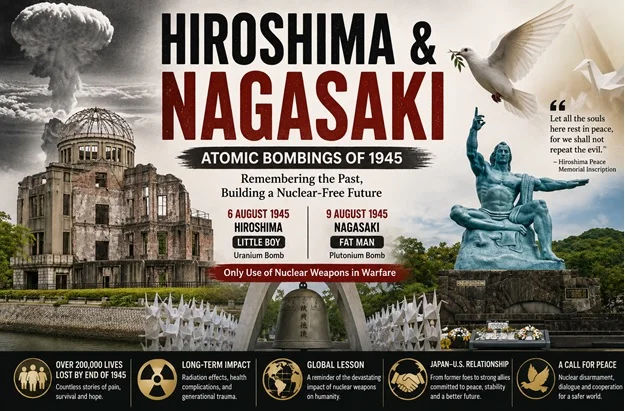
- On 6th August 1945, during the final stages of the Second World War, the United States dropped an atomic bomb, nicknamed "Little Boy," on the Japanese city of Hiroshima.
- The blast destroyed the city almost instantly and is estimated to have killed around 140,000 people by the end of that year, through the explosion itself, the resulting fires, and radiation exposure.
- Three days later, on 9th August 1945, a second atomic bomb, "Fat Man," was dropped on the city of Nagasaki, killing approximately 70,000 people.
- Japan announced its surrender on 15th August 1945, formally ending the Second World War and Japan's decades-long campaign of military expansion in Asia.
How Do Atomic Bombs Work?
- Atomic bombs release energy through nuclear fission, a process in which the nucleus of a heavy atom, such as uranium or plutonium, is split apart, releasing an enormous burst of energy in a fraction of a second.
- This produces an intense blast wave, extreme heat capable of igniting fires across a wide area, and lethal radiation that continues to harm survivors long after the initial explosion.
- Unlike conventional bombs, atomic weapons cause damage at a scale that engulfs entire cities within moments, followed by long-term health effects such as radiation sickness, cancers, and genetic damage that affect survivors and, in some cases, their descendants.
Why Was the Decision to Bomb Japan Taken?
- The United States sought to bring a swift end to the Second World War and avoid what military planners projected could be a costly land invasion of Japan.
- American leaders believed a decisive show of force would compel Japan's unconditional surrender without prolonging the war further.
- The bombings were also viewed by some historians as a demonstration of American military power to the Soviet Union, amid the emerging tensions of the Cold War.
Human and Long-Term Impact
- Beyond the immediate death toll, tens of thousands more died in the following months and years from burns, radiation sickness, and related illnesses.
- Survivors, known as hibakusha, faced lifelong health complications, including elevated risks of cancer, alongside social stigma and discrimination in Japanese society.
- Many Korean forced labourers present in the two cities at the time were also among the victims, a fact that historians say has often been overlooked in mainstream accounts of the bombings.
- Today, Hiroshima has been rebuilt into a thriving city of over 1.1 million people, home to the Hiroshima Peace Memorial Museum and the Atomic Bomb Dome, a UNESCO World Heritage Site preserved in its ruined state as a permanent reminder of the destructive power of nuclear weapons.
Recent Developments and Global Steps
Several notable developments have kept the issue of nuclear disarmament in focus over the past couple of years:
- In May 2023, G7 leaders visited the Hiroshima Peace Memorial Museum and laid wreaths at the cenotaph during the G7 Summit held in Hiroshima, a symbolic step that brought several nuclear-armed and allied nations face to face with the bombing's legacy.
- In October 2024, Nihon Hidankyo, the Japan Confederation of A- and H-Bomb Sufferers Organizations, was awarded the Nobel Peace Prize for its decades of advocacy for nuclear abolition and for preserving hibakusha testimony. The award drew renewed global attention to survivor voices.
- In December 2025, 117 Japanese lawmakers expressed support for Japan signing and ratifying the Treaty on the Prohibition of Nuclear Weapons (TPNW), in a survey conducted by Nihon Hidankyo, though Japan has still not signed the treaty.
- In February 2026, Japanese Prime Minister Sanae Takaichi affirmed that her government would continue to uphold Japan's three non-nuclear principles, which prohibit producing, possessing, or hosting nuclear weapons, rejecting the idea of a nuclear-sharing arrangement with the United States similar to NATO's.
- In June 2026, Nihon Hidankyo held its general meeting in Tokyo, attended by hibakusha from 30 of Japan's 47 prefectures, and decided it will vote on the organisation's future at its 2027 meeting, as its ageing membership shrinks.
- The Eleventh Review Conference of the Nuclear Non-Proliferation Treaty (NPT) is scheduled for 2026, with Japan submitting a national report on its disarmament commitments and hibakusha representatives, including Nihon Hidankyo members, addressing preparatory meetings in New York to press for the elimination of nuclear weapons.
Why Does This Anniversary Still Matter Today?
- More than 12,000 nuclear warheads are estimated to remain in the world's arsenals, keeping the risk of nuclear conflict a live global concern.
- Geopolitical tensions between nuclear-armed states have grown in recent years, with several arms control agreements weakening or lapsing.
- The generation of hibakusha who can give first hand testimony is rapidly diminishing, making the preservation of their accounts through museums, digital archives, and education increasingly urgent.
- The anniversary renews global calls for disarmament and serves as a reminder of the human cost of nuclear warfare, reinforcing support for treaties aimed at nuclear non-proliferation.
Japan–United States Relations
- Following the atomic bombings and Japan's surrender in 1945, the United States occupied Japan (1945–1952) under General Douglas MacArthur, introducing democratic reforms and a new Constitution. Today, Japan and the U.S. share one of the world's strongest strategic alliances under the 1960 Treaty of Mutual Cooperation and Security.
- The U.S. maintains military bases in Japan, while both countries cooperate on defence, trade, technology, and Indo-Pacific security. Despite the tragic legacy of Hiroshima and Nagasaki, the two nations have transformed from wartime adversaries into close allies committed to regional stability and a free, open Indo-Pacific.
Way Forward
- Strengthen global arms-control agreements.
- Promote universal nuclear disarmament.
- Enhance confidence-building measures among nuclear states.
- Increase awareness of the humanitarian impact of nuclear weapons.
- Encourage peaceful dialogue and international cooperation.
Prelims MCQ
Q. With reference to the atomic bombings during World War II, consider the following statements:
- The bomb dropped on Hiroshima was called Little Boy.
- The bomb dropped on Nagasaki was a plutonium bomb known as Fat Man.
- Hiroshima and Nagasaki remain the only cities where nuclear weapons have been used in warfare.
Which of the statements given above is/are correct?
A. 1 only
B. 1 and 2 only
C. 2 and 3 only
D. 1, 2 and 3
Mains Practice Question
Q. The Hiroshima and Nagasaki bombings continue to shape the global discourse on nuclear deterrence and disarmament. Discuss their significance in the contemporary international security architecture
|
FAQs
Why Hiroshima and Nagasaki are remembered every year?
To honour the victims and reinforce global commitments to peace, nuclear disarmament, and the prevention of future nuclear warfare.
What is the meaning of Hibakusha?
Survivors of the Hiroshima and Nagasaki atomic bombings.
Why are these bombings historically significant?
They are the only wartime use of nuclear weapons in history.
Which treaty is the cornerstone of nuclear non-proliferation?
The NPT (1968).
What is India's nuclear doctrine?
Credible Minimum Deterrence and No First Use (NFU).
|






 Contact Us
  New Batch : 9555124124/ 7428085757
  Tech Support : 9555124124/ 7428085757