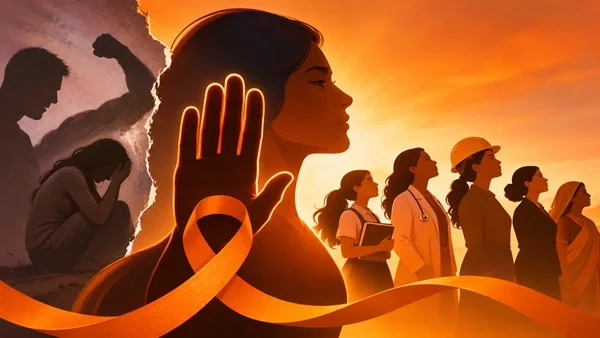
Why in news?
The International Day for the Elimination of Violence against Women is observed every year on 25 November to raise awareness about gender-based violence and promote women's safety and dignity.
Key Facts
|
Particular
|
Details
|
|
Official Name
|
International Day for the Elimination of Violence against Women
|
|
Observed On
|
25 November
|
|
Established By
|
United Nations General Assembly
|
|
Resolution
|
54/134
|
|
Resolution Adoption
|
17 December 1999
|
|
First Official Observance
|
2000
|
|
Historical Inspiration
|
Assassination of the Mirabal Sisters
|
|
Country
|
Dominican Republic
|
|
2026 Theme
|
Ensure Justice, Protect Survivors, End Impunity
|
|
Global Campaign
|
UNiTE to End Violence against Women and Girls
|
|
Related Campaign
|
16 Days of Activism
|
|
Campaign Period
|
25 November-10 December
|
|
Major Organisation
|
UN Women
|
|
Related SDG
|
SDG 5 (Gender Equality)
|
What is the International Day for the Elimination of Violence against Women?
- It is a United Nations observance dedicated to eliminating all forms of violence against women and girls.
- It recognises violence against women as a violation of human rights and a major obstacle to gender equality.
- It covers physical, sexual, psychological and economic violence occurring in both public and private spaces.
- The day encourages governments, international organisations and civil society to strengthen laws, improve protection mechanisms and ensure justice for survivors.
- It also promotes women's freedom to participate in education, employment, politics and public life without fear of violence.
Historical Background: Why is 25 November Observed?
- The day commemorates the Mirabal Sisters of the Dominican Republic: Patria, Minerva and María Teresa.
- They were political activists who opposed the dictatorship of Rafael Leónidas Trujillo.
- They were popularly known as Las Mariposas, meaning The Butterflies.
- On 25 November 1960, the three sisters were assassinated by agents of the Trujillo regime.
- Their deaths became a symbol of resistance against oppression, injustice and violence.
- In 1981, women's rights activists in Latin America formally began observing 25 November as a day against gender-based violence.
- In 1993, the UN adopted the Declaration on the Elimination of Violence against Women through Resolution 48/104.
- On 17 December 1999, the UN General Assembly adopted Resolution 54/134, officially designating 25 November as the International Day for the Elimination of Violence against Women.
- The first official UN observance took place in 2000.
Important Timeline
|
Year
|
Major Development
|
|
1960
|
Assassination of the Mirabal Sisters
|
|
1981
|
Women's rights activists began observing 25 November
|
|
1979
|
Adoption of CEDAW
|
|
1993
|
UN Declaration on the Elimination of Violence against Women
|
|
1999
|
UNGA Resolution 54/134 adopted
|
|
2000
|
First official observance
|
|
2008
|
Launch of UNiTE campaign
|
|
2017
|
Launch of EU-UN Spotlight Initiative
|
|
2026
|
Campaign focuses on justice, survivor protection and accountability
|
What is Violence against Women?
- According to the UN, violence against women refers to gender-based acts that cause or are likely to cause physical, sexual or psychological harm or suffering.
- It includes threats, coercion and arbitrary deprivation of liberty.
- Such violence can occur within families, workplaces, educational institutions, public spaces and digital platforms.
Major Forms of Violence against Women
- Physical Violence: Beating, assault, burning and other acts causing bodily injury.
- Sexual Violence: Rape, sexual assault, forced sexual acts and sexual exploitation.
- Psychological Violence: Threats, humiliation, intimidation, emotional abuse and controlling behaviour.
- Economic Violence: Restricting access to money, employment, financial resources and economic independence.
- Domestic Violence: Physical, sexual, verbal, emotional or economic abuse within domestic relationships.
- Workplace Harassment: Unwelcome sexual advances, demands for sexual favours and sexually coloured remarks.
- Human Trafficking: Exploitation of women and girls through forced labour, sexual exploitation and other prohibited practices.
- Technology-Facilitated Violence: Cyberstalking, online harassment, deepfake abuse, blackmail and non-consensual sharing of intimate images.
Global Statistics on Violence against Women
- According to WHO, approximately 840 million women and girls have experienced partner or sexual violence during their lifetime.
- Around 316 million women aged 15 years and above experienced physical or sexual intimate partner violence in the previous 12 months, according to estimates published in November 2025.
- Approximately 25.8% of ever-partnered women aged 15–49 have experienced physical or sexual violence by an intimate partner.
- Adolescent girls are also vulnerable, making early prevention, education and support essential.
- Underreporting remains a major challenge because of social stigma, fear, financial dependence and inadequate access to justice.
|
Indicator
|
Global Estimate
|
|
Women and girls affected during lifetime
|
840 million
|
|
Global prevalence
|
Approximately 1 in 3
|
|
Women affected by intimate partner violence in the previous year
|
316 million
|
|
Ever-partnered women aged 15–49 affected during lifetime
|
25.8%
|
International Frameworks for Eliminating Violence against Women
1. CEDAW, 1979
- Convention on the Elimination of All Forms of Discrimination against Women.
- Adopted by the UN General Assembly on 18 December 1979.
- Often described as the international bill of rights for women.
- Seeks to eliminate discrimination in political, economic, social and cultural life.
- India ratified it in 1993, subject to certain declarations and reservations.
2. UN Declaration, 1993
- Adopted through Resolution 48/104.
- Recognises violence against women as a violation of human rights.
- Calls upon states to prevent violence, investigate incidents and provide remedies to survivors.
3. Beijing Declaration and Platform for Action, 1995
- Adopted during the Fourth World Conference on Women in Beijing.
- Identified 12 critical areas of concern for women's advancement.
- Recognised violence against women as a major obstacle to gender equality.
4. UNiTE Campaign, 2008
- Launched by the UN Secretary-General.
- Mobilises governments, civil society and citizens to eliminate gender-based violence.
- Promotes awareness, prevention, accountability and survivor support.
5. Spotlight Initiative, 2017
- A partnership between the European Union and the United Nations.
- Aims to eliminate violence against women and girls.
- Focuses on legal reforms, institutional strengthening and changing harmful social norms.
Important dates:
|
Date
|
Observance
|
|
25 November
|
International Day for the Elimination of Violence against Women
|
|
1 December
|
World AIDS Day
|
|
3 December
|
International Day of Persons with Disabilities
|
|
6 December
|
Anniversary of the Montreal Massacre
|
|
10 December
|
Human Rights Day
|
Violence against Women in India: Major Concerns
- Domestic Violence: Physical, sexual, emotional and economic abuse within domestic relationships.
- Dowry-related Violence: Harassment, cruelty and deaths associated with dowry demands.
- Sexual Violence: Rape, sexual assault and exploitation.
- Workplace Harassment: Unsafe working environments and sexual harassment.
- Cybercrime: Online stalking, impersonation, blackmail and deepfake-based abuse.
- Human Trafficking: Exploitation of women and girls for forced labour and sexual exploitation.
- Child Marriage: Early marriage restricts girls' education, health and independence.
- Underreporting: Social stigma, fear of retaliation and financial dependence discourage reporting.
Important Indian Statistics
According to NFHS-5 (2019–21):
|
Indicator
|
Percentage
|
|
Ever-married women aged 18–49 who experienced spousal violence
|
29.3%
|
|
Corresponding figure under NFHS-4
|
31.2%
|
|
Women experiencing physical violence during pregnancy
|
3.1%
|
Constitutional Provisions for Women's Protection in India
|
Article
|
Provision
|
|
Article 14
|
Equality before law
|
|
Article 15(1)
|
Prohibition of discrimination on grounds including sex
|
|
Article 15(3)
|
Special provisions for women and children
|
|
Article 16
|
Equality of opportunity in public employment
|
|
Article 21
|
Protection of life and personal liberty
|
|
Article 23
|
Prohibition of human trafficking and forced labour
|
|
Article 39(a)
|
Adequate means of livelihood
|
|
Article 39(d)
|
Equal pay for equal work
|
|
Article 42
|
Humane working conditions and maternity relief
|
|
Article 51A(e)
|
Duty to renounce practices derogatory to women's dignity
|
Major Laws for Women's Protection in India
|
Legislation
|
Year
|
Main Objective
|
|
Dowry Prohibition Act
|
1961
|
Prohibits giving and taking dowry
|
|
Indecent Representation of Women Act
|
1986
|
Prohibits specified indecent representations
|
|
Commission of Sati (Prevention) Act
|
1987
|
Prevents sati and its glorification
|
|
Protection of Women from Domestic Violence Act
|
2005
|
Provides protection against domestic abuse
|
|
Prohibition of Child Marriage Act
|
2006
|
Prohibits child marriage
|
|
POSH Act
|
2013
|
Addresses workplace sexual harassment
|
|
Criminal Law Amendment Act
|
2013
|
Strengthened laws relating to sexual offences
|
|
Bharatiya Nyaya Sanhita
|
2023
|
Contains provisions relating to sexual offences and cruelty
|
Important Legal Provisions
- Domestic Violence Act, 2005: Provides protection orders, residence orders, monetary relief, custody orders and compensation.
- POSH Act, 2013: Provides mechanisms to prevent and address sexual harassment at workplaces through Internal Committees and Local Committees.
- Dowry Prohibition Act, 1961: Prohibits giving, taking and demanding dowry.
- Bharatiya Nyaya Sanhita, 2023: Replaced the Indian Penal Code from 1 July 2024 and includes provisions addressing rape, sexual harassment, stalking, dowry death and cruelty.
Government Initiatives for Women's Safety
1. Mission Shakti
- An umbrella scheme of the Ministry of Women and Child Development.
- Aims to strengthen women's safety, security and empowerment.
- Has two components: Sambal and Samarthya.
|
Component
|
Objective
|
Major Schemes
|
|
Sambal
|
Safety and security
|
One Stop Centres, Women Helpline, BBBP, Nari Adalat
|
|
Samarthya
|
Women's empowerment
|
Shakti Sadan, Sakhi Niwas, PMMVY, Palna
|
2. One Stop Centre Scheme (Sakhi Centres)
- Launched in 2015.
- Provides medical assistance, police support, legal aid, counselling and temporary shelter under one roof.
- As of June 2026, 1,033 centres had been approved and 985 were operational, assisting more than 15.20 lakh women since inception.
3. Beti Bachao Beti Padhao
- Launched on 22 January 2015.
- Aims to address gender-biased sex selection and promote the survival, protection and education of girls.
- Implemented through the Ministry of Women and Child Development, Ministry of Health and Family Welfare, and Ministry of Education.
4. Nari Adalat
- A component of Mission Shakti.
- Provides a grassroots platform for grievance redressal and mediation at the Gram Panchayat level.
5. SHe-Box Portal
- An online complaint-management platform for sexual harassment at workplaces.
- Facilitates submission and monitoring of complaints through the appropriate Internal or Local Committee.
6. National Commission for Women (NCW)
- Established in January 1992 under the National Commission for Women Act, 1990.
- A statutory body that examines complaints, reviews safeguards and recommends legal reforms.
Significance
- Human Rights: Protects women's dignity, equality and personal liberty.
- Gender Equality: Promotes equal opportunities and participation.
- Social Justice: Challenges discriminatory practices and unequal power structures.
- Economic Development: Enables women to participate fully in the workforce.
- Sustainable Development: Supports SDG 5 and SDG 16.
- Social Transformation: Encourages a society based on safety, respect and equal rights.
Major Challenges
- Patriarchal Mindset: Gender stereotypes and unequal power relations normalise discrimination.
- Social Stigma: Victim-blaming and fear of social exclusion discourage reporting.
- Delayed Justice: Delays in investigation and prosecution weaken confidence in institutions.
- Economic Dependence: Financial insecurity can prevent women from leaving abusive situations.
- Digital Violence: Deepfakes, cyberstalking and online harassment create emerging threats.
- Implementation Gap: Laws may exist but enforcement and awareness remain inadequate.
Prelims MCQ
Q. With reference to the International Day for the Elimination of Violence against Women, consider the following statements:
- It is observed on 25 November.
- It was designated through UNGA Resolution 54/134.
- Its date is associated with the assassination of the Mirabal Sisters.
- The 16 Days of Activism concludes on International Human Rights Day.
Which of the statements given above are correct?
(a) 1 and 2 only
(b) 1, 2 and 3 only
(c) 1, 3 and 4 only
(d) 1, 2, 3 and 4
Mains Practice Question
Q. Discuss the role of constitutional provisions, legal frameworks and government initiatives in addressing this issue in India.
|
FAQs
When is the International Day for the Elimination of Violence against Women observed?
25 November.
Which UN resolution established this day?
UN General Assembly Resolution 54/134.
Who were the Mirabal Sisters?
Patria, Minerva and María Teresa Mirabal, political activists from the Dominican Republic.
What is the 2026 theme?
Ensure Justice, Protect Survivors, End Impunity.
What does orange symbolise?
A brighter future free from violence against women and girls.
|