Prelims: Chemical Contamination, Bromate, Polycyclic Aromatic Hydrocarbons (PAHs), Food Safety and Standards Authority of India (FSSAI), BIS, Packaged Drinking Water Standards.
Mains: GS Paper II: Statutory, Regulatory and Quasi-Judicial Bodies; Government Policies and Interventions; Consumer Protection.
GS Paper III: Science and Technology, Public Health, Food Processing Industry and Environmental Pollution. |
Why in news?
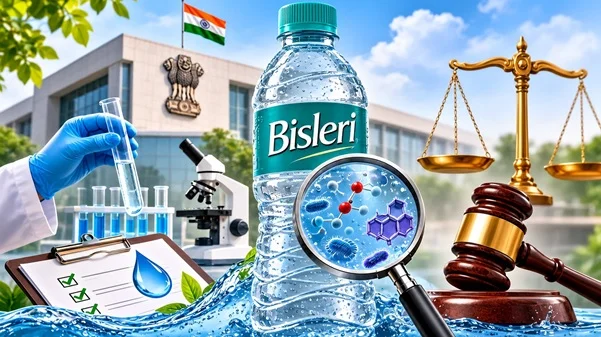
- On November 22, 2026, the Food Safety and Standards Authority of India (FSSAI) sanctioned prosecution against Bisleri International Pvt. Ltd. after a regulatory sample of its packaged drinking water was declared unsafe.
Key Facts
|
Aspect
|
Details
|
|
Company
|
Bisleri International Pvt. Ltd.
|
|
Regulatory authority
|
FSSAI
|
|
Product category
|
Packaged Drinking Water (other than Mineral Water)
|
|
Sample collection
|
September 30, 2025, according to the company
|
|
Manufacturing location
|
Goa
|
|
Initial concern
|
Bromate above the prescribed limit
|
|
Bromate level reported by company
|
12 µg/L
|
|
Prescribed bromate limit
|
10 µg/L
|
|
Subsequent laboratory finding
|
Detection of PAHs
|
|
Prosecution sanction
|
November 22, 2026
|
|
Company's response
|
November 23, 2026
|
|
Further action
|
Wider testing of packaged drinking water brands
|
What happened in the Bisleri Case?
- The controversy concerns a regulatory sample of packaged drinking water collected from Bisleri International's premises in Goa.
- According to the company's account, six samples were collected on September 30, 2025. Five samples reportedly complied with the applicable standards, while one sample recorded a bromate concentration of 12 micrograms per litre (µg/L), exceeding the prescribed limit of 10 µg/L.
- The company challenged the initial findings through an appeal. Subsequently, the sample was examined by a Referral Food Laboratory.
- According to FSSAI, the referral laboratory also declared the sample unsafe due to the detection of Polycyclic Aromatic Hydrocarbons (PAHs).
- Based on the laboratory findings, FSSAI sanctioned prosecution against Bisleri International under the Food Safety and Standards Act, 2006.
- The company, however, disputed the findings and cited independent testing that reportedly found bromate levels within permissible limits. It also questioned the communication and handling of the matter.
What is Bromate and how does it enter Drinking Water?
- Bromate is an inorganic chemical ion represented by the formula BrO₃⁻.
- It can form during certain ozone-based drinking-water treatment processes when ozone reacts with naturally occurring bromide ions present in source water.
Mechanism of Bromate Formation
- Presence of Bromide: Some groundwater and surface-water sources naturally contain bromide ions (Br⁻).
- Ozonation: Ozone (O₃) is introduced during water treatment to disinfect water and control microorganisms.
- Oxidation: Under certain conditions, ozone-related oxidation reactions convert bromide into bromate.
- Contamination Concern: If bromate concentrations exceed prescribed limits, the treated water may become unsafe for consumption.
Why is Bromate Harmful?
- Bromate is recognised as a potential human carcinogen.
- Long-term exposure to elevated concentrations is associated with health concerns, particularly involving the kidneys.
- Experimental studies have reported adverse effects in animals, including kidney and thyroid-related effects.
Important Facts
|
Parameter
|
Details
|
|
Chemical name
|
Bromate
|
|
Formula
|
BrO₃⁻
|
|
Possible source
|
Ozone-based water treatment
|
|
Precursor
|
Bromide
|
|
WHO guideline value
|
0.01 mg/L (10 µg/L)
|
|
Major concern
|
Potential carcinogenic effects
|
What are Polycyclic Aromatic Hydrocarbons (PAHs)?
- Polycyclic Aromatic Hydrocarbons (PAHs) are a group of organic chemical compounds containing two or more fused aromatic rings made up of carbon and hydrogen atoms.
- They are commonly generated during the incomplete combustion of organic materials.
- Major Sources of PAHs are Incomplete combustion of coal, petroleum and wood, Industrial emissions, Vehicle exhaust, Forest fires and Certain industrial and manufacturing processes.
- PAHs can enter the environment through air, soil and water contamination.
Why are PAHs Dangerous?
- Increased cancer risk following prolonged exposure to certain PAHs.
- DNA damage and genotoxic effects.
- Mutagenic effects in some compounds.
- Adverse effects on human health following sustained exposure.
- In the Bisleri case, the Referral Food Laboratory reportedly detected PAHs in the regulatory sample and declared it unsafe.
- The detection of PAHs is particularly important because it represents a separate chemical safety concern from the initial bromate finding.
Bromate vs PAHs: Key Differences
|
Basis
|
Bromate
|
PAHs
|
|
Nature
|
Inorganic ion
|
Group of organic compounds
|
|
Chemical composition
|
Bromine and oxygen
|
Carbon and hydrogen
|
|
Formation
|
Certain ozone-based water treatment reactions
|
Incomplete combustion of organic materials
|
|
Major concern
|
Potential carcinogenicity
|
Some compounds are carcinogenic and mutagenic
|
|
Relevance to case
|
Initial laboratory concern
|
Referral laboratory finding
|
Bisleri's Response to FSSAI's Findings
- Six samples were collected from its Goa manufacturing facility on September 30, 2025.
- According to the company, five samples complied with the prescribed standards.
- The sixth sample recorded bromate at 12 µg/L against the permissible limit of 10 µg/L.
- Bisleri challenged the initial findings on November 22, 2025.
- The company said subsequent testing found bromate within the permissible limit.
- It also stated that it had commissioned independent testing at an FSSAI-approved laboratory.
- According to Bisleri, the independent test results were submitted to FSSAI's Western Regional Office through a letter dated February 2, 2026.
- The company said it had not received further communication and had understood that the matter was closed.
- Bisleri also stated that it follows a 10-step manufacturing process involving more than 90 quality checks.
- The company reiterated its willingness to cooperate with FSSAI and address the issue through the appropriate regulatory process.
What does Sanction for Prosecution mean?
- FSSAI's decision to sanction prosecution is an important regulatory development, but it does not mean that the company has already been convicted.
- Under the Food Safety and Standards Act, 2006, unsafe food and related violations can attract legal action.
- The prosecution process involves taking the matter before the competent judicial authority, where the evidence and the company's defence can be examined.
|
Term
|
Meaning
|
|
Investigation
|
Examination of a suspected violation
|
|
Laboratory Analysis
|
Scientific testing of food samples
|
|
Referral Laboratory
|
Laboratory used for further examination under the prescribed procedure
|
|
Sanction for Prosecution
|
Approval to initiate prosecution
|
|
Prosecution
|
Legal proceedings against the alleged offender
|
|
Conviction
|
Judicial determination of guilt
|
Food Safety and Standards Act, 2006
- Ensure the availability of safe and wholesome food.
- Establish science-based food standards.
- Regulate food manufacturing, storage, distribution, sale and import.
- Protect consumers from unsafe, substandard and adulterated food.
- Strengthen food testing, inspection and enforcement.
Important Provisions
|
Section
|
Subject
|
|
Section 16
|
Duties and functions of FSSAI
|
|
Section 26
|
Responsibilities of Food Business Operators
|
|
Section 31
|
Licensing and registration of food businesses
|
|
Section 38
|
Powers of Food Safety Officers
|
|
Section 47
|
Sampling and analysis
|
|
Section 59
|
Punishment for unsafe food
|
Section 59: Punishment for Unsafe Food
|
Consequence
|
Maximum imprisonment
|
Fine
|
|
No injury
|
3 months
|
₹3 lakh
|
|
Non-grievous injury
|
1 year
|
₹3 lakh
|
|
Grievous injury
|
6 years
|
₹5 lakh
|
|
Death
|
7 years to life imprisonment
|
Minimum ₹10 lakh
|
FSSAI: India's Food Safety Regulator
- The Food Safety and Standards Authority of India is a statutory authority established under the Food Safety and Standards Act, 2006.
- Administrative Ministry: Ministry of Health and Family Welfare.
- Headquarters: New Delhi.
- Major Functions are:
- Formulating science-based food standards.
- Regulating food manufacturing and distribution.
- Granting licences and registrations to Food Business Operators.
- Monitoring food quality through sampling and testing.
- Coordinating with State Food Safety Authorities.
- Creating awareness about food safety.
- Taking enforcement action against violations.
Institutional Structure
|
Institution
|
Major Role
|
|
FSSAI
|
National food safety regulator
|
|
Scientific Panels
|
Provide scientific expertise
|
|
Scientific Committee
|
Coordinates scientific opinions
|
|
Central Advisory Committee
|
Facilitates coordination between stakeholders
|
|
State Food Safety Authorities
|
Enforce food safety regulations at the state level
|
|
Food Safety Officers
|
Conduct inspections and collect samples
|
New FSSAI Testing Scheme for Packaged Drinking Water
- The Bisleri case comes at a time when India's regulatory framework for packaged drinking water is undergoing an important change.
- On October 17, 2024, the requirement for mandatory BIS Certification Mark for packaged drinking water and mineral water was removed through an amendment to the Food Safety and Standards (Prohibition and Restriction on Sales) Regulations, 2011.
- Subsequently, FSSAI issued a Scheme of Testing for Packaged Drinking Water and Mineral Water on December 17, 2025.
- The new scheme became effective from January 1, 2026.
Key Areas of Testing
|
Testing Category
|
Purpose
|
|
Microbiological Parameters
|
Detect bacterial and other microbial contamination
|
|
Chemical Parameters
|
Identify harmful chemical substances and metals
|
|
Pesticide Residues
|
Detect pesticide contamination
|
|
Source Water Testing
|
Assess the quality of raw water
|
|
Packaging Compliance
|
Ensure the safety of packaging materials
|
Why is FSSAI expanding testing to other packaged water brands?
- Following the Bisleri findings, reports indicated that FSSAI planned to widen its testing exercise to include additional Bisleri samples as well as samples from other packaged drinking water brands.
- The move is significant because the packaged drinking water industry includes national brands, regional manufacturers and smaller local producers.
- Major Objectives
- Industry-wide Surveillance: Check compliance across different packaged drinking water manufacturers.
- Chemical Safety: Identify contaminants such as bromate and other harmful chemical substances.
- Microbiological Safety: Detect bacteria and other microorganisms.
- Manufacturing Compliance: Review quality-control practices at production facilities.
- Consumer Protection: Ensure that products available in the market meet prescribed safety standards.
Similar Cases of Contaminated Packaged Drinking Water
A. MUJI Bottled Water – Hong Kong, 2019
- In 2019, Hong Kong's Centre for Food Safety reported that certain imported MUJI bottled water products from Japan contained bromate above the prescribed limit.
- The affected products included specific Natural Mineral Water and Sparkling Water variants.
- The retailer initiated precautionary withdrawal measures for the affected products.
B. Amana Bottled Water – Saudi Arabia, 2021
- The Saudi Food and Drug Authority reported excessive bromate levels in Amana bottled drinking water.
- Consumers were advised not to consume the affected product, and withdrawal measures were undertaken.
C. New Amruth Aqua – India, 2023
- The Bureau of Indian Standards issued a product recall alert concerning a packaged drinking water product marketed under the New Amruth Aqua brand.
- The product was found to contain Pseudomonas aeruginosa, a bacterium that can cause infections, particularly among vulnerable individuals.
D. BIS Surveillance in Haryana – 2021
- BIS conducted market and factory surveillance of packaged drinking water manufacturers in Haryana.
- Some samples showed microbiological and quality-related non-compliance, including the presence of undesirable microorganisms.
Why is the Bisleri Case important for India?
- Public Health Protection: Drinking water is directly linked to human health. Chemical and microbial contamination can create serious risks, making continuous monitoring essential.
- Consumer Confidence: Consumers generally associate packaged water with safety and quality. Regulatory action helps strengthen accountability and transparency.
- Corporate Responsibility: Food Business Operators must ensure that every stage of production, treatment, packaging and distribution complies with prescribed standards.
- Strengthening Regulatory Governance: The case highlights the need for stronger laboratory infrastructure, regular inspections and effective enforcement.
- Industry-wide Quality Control: Wider testing can help identify weaknesses across the industry and encourage manufacturers to strengthen their internal quality systems.
Challenges in Ensuring Safe Packaged Drinking Water
- Laboratory Infrastructure: Uneven availability of advanced food-testing laboratories.
- Chemical Contamination: Difficulty in detecting certain contaminants without specialised equipment.
- Microbiological Risks: Possibility of contamination during treatment, bottling or storage.
- Regulatory Monitoring: Need for regular inspection of large and small manufacturers.
- Traceability: Difficulty in tracking affected batches across distribution networks.
- Consumer Awareness: Limited understanding of water-quality parameters and product labels.
- Enforcement: Need for timely action and transparent communication of laboratory findings.
Prelims MCQ
Q. With reference to the Food Safety and Standards Authority of India (FSSAI), consider the following statements:
- FSSAI was established under the Food Safety and Standards Act, 2006.
- Bromate can form during certain ozone-based drinking-water treatment processes.
- PAHs are a group of inorganic chemical compounds.
- Section 59 of the Food Safety and Standards Act deals with punishment for unsafe food.
Which of the statements given above are correct?
(a) 1 and 2 only
(b) 1, 2 and 4 only
(c) 2, 3 and 4 only
(d) All four
Mains Practice Question
Q. In light of the recent FSSAI action against Bisleri International, examine the challenges associated with ensuring the safety and quality of packaged drinking water.
|
FAQs
Why has FSSAI sanctioned prosecution against Bisleri?
FSSAI stated that a regulatory sample of Bisleri's packaged drinking water failed the prescribed bromate limit and was subsequently declared unsafe by a Referral Food Laboratory after PAHs were detected.
What is the permissible bromate limit in drinking water under WHO guidelines?
The WHO guideline value is 10 micrograms per litre (µg/L).
What is the Food Safety and Standards Act, 2006?
It is the principal legislation governing food safety in India and provides the legal framework for FSSAI.
What is the significance of Section 59?
Section 59 prescribes penalties for offences relating to unsafe food.
When did the new FSSAI Testing Scheme for packaged drinking water become effective?
January 1, 2026.
|