Why in news?
Lachit Divas is observed every year on 24 November in Assam to commemorate the birth anniversary of Lachit Borphukan, the legendary military commander of the Ahom Kingdom.
Key Facts
|
Particular
|
Details
|
|
Observance
|
Lachit Divas
|
|
Date
|
24 November
|
|
State
|
Assam
|
|
Commemorates
|
Birth anniversary of Lachit Borphukan
|
|
Birth Date
|
24 November 1622
|
|
Birthplace
|
Charaideo, Assam
|
|
Father
|
Momai Tamuli Borbarua
|
|
Kingdom
|
Ahom Kingdom
|
|
Ruler during Saraighat
|
Swargadeo Chakradhwaj Singha
|
|
Mughal Emperor
|
Aurangzeb
|
|
Mughal Commander
|
Raja Ram Singh I
|
|
Famous Battle
|
Battle of Saraighat, 1671
|
|
Associated River
|
Brahmaputra
|
|
Major Achievement
|
Defence of Assam against Mughal expansion
|
|
Death
|
25 April 1672
|
|
National Recognition
|
Lachit Borphukan Gold Medal at NDA
|
Who was Lachit Borphukan?
- Lachit Borphukan was a prominent military commander of the Ahom Kingdom, which ruled large parts of present-day Assam for nearly six centuries.
- He was born on 24 November 1622 at Charaideo in Assam.
- He was the youngest son of Momai Tamuli Borbarua, an important administrator and military official under Ahom ruler Pratap Singha.
- He received education in humanities, religious scriptures, economics and military strategies.
- He developed expertise in military administration, battlefield planning and leadership.
- Before becoming the commander-in-chief, he held several important administrative and military positions, including Ghora Barua (superintendent of royal horses), commander of Simulgarh Fort and Dolakasharia Barua (superintendent of royal household guards).
- His military capabilities impressed Ahom ruler Chakradhwaj Singha, who appointed him as the commander of the Ahom forces.
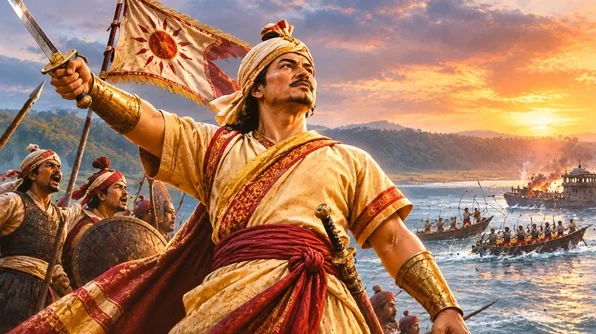
- He is remembered for his exceptional leadership during the Battle of Saraighat in 1671.
Understanding the Ahom Kingdom
- The Ahom Kingdom was established in 1228 by Sukaphaa, a Tai prince who entered the Brahmaputra Valley and established his rule in present-day Assam.
- The Ahoms developed a powerful political and military system that enabled them to govern the region for approximately 600 years.
- Their kingdom became an important regional power in northeastern India.
- The Ahoms successfully resisted several attempts by the Mughal Empire to extend its control over Assam.
- Their military strength was based on infantry, naval warfare, fortified positions, local knowledge and an organised administrative system.
Important Features of the Ahom Administration
1. Paik System
- The Paik system was the principal labour and military organisation of the Ahom Kingdom.
- Adult male subjects were organised into groups called paiks.
- They provided military service and contributed labour for public works, agriculture and other state requirements.
- This system helped the Ahom rulers mobilise manpower for administration and warfare.
2. Administrative Officials
- The Ahom administration had several important officials, including Borbarua and Borphukan.
- Borbarua exercised important administrative and military responsibilities in the eastern and central regions.
- Borphukan was responsible for the western territories and military administration.
3. Military Organisation
- The Ahom military included infantry, cavalry, elephants and a strong river-based naval force.
- The Brahmaputra and its tributaries played an important role in military operations.
- The army used local geographical knowledge, defensive positions and guerrilla tactics.
Historical Background: Mughal-Ahom Conflict
- The Mughal-Ahom conflict began in 1615 and continued intermittently for several decades.
- The Mughal Empire wanted to extend its influence over the Brahmaputra Valley because of its strategic location and economic importance.
- The Ahom Kingdom resisted Mughal expansion to protect its sovereignty and territorial control.
- The conflict intensified during the reign of Mughal Emperor Aurangzeb.
- In 1662, Mughal general Mir Jumla invaded Assam and occupied important Ahom territories, including the Ahom capital Garhgaon.
- The Ahom ruler Jayadhwaj Singha was forced to sign the Treaty of Ghilajharighat in 1663.
- The treaty imposed significant conditions on the Ahom Kingdom, including territorial concessions and the payment of indemnity.
- After the death of Jayadhwaj Singha, Chakradhwaj Singha became the Ahom ruler and decided to recover the lost territories.
- He appointed Lachit Borphukan to lead the military campaign against the Mughals.
- In 1667, Lachit Borphukan successfully led the Ahom forces in recovering Guwahati from Mughal control.
Important Timeline of Mughal-Ahom Conflict
|
Year
|
Major Development
|
|
1615
|
Beginning of major Mughal-Ahom hostilities
|
|
1662
|
Mir Jumla invaded Assam
|
|
1663
|
Treaty of Ghilajharighat signed
|
|
1663
|
Jayadhwaj Singha died; Chakradhwaj Singha succeeded him
|
|
1667
|
Lachit Borphukan recovered Guwahati
|
|
1669
|
Battle of Alaboi
|
|
1671
|
Battle of Saraighat; Ahom victory
|
|
1672
|
Death of Lachit Borphukan
|
Battle of Alaboi (1669): A Turning Point in the Mughal-Ahom Conflict
- The Battle of Alaboi was fought on approximately 5 August 1669 near present-day Dadara and Pacharia in Kamrup district of Assam.
- It was fought between the Ahom forces led by Lachit Borphukan and the Mughal army commanded by Raja Ram Singh I.
- The Mughal forces attempted to advance into Ahom territory after the recovery of Guwahati by the Ahoms in 1667.
- During the battle, the Mughal forces inflicted heavy casualties on the Ahom army.
- According to the Government of Assam's historical account, approximately 10,000 Ahom soldiers lost their lives.
- Despite the heavy losses, the Ahoms continued their resistance and prevented the Mughal forces from achieving their larger objective.
- The battle demonstrated the difficulties faced by the Mughals in conducting military operations in Assam's geographical conditions.
Battle of Saraighat (1671): The Greatest Military Achievement of Lachit Borphukan
- The Battle of Saraighat was fought in 1671 between the Ahom Kingdom and the Mughal Empire near Saraighat on the Brahmaputra River, close to present-day Guwahati.
- The Mughal forces were led by Raja Ram Singh I, a Rajput commander serving the Mughal emperor Aurangzeb.
- The Ahom forces were commanded by Lachit Borphukan under the rule of Swargadeo Chakradhwaj Singha.
- The Mughals wanted to regain Guwahati and expand their influence further into Assam.
- The Ahoms used their knowledge of the Brahmaputra, its river channels, surrounding hills and local terrain to counter the larger Mughal military force.
- The battle was predominantly a naval engagement, in which the Ahom forces used smaller and more manoeuvrable boats.
- Lachit Borphukan's leadership helped reorganise the Ahom forces and motivated soldiers to continue fighting despite difficult circumstances.
- The Ahom forces eventually defeated the Mughal army and prevented further Mughal expansion into the Brahmaputra Valley.
Military Strategies Used by Lachit Borphukan
1. Advantage of Geography
- Lachit used his detailed knowledge of the Brahmaputra River and surrounding geographical features.
- The narrow river passages and local waterways helped the Ahoms counter the larger Mughal forces.
- The Ahoms selected defensive positions that reduced the effectiveness of Mughal numerical superiority.
2. Naval Warfare
- The Battle of Saraighat was primarily fought on the Brahmaputra.
- The Ahom forces used smaller boats that were better suited to navigating local river conditions.
- Their manoeuvrability helped them conduct coordinated attacks against the larger Mughal vessels.
3. Guerrilla Warfare
- The Ahoms used surprise attacks, local routes and knowledge of the terrain.
- They avoided depending entirely on direct confrontation with the larger Mughal army.
- These tactics disrupted Mughal movements and created operational difficulties.
4. Intelligence and Planning
- The Ahom commanders used information about Mughal movements and geographical conditions.
- They combined defensive preparations with strategic attacks.
- Their military planning helped them exploit weaknesses in the opposing forces.
5. Leadership and Motivation
- Lachit Borphukan motivated his soldiers even when the Ahom army faced serious difficulties.
- His personal commitment to defending the kingdom became an important source of inspiration.
- His leadership during the final phase of the battle contributed to the Ahom victory.
The Famous Incident: Lachit Borphukan and His Maternal Uncle
- One of the most remembered episodes associated with Lachit Borphukan concerns his maternal uncle, who was responsible for supervising the construction of a defensive embankment before the Battle of Saraighat.
- When Lachit discovered that the work had not been completed properly despite its strategic importance, he became extremely angry.
- According to popular historical accounts, he executed his maternal uncle for negligence of duty.
- He is associated with the famous Assamese expression: "My uncle is not greater than my country."
- The incident is remembered as an example of his commitment to discipline, responsibility and the security of the kingdom.
- It reflects the principle that personal relationships should not come before public duty and national security.
Lachit Borphukan's Leadership during the Battle of Saraighat
- During the final stages of the Battle of Saraighat, the Ahom forces faced intense pressure from the advancing Mughal fleet.
- Lachit Borphukan was reportedly suffering from illness but refused to abandon his military responsibilities.
- He personally joined the naval engagement and motivated the Ahom soldiers.
- His presence encouraged the forces to reorganise and launch a determined counterattack.
- The Ahoms eventually defeated the Mughal forces, securing an important victory for the kingdom.
National Recognition of Lachit Borphukan
1. Lachit Borphukan Gold Medal at NDA
- The National Defence Academy instituted the Lachit Borphukan Gold Medal in 1999.
- It is awarded to the best cadet passing out from the academy.
- The award recognises military excellence, leadership, discipline and courage.
- It ensures that the legacy of Lachit Borphukan continues to inspire future military officers.
2. Statue of Valour
- A 125-foot bronze statue of Lachit Borphukan, known as the Statue of Valour, was inaugurated at Hollongapar in Jorhat, Assam, in March 2024.
- It was established to honour his military achievements and contribution to Assam's history.
- The monument has become an important symbol of Assam's historical heritage.
3. 400th Birth Anniversary Celebrations (2022)
- The year 2022 marked the 400th birth anniversary of Lachit Borphukan.
- The celebrations were inaugurated in Guwahati in February 2022 by the then President of India, Ram Nath Kovind.
- A year-long national commemoration was organised to highlight his contribution to Indian history.
- The celebrations concluded with a programme in New Delhi in November 2022.
Prelims MCQ
Q. With reference to Lachit Borphukan, consider the following statements:
- He was a military commander of the Ahom Kingdom.
- He led the Ahom forces during the Battle of Saraighat in 1671.
- The Battle of Saraighat was fought on the Brahmaputra River.
- The Lachit Borphukan Gold Medal is awarded at the Indian Military Academy.
Which of the statements given above are correct?
(a) 1 and 2 only
(b) 1, 2 and 3 only
(c) 2, 3 and 4 only
(d) 1, 2, 3 and 4
Mains Practice Question
Q. The Battle of Saraighat represents an important example of regional military resistance against Mughal expansion. Discuss.
|
FAQs
1. When is Lachit Divas observed?
24 November every year.
2. Who was Lachit Borphukan?
He was a prominent military commander of the Ahom Kingdom of Assam.
3. When was Lachit Borphukan born?
24 November 1622.
4. What was the Battle of Saraighat?
It was a major naval battle fought in 1671 between the Ahom Kingdom and the Mughal Empire on the Brahmaputra River.
5. Who led the Mughal army during the Battle of Saraighat?
Raja Ram Singh I.
|