BepiColombo at Mercury: The Science, Technology and Story Behind ESA's Mission

Prelims: Space Technology, Planetary Exploration, Mercury, European Space Agency (ESA), Japan Aerospace Exploration Agency (JAXA), Solar-Electric Propulsion, Gravitational Assist and Orbital Mechanics.
Mains: GS Paper III: Developments and their Applications and Effects in Everyday Life; Achievements of Indians in Science and Technology; Indigenisation of Technology and Developing New Technology; Space Technology and International Collaboration.

Why in news?

  • On 21 November 2026, the European-Japanese BepiColombo mission successfully achieved Mercury Orbit Insertion (MOI), marking a major milestone after an approximately eight-year journey.

Key Facts 

Aspect

Details

Mission Name

BepiColombo

Mission Type

Uncrewed planetary exploration mission

Target Planet

Mercury

Launch Date

20 October 2018

Launch Vehicle

Ariane 5

Launch Site

Europe's Spaceport, Kourou, French Guiana

Lead Agencies

ESA and JAXA

European Component

Mercury Planetary Orbiter (MPO)

Japanese Component

Mercury Magnetospheric Orbiter (Mio)

Transfer Component

Mercury Transfer Module (MTM)

Mission Objective

Study Mercury's surface, interior, magnetic field & magnetosphere

Orbit Insertion

21 November 2026

Technical Problem

Software glitch involving attitude guidance and thruster control

Thruster Burn

Approximately 37 minutes planned

Velocity Change Achieved

Approximately 77%

Actual Orbital Period

Approximately 75 hours

Planned Orbiter Separation

9 December 2026 (Germany); 10 December (Japan)

Expected Science operations

April 2027

Named After

Italian scientist Giuseppe (Bepi) Colombo

What is BepiColombo?

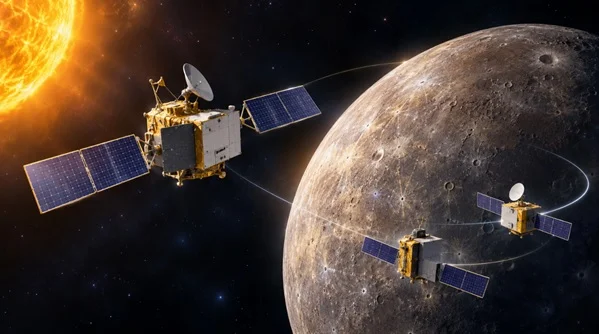
  • BepiColombo is a joint planetary exploration mission developed by the European Space Agency (ESA) and Japan Aerospace Exploration Agency (JAXA) to investigate Mercury, the innermost planet of the Solar System.
  • It is designed to deploy two dedicated scientific orbiters around Mercury to study different aspects of the planet simultaneously.
  • It is the first mission designed to place two spacecraft around Mercury at the same time.
  • The mission aims to understand Mercury's geological evolution, internal structure, magnetic field, surface composition and interaction with the solar wind.

Why is Mercury difficult to explore?

  • Proximity to the Sun: Mercury is located approximately 0.39 astronomical units (AU) from the Sun, exposing spacecraft to intense solar radiation and heat.
  • Strong Solar Gravity: A spacecraft travelling towards Mercury gains speed because of the Sun's gravitational attraction. It must reduce its velocity relative to Mercury to enter orbit.
  • Extreme Temperature Conditions: Mercury experiences extreme temperature variations because it has almost no substantial atmosphere to distribute heat.
  • Orbital Insertion Difficulty: Reaching Mercury is not enough; the spacecraft must slow down sufficiently to become gravitationally captured by the planet.
  • Fuel Constraints: Repeated trajectory corrections and braking manoeuvres must be carefully designed because spacecraft carry limited propellant.

Why was the BepiColombo Mission launched?

  • Understanding Planetary Formation: Mercury has a disproportionately large metallic core compared with its overall size. Studying it can help scientists understand how rocky planets formed.
  • Investigating Magnetic Fields: Mercury possesses a global magnetic field despite its relatively small size. Studying this field can provide information about its internal structure.
  • Exploring Surface Composition: The mission will investigate the minerals, chemical composition and geological features present on Mercury.
  • Studying Water Ice: Scientists have found evidence of water ice in permanently shadowed polar craters.
  • Understanding Solar Wind Interaction: Mercury is directly exposed to the solar wind because it lacks a substantial atmosphere and has a relatively small magnetosphere.
  • International Scientific Cooperation: The mission brings together European and Japanese expertise in spacecraft engineering, planetary science and space exploration.

Three Major Components of BepiColombo

1. Mercury Transfer Module (MTM)

  • Developed by ESA, the Mercury Transfer Module provides propulsion and power during the interplanetary journey towards Mercury.
  • It uses solar-electric propulsion (SEP), which converts electrical energy from solar panels into thrust by accelerating charged particles.
  • It carries four ion thrusters used for long-duration propulsion.
  • It also contains solar arrays that generate electricity for the propulsion system.
  • After completing its primary transportation role, the MTM separated from the remaining spacecraft on 3 September 2026.

2. Mercury Planetary Orbiter (MPO)

  • Developed by ESA, the Mercury Planetary Orbiter is designed to investigate Mercury's surface, internal structure and geological characteristics.
  • It carries scientific instruments to study the planet's topography, mineral composition, gravity field and magnetic environment.
  • It will operate in a relatively low-altitude polar orbit.
  • It also took responsibility for controlling the spacecraft combination after the separation of the Mercury Transfer Module.

3. Mercury Magnetospheric Orbiter (Mio)

  • Developed by JAXA, Mio is designed to investigate Mercury's magnetic field and surrounding plasma environment.
  • It will study the magnetosphere, solar wind interaction, energetic particles and plasma waves.
  • It will operate in a highly elliptical polar orbit, allowing observations of different regions of Mercury's magnetosphere.
  • It was previously known as the Mercury Magnetospheric Orbiter (MMO).

Difference between Solar-Electric and Chemical Propulsion

Basis

Solar-Electric Propulsion

Chemical Propulsion

Energy Source

Electrical energy from solar panels

Chemical energy from propellants

Thrust

Low

Relatively high

Operation

Long-duration continuous thrust

Short-duration burns

Fuel Efficiency

High

Comparatively lower

Main Application

Interplanetary trajectory changes

Orbital insertion and corrections

BepiColombo Component

Mercury Transfer Module

Mercury Planetary Orbiter

Nine Planetary Flybys

Planet

Number of Flybys

Purpose

Earth

1

Initial trajectory adjustment

Venus

2

Reduce orbital energy and modify trajectory

Mercury

6

Gradually reduce relative velocity and prepare for orbital insertion

Total

9

Trajectory modification and arrival preparation

What is a Gravitational Assist or Gravity Assist?

  • A gravitational assist is a spaceflight technique in which a spacecraft uses the gravitational influence of a planet or another celestial body to modify its speed and direction relative to the Sun.
  • During a flyby, the spacecraft approaches a planet, passes around it and leaves with a modified trajectory.
  • The spacecraft exchanges a very small amount of orbital energy and momentum with the planet.
  • The planet's motion around the Sun allows the spacecraft to gain or lose heliocentric orbital energy.

Mercury Orbit Insertion (MOI): What happened on 21 November 2026?

  • Mercury Orbit Insertion is the process through which a spacecraft reduces its velocity sufficiently to become gravitationally bound to a planet.
  • On 21 November 2026, BepiColombo carried out its first major orbital insertion manoeuvre after the separation of the Mercury Transfer Module.
  • The spacecraft approached Mercury's South Polar Region and passed approximately 635 km above the planet's surface.
  • Its four axial thrusters were activated to slow down the spacecraft.
  • The planned thruster burn was approximately 37 minutes long.
  • However, the manoeuvre was interrupted because of a software glitch involving attitude guidance and thruster control.

What is Safe Mode in a Spacecraft?

  • Safe mode is an automatic protective operating condition activated when a spacecraft detects an unexpected problem or abnormal system behaviour.
  • It suspends non-essential operations to protect critical systems.
  • Depending on the spacecraft design, it can restrict scientific observations, reorient the spacecraft and prioritise essential power and communication functions.
  • Ground controllers analyse telemetry and send instructions to restore normal operations.

Major Scientific Objectives of BepiColombo

1. Understanding Mercury's Internal Structure

  • Mercury has an unusually large metallic core compared with its overall planetary size.
  • Scientists want to understand the composition, dimensions and physical state of its core.
  • The mission will use gravity measurements and other scientific observations to investigate the internal distribution of mass.
  • This will help explain the planet's formation and evolution.

2. Studying Mercury's Magnetic Field

  • Mercury possesses a global magnetic field, unlike the Moon and several other rocky bodies.
  • Its magnetic field is much weaker than Earth's.
  • Scientists believe that it is generated through dynamo processes involving electrically conducting liquid material in its core.
  • BepiColombo will investigate the structure, strength and dynamics of this magnetic field.

3. Investigating Water Ice on Mercury

  • Despite being the closest planet to the Sun, Mercury may contain water ice in permanently shadowed craters near its poles.
  • These craters remain extremely cold because sunlight never directly reaches their floors.
  • Observations from earlier missions, particularly NASA's MESSENGER, provided evidence of water ice in these regions.
  • BepiColombo will investigate the polar environment and the nature of these deposits.

4. Studying Mercury's Surface and Geological Features

  • Mercury contains unusual geological features called hollows.
  • Hollows are irregular, shallow depressions found on the planet's surface.
  • Scientists believe they may form through the loss of volatile materials from surface rocks.
  • BepiColombo will investigate their composition, distribution and formation processes.

5. Understanding Solar Wind Interaction

  • Mercury is directly exposed to the solar wind, a continuous stream of charged particles emitted by the Sun.
  • Its magnetic field creates a magnetosphere that interacts with the incoming solar wind.
  • The mission will study plasma, energetic particles and magnetic disturbances around the planet.
  • This will improve understanding of how planetary magnetic fields respond to solar activity.

Important Scientific Instruments of BepiColombo

Instrument

Spacecraft

Main Function

BepiColombo Laser Altimeter (BELA)

MPO

Measures surface topography and elevation

Mercury Radiometer and Thermal Infrared Spectrometer (MERTIS)

MPO

Studies surface mineral composition and thermal properties

Mercury Gamma-ray and Neutron Spectrometer (MGNS)

MPO

Investigates elemental composition of the surface

Mercury Imaging X-ray Spectrometer (MIXS)

MPO

Studies elemental composition using X-ray fluorescence

Mercury Orbiter Radio-science Experiment (MORE)

MPO

Investigates gravity field and internal structure

Mercury Planetary Orbiter Magnetometer (MPO-MAG)

MPO

Studies magnetic field

Mercury Magnetometer (MMO-MAG)

Mio

Investigates magnetic field and magnetospheric dynamics

Mercury Plasma Particle Experiment (MPPE)

Mio

Studies plasma and energetic particles

Mercury Plasma Wave Instrument (PWI)

Mio

Studies plasma waves and electromagnetic phenomena

What will happen next?

  • Separation of MPO and Mio: The two scientific orbiters are expected to separate on 9 December 2026 in Germany (10 December in Japan).
  • Mio's Sunshield Separation: The protective sunshield, called MOSIF, is expected to be ejected on 16 December 2026.
  • Orbital Adjustments: MPO will perform further thruster manoeuvres to reach its designated scientific orbit.
  • Final Scientific Orbit: MPO is expected to reach its final orbit in March 2027.
  • Scientific Operations: Routine scientific operations are scheduled to begin on 6 April 2027.

Significance of the BepiColombo Mission

  • Understanding Planetary Evolution: The mission will provide information about the formation and evolution of Mercury and other rocky planets.
  • Advancement in Space Technology: It demonstrates the use of solar-electric propulsion, chemical propulsion and advanced trajectory planning.
  • Understanding Planetary Magnetic Fields: It will help explain how a small rocky planet can generate and maintain a global magnetic field.
  • Search for Water Ice: Investigations of permanently shadowed craters will improve understanding of volatile materials in the inner Solar System.
  • International Cooperation: The collaboration between ESA and JAXA demonstrates the importance of international partnerships in complex space missions.

Previous Missions to Mercury

Mission

Space Agency

Major Contribution

Mariner 10 (1973)

NASA

First spacecraft to visit Mercury; conducted three flybys

MESSENGER (2004)

NASA

First spacecraft to orbit Mercury; studied its surface, composition and magnetic field

BepiColombo (2018)

ESA and JAXA

Designed to deploy two scientific orbiters for comprehensive study of Mercury

Prelims MCQ

Q. With reference to the BepiColombo mission, consider the following statements:

  1. It is a joint mission of the European Space Agency and Japan Aerospace Exploration Agency.
  2. Its primary objective is to study Venus and its atmosphere.
  3. It consists of two scientific orbiters, namely MPO and Mio.
  4. It uses solar-electric propulsion during its interplanetary journey.

Which of the statements given above are correct?

(a) 1 and 2 only
(b) 1, 3 and 4 only
(c) 2, 3 and 4 only
(d) 1, 2, 3 and 4

Mains Practice Question

Q. Discuss its technological significance and contribution to understanding the evolution of the Solar System.

FAQs

What is the BepiColombo mission?

It is a joint ESA-JAXA mission designed to study Mercury through two scientific orbiters.

When was BepiColombo launched?

20 October 2018, aboard an Ariane 5 rocket.

What are the two scientific orbiters of BepiColombo?

ESA's Mercury Planetary Orbiter (MPO) and JAXA's Mercury Magnetospheric Orbiter (Mio).

What is the main purpose of the Mercury Transfer Module?

It provides interplanetary transportation using solar-electric propulsion.

What is Mercury Orbit Insertion?

It is the manoeuvre through which a spacecraft reduces its velocity sufficiently to become gravitationally captured by Mercury.