Why in News?
A new study published in Nature Geoscience has found that the salty water emerging from Antarctica's Blood Falls contains marine-specific microorganisms, providing strong evidence that the subglacial brine originated from ancient seawater trapped beneath the glacier thousands of years ago.
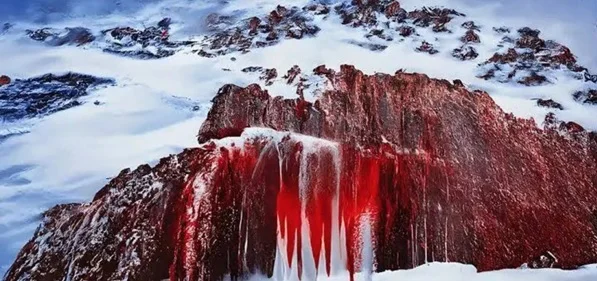
What is Blood Falls?
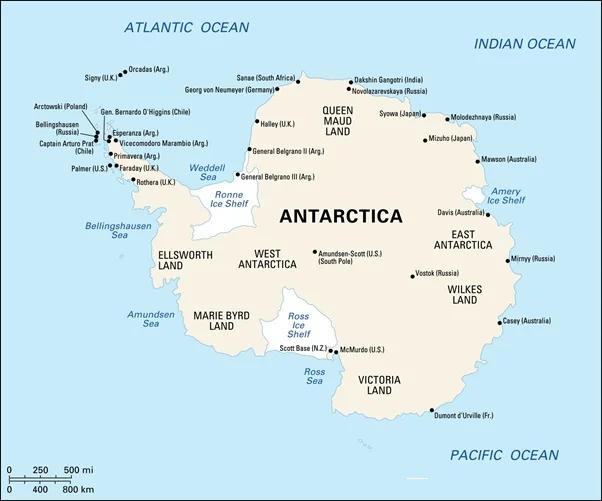
- Blood Falls is a striking red-colored waterfall located at the terminus of Taylor Glacier in the McMurdo Dry Valleys, Antarctica.
- It flows into Lake Bonney, one of Antarctica's ice-covered lakes.
- The waterfall's crimson color is caused by iron-rich brine. When the iron-rich saline water reaches the surface, it reacts with oxygen and forms iron oxides (rust), giving the water its blood-red appearance.
- The feature was first discovered in 1911 by Australian geologist Griffith Taylor.
Key Findings of the Study
- Researchers analyzed 167 samples of water, sediment, ice, mud, and air collected from the McMurdo Dry Valleys.
- Advanced genetic sequencing identified both prokaryotic (bacteria and archaea) and eukaryotic microorganisms.
- The microbial community at Blood Falls was found to be predominantly marine in origin, unlike surrounding areas that were dominated by freshwater and terrestrial microorganisms.
- Around 9.34% of eukaryotic microorganisms at the glacier terminus matched nearby marine communities, compared to only 1.15% at other Dry Valleys locations.
- The findings suggest that the subglacial brine originated from ancient seawater that became trapped beneath Taylor Glacier after sea levels fell and the glacier advanced.
How Did the Ancient Seawater Become Trapped?
Scientists believe that:
- During earlier warm climatic periods, seawater flooded Taylor Valley.
- As global temperatures declined, sea levels fell.
- Taylor Glacier advanced and sealed off the seawater beneath thick layers of ice.
- The isolated seawater gradually evolved into a highly saline subglacial brine while preserving ancient marine microorganisms.
Scientific Significance
The study provides important evidence that:
- Ancient microbial ecosystems can survive for thousands of years beneath glaciers.
- Subglacial environments preserve biological records of Earth's climatic history.
- Marine microorganisms can remain isolated despite major environmental changes.
- Modern wind transport alone cannot explain the presence of these marine microbes.
Why is this Important?
The findings help scientists:
- Reconstruct Antarctica's past climate and sea-level changes.
- Understand how life survives in extreme environments.
- Study long-term microbial evolution under isolated conditions.
- Develop models for potential life in icy extraterrestrial environments such as Mars and Europa.
UPSC Prelims Questions
Q1. Blood Falls, recently seen in the news, is located in:
A. Greenland Ice Sheet
B. Taylor Glacier, Antarctica
C. Siachen Glacier, India
D. Vatnajökull Glacier, Iceland
UPSC Mains Questions
Q1. Discuss the significance of Antarctica's Blood Falls in understanding past climate change, sea-level fluctuations, and glacial evolution.
|
FAQs: Antarctica's Blood Falls
Q1. What is Blood Falls?
Answer: Blood Falls is a red-colored outflow of iron-rich saline water emerging from beneath Taylor Glacier in the McMurdo Dry Valleys, Antarctica, flowing into Lake Bonney.
Q2. Why is it called "Blood Falls"?
Answer: It is called Blood Falls because the water appears blood-red due to the oxidation (rusting) of iron-rich brine when it comes into contact with oxygen.
Q3. Where is Blood Falls located?
Answer: It is located at the terminus of Taylor Glacier in the McMurdo Dry Valleys, one of the coldest and driest regions of Antarctica.
Q4. What did the recent Nature Geoscience study discover?
Answer: The study found that the microorganisms in Blood Falls are predominantly marine-specific, indicating that the subglacial brine originated from ancient seawater trapped beneath Taylor Glacier.
|






 Contact Us
  New Batch : 9555124124/ 7428085757
  Tech Support : 9555124124/ 7428085757