Prelims: Governance | Social Justice | Women Empowerment | NITI Aayog | Care Economy
Mains: GS Paper II – Government Policies & Interventions for Vulnerable Sections | Women Empowerment | Inclusive Development | Social Sector |
Why in the News?
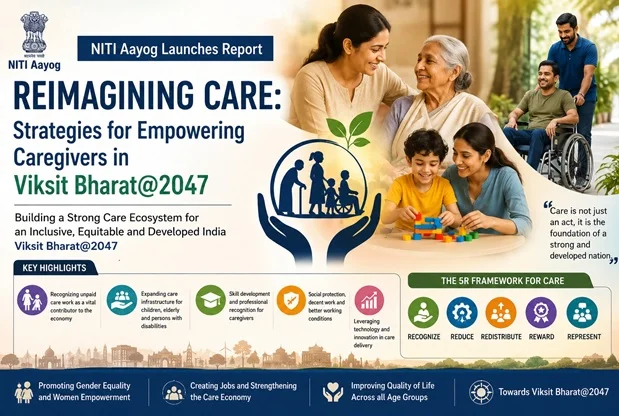
- NITI Aayog has released a landmark report titled "Reimagining Care: Strategies for Empowering Caregivers in Viksit Bharat@2047".
- The report highlights the need to recognize, reduce, redistribute, reward, and represent unpaid and paid care work in India while proposing policy reforms to strengthen the country's care economy and achieve the vision of Viksit Bharat@2047.
What Is the Report About?
- The report addresses the growing demand for caregiving services in India, driven by an ageing population, rising chronic illness, smaller family sizes, and increasing workforce participation among women, all of which are reducing the traditional pool of informal, family-based caregivers.
- It draws on international best practices to recommend ways of building a more structured, professional, and sustainable caregiving ecosystem, one that recognises caregiving as a legitimate and skilled workforce sector rather than an informal, largely invisible activity, and positions India to become a global hub for trained caregivers.
Key Recommendations of the Report
- It recommends formulating a National Policy on Caregiving to provide an overarching framework for the sector.
- It proposes establishing a National Caregiver Council (NCC) to regulate and accredit caregivers, standardise training and certification, and develop courses for the profession.
- It calls for creating a dedicated caregiver cadre, granting caregivers formal professional recognition as skilled workers.
- It recommends promoting the global mobility of Indian caregivers and setting up regional centres to support a well-functioning caregiving ecosystem.
- It proposes launching a National Digital Caregiving Portal to connect trained caregivers with care seekers across the country.
- It calls for expanding social security, welfare measures, and entrepreneurship support specifically designed for caregivers.
What is the Care Economy?
The care economy comprises both paid and unpaid activities undertaken to care for:
- Children
- Elderly persons
- Persons with disabilities
- Sick individuals
- Family members requiring daily assistance
These services are provided within households as well as through institutions such as childcare centres, hospitals, old-age homes, and community care facilities.
Why is the Care Economy Important?
- Supports overall economic productivity.
- Increases women's labour force participation.
- Promotes gender equality.
- Improves child development and elderly care.
- Creates employment opportunities.
- Strengthens social protection systems.
- Contributes to inclusive economic growth.
How Will This Improve Care Delivery?
- To improve the quality and availability of care services, the report recommends building a standardised national framework for caregiver training, certification, and career progression.
- It also calls for stronger support systems for informal caregivers, such as family members who provide unpaid care, wider use of digital technologies for training and service delivery, and improved coordination between the Centre and state governments to ensure consistent standards nationwide.
Five "R" Framework for Care
The report is based on the internationally recognised 5R Framework:
- Recognize unpaid care work.
- Reduce excessive care burden through public services and technology.
- Redistribute care responsibilities among families, communities, employers, and the government.
- Reward caregivers through decent wages and social protection.
- Represent caregivers in policymaking and labour institutions.
Why Does This Matter for Viksit Bharat@2047?
- As India works towards its Viksit Bharat@2047 vision of becoming a developed nation by the 100th year of independence, the report frames caregiving as an essential part of the country's social development, alongside its economic growth ambitions.
- A well-organised caregiving ecosystem is expected to support India's rapidly ageing population, strengthen the healthcare and social welfare system, and generate significant employment, particularly for women, in a sector that has so far remained largely informal and undervalued.
- By positioning caregiving as a professional, skilled workforce category, the report aims to ensure that India's growth story is inclusive and accounts for the needs of its most vulnerable citizens, including the elderly, the chronically ill, and persons with disabilities.
Challenges Identified
- High burden of unpaid care work on women.
- Low female labour force participation.
- Inadequate childcare and eldercare facilities.
- Limited formal recognition of caregivers.
- Shortage of trained care professionals.
- Weak social security coverage.
- Lack of comprehensive data on care work.
Recent Initiatives Supporting the Care Economy
The report highlights several government initiatives contributing to a stronger care ecosystem:
- Mission Shakti
- Palna Scheme (National Creche Scheme)
- Poshan Abhiyaan
- Ayushman Bharat
- National Programme for Health Care of the Elderly (NPHCE)
- PM Jan Arogya Yojana
- Accessible India Campaign (Sugamya Bharat Abhiyan)
Significance of the Report
- Supports the vision of Viksit Bharat@2047.
- Promotes inclusive and gender-responsive growth.
- Encourages higher female workforce participation.
- Generates employment in the care sector.
- Improves quality of life for children, elderly persons, and persons with disabilities.
- Strengthens India's social infrastructure.
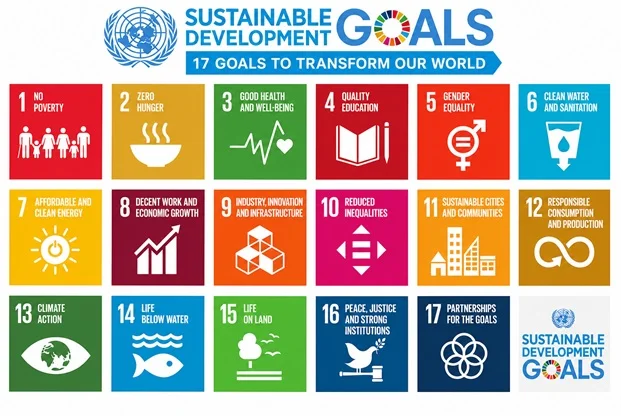
- Contributes to achieving multiple Sustainable Development Goals (SDGs), particularly SDGs 3, 5, 8, and 10.
Way Forward
- Formulate a comprehensive National Care Policy.
- Increase investment in care infrastructure.
- Strengthen institutional support for caregivers.
- Promote shared caregiving responsibilities.
- Expand digital and community-based care services.
- Improve data collection through regular Time Use Surveys.
- Integrate care economy into long-term development planning.
Prelims MCQ
Q. With reference to the report "Reimagining Care: Strategies for Empowering Caregivers in Viksit Bharat@2047", consider the following statements:
- It was released by NITI Aayog.
- The report promotes the internationally recognised 5R Framework for care.
- It primarily focuses on strengthening India's care economy and increasing women's labour force participation.
Which of the statements given above is/are correct?
A. 1 and 2 only
B. 2 and 3 only
C. 1 and 3 only
D. 1, 2 and 3
Mains Practice Question
Q. Discuss the significance of NITI Aayog's 'Reimagining Care' report in promoting inclusive growth and women's empowerment.
|
FAQs
What is the "Reimagining Care" report?
It is a NITI Aayog report that provides a roadmap for strengthening India's care economy and empowering caregivers.
What is meant by the care economy?
It includes paid and unpaid services related to childcare, eldercare, disability care, healthcare, and household caregiving.
What is the 5R Framework?
Recognize, Reduce, Redistribute, Reward, and Represent care work.
What sectors will benefit from the report?
Childcare, healthcare, eldercare, disability support, education, and social protection.
Which SDGs are supported by the report?
Primarily SDG 3 (Good Health), SDG 5 (Gender Equality), SDG 8 (Decent Work and Economic Growth), and SDG 10 (Reduced Inequalities).
|






 Contact Us
  New Batch : 9555124124/ 7428085757
  Tech Support : 9555124124/ 7428085757