
- UPSC Exam
- State PCS
- One Day Exam
- Current Affairs
- PT Quiz
- Downlaods
- About Coaching
- Blog
- Videos

| Prelims: (Economy + CA) Mains: (GS-3 – Infrastructure, Transport Systems, Engineering Innovations) |
The Government of India has approved a ₹117.54 crore renovation project for the bascule bridge at the Syama Prasad Mookerjee Port in Kolkata.
The project aims to restore and modernise the historic movable bridge mechanism, ensuring smooth navigation for vessels while maintaining efficient road connectivity within the port area.
The initiative highlights the importance of modernising critical maritime infrastructure in India’s major ports.
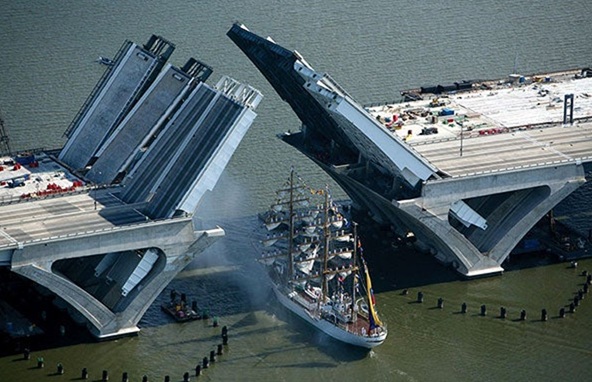
Bascule bridges are believed to have originated during the mediaeval period in Europe.
Initially, they were used as defensive drawbridges in castles and fortified towns, allowing residents to block entry during attacks.
Over time, the design evolved into a modern engineering structure widely used in ports and canal systems.
The leaf is the movable section of the bridge that lifts upward to create space for vessels to pass.
The span may be:
A counterweight balances the bridge span during lifting.
In most bascule bridges:
The weight balance may also be adjusted depending on the frequency of waterway traffic.
Bascule bridges can be classified based on the number of lifting spans.
In rare cases, bridges may have three or four leaves, depending on the width of the waterway.
One of the most notable examples is the Broadway Bridge in Portland, United States.
It is known as the longest double-leaf bascule bridge in the world.
1. Ensuring Navigational Clearance
Bascule bridges allow large vessels to pass through waterways without permanent obstruction.
2. Maintaining Road Connectivity
The bridges provide dual functionality, supporting both road traffic and water transport.
3. Efficient Mechanical Operation
The counterweight system reduces energy requirements, making the bridge easier and more efficient to operate.
4. Critical for Port Infrastructure
In port cities like Kolkata, bascule bridges are essential for cargo transportation and maritime logistics.
5. Heritage and Engineering Value
Many bascule bridges are considered historic engineering structures, reflecting advances in mechanical engineering and infrastructure design.
The renovation project at Syama Prasad Mookerjee Port is important because:
Upgrading the bridge will help:
As maritime trade continues to expand, India must invest in:
Such investments will strengthen India’s logistics network and maritime economy.
FAQs1. What is a bascule bridge ? A bascule bridge is a movable bridge that can be raised using a counterweight system to allow ships to pass through a waterway. 2. Why is it called a bascule bridge ? The term “bascule” comes from French, meaning a seesaw or balancing mechanism, referring to the bridge’s counterweight design. 3. Where are bascule bridges commonly used ? They are commonly used in ports, canals, and navigable rivers where ship movement requires adjustable bridge clearance. 4. What is the role of the counterweight in a bascule bridge ? The counterweight balances the weight of the bridge span, reducing the force required to lift the bridge. 5. Which is the longest double-leaf bascule bridge in the world ? The Broadway Bridge in Portland, United States, is considered the longest double-leaf bascule bridge in the world. |



Our support team will be happy to assist you!

 Contact Us
  New Batch : 9555124124/ 7428085757
  Tech Support : 9555124124/ 7428085757