
- UPSC Exam
- State PCS
- One Day Exam
- Current Affairs
- PT Quiz
- Downlaods
- About Coaching
- Blog
- Videos

| Prelims: (Economics + CA) Mains: (GS 3 – Science & Technology, IT & Innovation; GS 2 – Governance, Global Groupings & Agreements; GS 3 – Economy, Skilling & Inclusive Growth) |
Prime Minister Narendra Modi articulated India’s Artificial Intelligence (AI) vision at the AI Impact Summit 2026 held in New Delhi. During the summit, India unveiled the “New Delhi Frontier AI Impact Commitments”, positioning AI as a global common good rather than a restricted strategic asset.
The summit witnessed participation from major global AI firms and policymakers, reflecting India’s effort to shape emerging global norms on AI governance, inclusion, and responsible innovation.
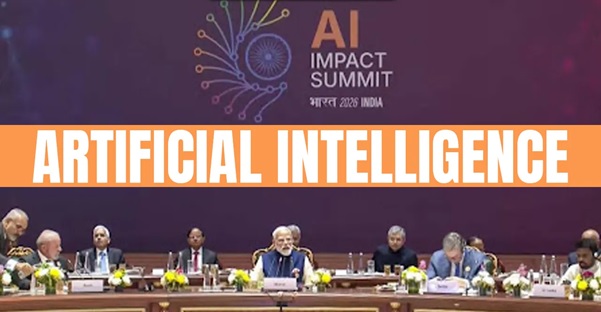
Global AI Acceleration
The rapid expansion of generative AI, large language models, and automation technologies has transformed AI into a central pillar of economic and strategic competition.
Strategic Competition
Several advanced economies treat AI as a strategic and proprietary technology, building closed innovation ecosystems to preserve technological advantage.
India’s Alternative Model
India has proposed a collaborative and open approach, advocating AI development as a shared global resource that promotes innovation, inclusion, and equitable growth.
Digital Public Infrastructure Foundation
India’s experience with scalable digital systems such as BHASHINI has provided a foundation for inclusive AI deployment, especially in linguistically diverse settings.
Global Governance Leadership: India seeks to position itself as a voice for the Global South in shaping inclusive AI norms.
Balancing Innovation and Regulation: The vision attempts to reconcile technological advancement with ethical oversight.
Economic Transformation: AI is projected to significantly impact productivity, employment patterns, and industrial competitiveness.
Technological Sovereignty: Open collaboration must coexist with protection of data ownership and national interests.
Digital Inclusion: Multilingual AI can expand access to digital services beyond English-dominated systems.
1. India’s Approach to Artificial Intelligence
AI as Opportunity, Not Threat
The Prime Minister stated that India does not view AI with fear but sees “fortune and the future” in it.
AI as a Global Common Good
India proposed that AI systems should benefit humanity when shared openly rather than confined within corporate or national silos.
Open-Source and Collaborative Innovation
Encouraging open ecosystems can enable wider scrutiny, improved safety standards, and faster innovation.
2. The MANAV Framework
Central to India’s AI governance philosophy is the “MANAV” framework:
M – Moral and Ethical Systems: AI development must adhere to ethical principles.
A – Accountable Governance: Transparent oversight and regulatory clarity are essential.
N – National Sovereignty: Data ownership must remain with those who generate it.
A – Accessible and Inclusive: AI should empower society rather than concentrate power.
V – Valid and Legitimate: Applications must comply with laws and verifiable standards.
The framework reflects a human-centric approach to AI governance.
3. New Delhi Frontier AI Impact Commitments
The summit saw voluntary commitments from major global firms including Google, OpenAI, Meta, Microsoft, and Anthropic.
Focus Areas
These commitments aim to promote transparency and evidence-based policymaking.
4. Multilingual AI and Digital Public Infrastructure
Language Inclusion
The Prime Minister’s address was livestreamed in seven Indian languages using AI-powered translation.
Role of BHASHINI
India’s language AI ecosystem, anchored in digital public infrastructure, seeks to bridge linguistic divides and democratise access to AI tools.
Strategic Importance
Multilingual AI enhances governance delivery, education access, and digital inclusion across diverse populations.
5. AI Governance: Deepfakes and Authenticity Standards
Emerging Risks
Deepfakes and synthetic content pose risks to democratic institutions and public trust.
Authenticity Labelling Proposal
Drawing an analogy with food nutrition labels, the Prime Minister proposed digital authenticity markers for AI-generated content.
Watermarking and Source Verification
Establishing standards for traceability and transparency aligns with global debates on responsible AI regulation.
6. Economic Transformation and Skilling
AI as Growth Catalyst
AI can create higher-value roles in design, analytics, and innovation.
Workforce Transition
The government emphasised skilling, reskilling, and upskilling initiatives to manage labour market shifts.
Ecosystem Development
India is investing in semiconductor manufacturing, secure data centres, quantum research, and digital infrastructure to build a resilient AI ecosystem.
Scalability Advantage
An AI model that succeeds in India’s diverse and large-scale environment can potentially scale globally.
7. Strategic Context and Global Debate
The summit occurred amid intensifying global competition over AI dominance.
While some countries favour closed technological stacks, India advocates openness combined with sovereignty safeguards.
India’s AI vision seeks to balance:
Norm-Setting Opportunity: India can influence emerging global AI governance frameworks.
Inclusive Growth Model: AI deployment can accelerate service delivery and digital inclusion.
Geopolitical Positioning: India strengthens its role as a bridge between advanced economies and the Global South.
Regulatory Complexity: Balancing openness with sovereignty requires careful institutional design.
Skill Transformation Imperative: Labour markets must adapt to automation-driven shifts.
Institutionalise the MANAV Framework: Translate principles into binding regulatory guidelines.
Develop Robust Authenticity Standards: Adopt watermarking and traceability mechanisms for AI-generated content.
Scale Multilingual AI Ecosystems: Strengthen digital public infrastructure to reach underserved communities.
Invest in Human Capital: Expand skilling initiatives aligned with AI-driven economic transitions.
Promote Global AI Cooperation: Leverage multilateral platforms to shape equitable AI governance norms.
FAQs1. What is India’s core vision for Artificial Intelligence? India envisions AI as a global common good that promotes inclusion, innovation, and shared prosperity. 2. What is the MANAV framework? It is India’s AI governance model emphasising ethical, accountable, sovereign, inclusive, and legitimate AI development. 3. What are the New Delhi Frontier AI Impact Commitments? They are voluntary pledges by major AI companies to enhance transparency, multilingual capacity, and social impact evaluation. 4. Why is multilingual AI important for India? India’s linguistic diversity requires AI tools that function effectively across languages to ensure inclusive digital access. 5. How does AI impact employment in India? AI can create higher-value opportunities but requires large-scale skilling and reskilling to manage workforce transitions. |



Our support team will be happy to assist you!

 Contact Us
  New Batch : 9555124124/ 7428085757
  Tech Support : 9555124124/ 7428085757