The famous Anaimangalam copper plates from the Chola period were recently brought back to India from the Netherlands. Historians and archaeologists have described this as a significant achievement in the history of the return of India's cultural heritage. For nearly two hundred years, these copper plates were preserved at Leiden University in the Netherlands and were known as the Leiden copper plates.
About the Anaimangalam Copper Plates
According to Chola history scholars, the Anaimangalam copper plates are important evidence of Tamil history, culture, and the greatness of the Chola Empire.
These copper plates date back to the reign of Raja Raja Chola I (985–1014 AD) and his son Rajendra Chola I (1014–1044 AD).
The inscriptions mention the donation of land to a Buddhist monastery in Anaimangalam village, near Nagapattinam.
This monastery was built by the Javanese king Sri Mara Vijayotunga Varman in memory of his father, Chudamani Varman, and hence, it was named Chudamani Varman Vihara.
Copper Plates Symbolize Religious Tolerance
The most striking feature of these copper plates is that they exemplify religious tolerance. The Chola rulers were followers of Shaivism, yet they supported the construction of the Buddhist monastery.
Raja Raja Chola I ordered the construction of the monastery, while his son Rajendra Chola I implemented the order. Later, Kulottunga Chola I also granted additional land and paddy to the monastery.
Features of the Copper Plates
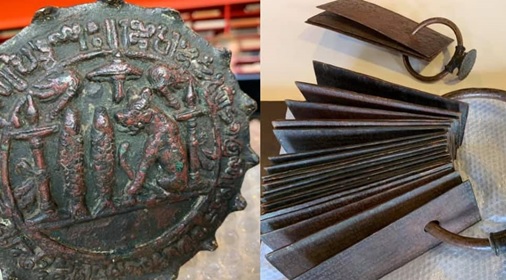
These copper plates are a collection of 24 plates, including 21 large and 3 small plates.
The larger plates contain inscriptions in both Sanskrit and Tamil.
The smaller plates mention additional grants made during the reign of Kulothunga Chola I.
These plates were strung on special metal rings bearing the royal emblems of the Chola Empire. These included :
The Chola tiger
The two fishes of the Pandyas
The Chera bow
The royal umbrella
The lamp
The swastika symbol.
The two fishes and the bow symbolized the Chola victory over the Pandya and Chera dynasties.
Return of Cultural Heritage
Historians believe that the return of these copper plates is not only an event of archaeological significance, but also a major step towards reclaiming India's cultural identity and historical heritage. These inscriptions provide important information about the administrative system, religious tolerance, and international relations of the Chola period.






 Contact Us
  New Batch : 9555124124/ 7428085757
  Tech Support : 9555124124/ 7428085757