New
GS Foundation (P+M) - Delhi : 19th Jan. 2026, 11:30 AM New Year offer UPTO 75% + 10% Off | Valid till 03 Jan 26 GS Foundation (P+M) - Prayagraj : 09th Jan. 2026, 11:00 AM New Year offer UPTO 75% + 10% Off | Valid till 03 Jan 26 GS Foundation (P+M) - Delhi : 19th Jan. 2026, 11:30 AM GS Foundation (P+M) - Prayagraj : 09th Jan. 2026, 11:00 AM

Aravalli Hills and Environmental Protection: Defining India’s Oldest Mountain Shield

Prelims: (Environment & Ecology + Current Affairs)
Mains: (GS 1: Geography; GS 2: Judiciary, Governance, Policy Making; GS 3: Environment Protection, Mining Regulation, Sustainable Development)

Why in News ?

In December 2025, the Supreme Court of India kept its earlier November 2025 judgment on the definition of the Aravalli Hills in abeyance, citing serious environmental and regulatory concerns. The Court proposed a re-examination of the issue through a high-powered expert committee and imposed restrictions on mining and irreversible administrative actions in the Aravalli region until further review.
Background & Context

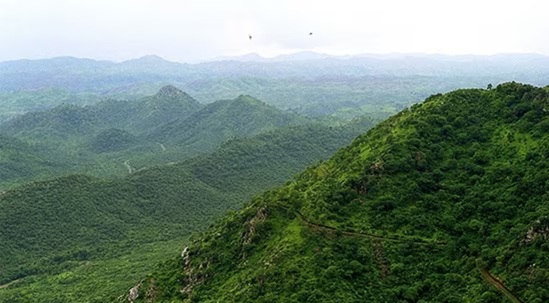
The Aravalli Hills are among the oldest surviving fold mountain systems in the world, with geological origins dating back nearly 1.5 billion years. Stretching over 690 km from Gujarat through Rajasthan and Haryana to Delhi, the range forms a critical ecological barrier in north-western India.

Over decades, the Aravallis have faced severe degradation due to:

  • Extensive legal and illegal mining
  • Rapid urbanisation
  • Infrastructure expansion
  • Weak enforcement of environmental regulations

Unlike many ecologically sensitive regions, protection of the Aravallis has evolved primarily through judicial intervention, rather than a single comprehensive legislation. Persistent ambiguity over the legal and scientific definition of the Aravalli range has remained the core challenge undermining conservation efforts.
About the Aravalli Mountain Range

Geographical and Ecological Significance

The Aravalli range plays a crucial environmental role by:

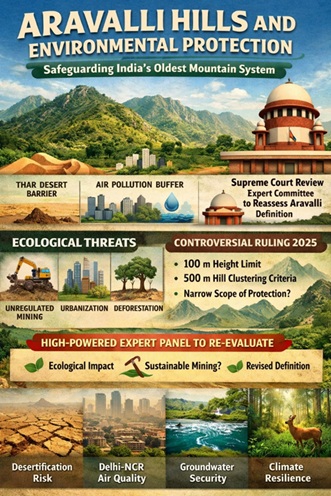
  • Preventing eastward expansion of the Thar Desert
  • Regulating regional climate and rainfall patterns
  • Recharging groundwater aquifers
  • Acting as a green buffer against air pollution, especially for Delhi-NCR
  • Supporting tropical dry deciduous forests
  • Sustaining diverse flora, fauna, and rural livelihoods

Despite their low elevation compared to the Himalayas, the Aravallis function as a keystone ecological system for north-west India.

Legal Background to the Aravalli Definition Issue

Environmental protection of the Aravallis has largely relied on:

  • Environment (Protection) Act, 1986
  • Forest conservation principles
  • Multiple Supreme Court rulings restricting mining activities

However, the absence of a scientifically precise and uniform definition of what constitutes the Aravalli Hills has led to regulatory disputes and inconsistent enforcement across states.

November 2025 Supreme Court Judgment

In November 2025, the Supreme Court upheld a government-appointed expert panel’s definition, which restricted the Aravallis to:

  • Hills with an elevation of 100 metres or more
  • Hill clusters, slopes, and hillocks located within 500 metres of each other

This significantly narrowed the geographical scope of the protected Aravalli region.

Latest Supreme Court Developments (December 2025)

In response to widespread environmental concerns, the Supreme Court placed its own earlier judgment in abeyance.

Key Directions Issued by the Court

  • No irreversible administrative or ecological actions to be taken based on the restrictive definition
  • Fresh or renewed mining leases prohibited without prior approval of the apex court
  • Recognition of public concern that the 100-metre elevation rule could exclude ecologically significant hills in:
    • Rajasthan
    • Haryana
    • Uttar Pradesh
    • Delhi

Judicial Observations

  • Excluding lower hill ranges could create a “significant regulatory lacuna”
  • Such gaps may enable unregulated mining and environmental degradation
  • Technical thresholds should not defeat substantive environmental protection

Proposed High-Powered Expert Committee

The Supreme Court proposed constituting an expert committee to:

  • Reassess whether regulated or sustainable mining in newly excluded areas still poses ecological risks
  • Evaluate short-term and long-term environmental impacts of the restrictive definition
  • Examine whether the 500-metre clustering rule creates paradoxes where ecologically continuous hills remain unprotected
  • Recommend a holistic, ecosystem-based definition of the Aravalli range

The Court emphasised that any final definition must be grounded in exhaustive scientific, geological, and ecological assessment.

Environmental and Policy Implications

  • Over-reliance on technical definitions can undermine ecological objectives
  • Mining regulation must balance:
    • Economic activity
    • Environmental sustainability
    • Inter-generational equity
  • Judicial oversight remains crucial in the absence of comprehensive legislative clarity
  • Highlights limitations of fragmented environmental governance

Analysis: Why the Aravalli Debate Matters

  • The case reflects the tension between developmental pressures and ecological preservation
  • Demonstrates the judiciary’s role as an environmental sentinel
  • Underscores the need for ecosystem-based policy approaches, rather than narrow physical thresholds
  • Has direct implications for:
    • Air quality in Delhi-NCR
    • Desertification control
    • Groundwater security
    • Climate resilience

Way Forward

  • Formulate a statutory, scientifically grounded definition of the Aravalli range
  • Adopt landscape-level conservation planning
  • Strengthen Centre–State coordination on mining regulation
  • Integrate Aravalli protection into climate adaptation and urban planning frameworks
  • Ensure continuous judicial and institutional monitoring

FAQs

Q1. Why are the Aravalli Hills ecologically important ?

They prevent desertification, regulate climate, recharge groundwater, and act as a pollution buffer for north-west India.

Q2. What was controversial about the November 2025 Supreme Court definition ?

The 100-metre elevation and 500-metre clustering criteria potentially excluded many ecologically significant hill systems.

Q3. Why did the Supreme Court pause its own judgment ?

Due to concerns that the restrictive definition could create regulatory gaps, enabling environmental degradation through mining.

Have any Query?

Our support team will be happy to assist you!

OR