
- UPSC Exam
- State PCS
- One Day Exam
- Current Affairs
- PT Quiz
- Downlaods
- About Coaching
- Blog
- Videos

| Prelims : (Defence & Security + CA) Mains : (GS 3 – Defence Technology, Internal Security; GS 2 – International Relations, Global Security Architecture) |
Recent reports suggest that Iran has destroyed a key radar system associated with the Terminal High Altitude Area Defense (THAAD) deployed by the United States in the Middle East.
The radar forms a crucial component of the THAAD missile defence network that detects and tracks incoming ballistic missiles. The development has drawn attention to the strategic importance of missile defence systems in modern warfare and regional security dynamics.
Ballistic missiles have become one of the most significant threats in modern warfare because they can carry conventional, nuclear, chemical, or biological warheads across long distances at extremely high speeds.
To counter this threat, several countries have developed Ballistic Missile Defence (BMD) systems, which are designed to detect, track, and intercept incoming missiles before they reach their targets.
The United States has developed a layered missile defence architecture known as the Ballistic Missile Defense System (BMDS).
This system integrates multiple defence layers, including :
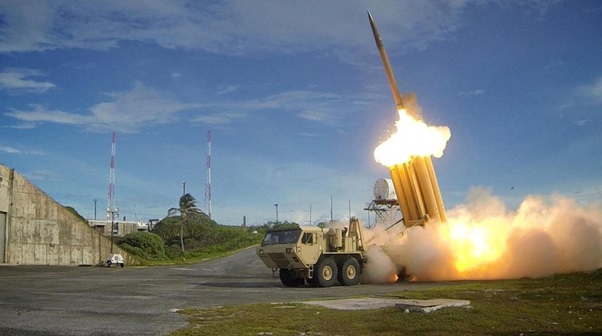
Within this architecture, THAAD provides a critical upper-tier defence layer designed to intercept ballistic missiles during the final phase of their flight trajectory.
The Terminal High Altitude Area Defense (THAAD) is one of the most advanced missile defence systems developed by the Lockheed Martin for the United States.
The system is specifically designed to detect, track, and intercept short-range, medium-range, and limited intermediate-range ballistic missiles during their terminal phase.
Unlike traditional missile defence systems that rely on explosive warheads, THAAD uses a direct kinetic impact technique, making it more precise and reducing collateral damage.
The system is deployed by the United States and several allied countries to protect strategic locations, military bases, and population centres from missile threats.
THAAD is designed to intercept missiles during the terminal stage of their trajectory, just before they reach their intended targets.
It can destroy incoming threats :
This capability provides an additional defensive layer beyond traditional missile defence systems.
One of the defining features of THAAD is its “hit-to-kill” technology.
Instead of using explosive warheads, the interceptor missile destroys the incoming target by directly colliding with it at extremely high speeds.
The impact generates immense kinetic energy that destroys the target missile.
Advantages of this approach include :
The THAAD system can intercept ballistic missile targets at a range of approximately 150–200 kilometres.
This range allows the system to defend large areas and strategic installations against missile attacks.
A complete THAAD battery consists of several integrated components that work together to detect and destroy incoming missiles.
These missiles are designed to collide with incoming ballistic missiles using kinetic energy.
They are equipped with advanced guidance systems that allow precise targeting.
THAAD interceptors are deployed using mobile truck-mounted launchers, which increase operational flexibility and allow rapid deployment to strategic locations.
Each launcher typically carries eight interceptor missiles.
The AN/TPY-2 Radar is a powerful long-range radar that plays a crucial role in detecting and tracking incoming ballistic missiles.
Functions of the radar include :
Because of its long detection range, the radar also contributes to regional missile surveillance and early warning networks.
This unit serves as the command and control centre of the THAAD system.
It coordinates :
The THAAD battery also includes additional support equipment for maintenance, power supply, and operational coordination.
A standard THAAD battery generally includes :
Each launcher carries eight interceptor missiles, providing significant defensive capability against multiple missile threats.
THAAD forms an important layer in the multi-tier missile defence architecture, complementing lower-altitude systems like the Patriot missile defence system.
Countries facing missile threats deploy THAAD to protect :
This is particularly important in regions with active missile development programmes.
The presence of advanced missile defence systems can strengthen deterrence by reducing the effectiveness of an adversary’s missile capabilities.
The United States has deployed THAAD in several allied countries to enhance regional security.
Examples include deployments in :
These deployments help counter missile threats in geopolitically sensitive regions.
Despite its strategic importance, the THAAD system has also generated geopolitical concerns.
Some countries argue that THAAD deployments can alter the strategic balance of power in a region.
Missile defence systems like THAAD involve very high development, deployment, and maintenance costs.
Although highly advanced, missile defence systems cannot guarantee interception of all incoming missiles, especially during large-scale attacks.
The powerful radar systems associated with THAAD can monitor large areas, which has raised strategic and diplomatic concerns among neighbouring countries.
As missile technologies continue to evolve, countries are increasingly investing in advanced missile defence systems to protect their national security interests.
Future developments may focus on :
Balancing missile defence capabilities with diplomatic efforts will remain crucial to maintaining global strategic stability.
FAQs1. What is the THAAD system ? The Terminal High Altitude Area Defense (THAAD) system is an advanced missile defence platform developed by the United States to intercept and destroy incoming ballistic missiles during their terminal phase. 2. How does THAAD destroy incoming missiles ? THAAD uses “hit-to-kill” technology, where interceptor missiles destroy targets by directly colliding with them using kinetic energy instead of explosive warheads. 3. What is the role of the AN/TPY-2 radar in the THAAD system ? The AN/TPY-2 radar detects and tracks incoming ballistic missiles and provides targeting information for the interceptor missiles. 4. What types of missiles can THAAD intercept ? THAAD is designed to intercept short-range, medium-range, and limited intermediate-range ballistic missiles. 5. Why is THAAD strategically important ? The system strengthens missile defence capabilities, protects critical infrastructure, and enhances deterrence against ballistic missile threats. |



Our support team will be happy to assist you!

 Contact Us
  New Batch : 9555124124/ 7428085757
  Tech Support : 9555124124/ 7428085757