
- UPSC Exam
- State PCS
- One Day Exam
- Current Affairs
- PT Quiz
- Downlaods
- About Coaching
- Blog
- Videos

| Prelims: (Science and Technology + CA) Mains: (GS Paper 3 – Environment, Industrial Development, Climate Change, Sustainable Manufacturing) |
Biomaterials are drawing renewed policy and industry attention as India and other countries search for low-carbon alternatives to fossil-based materials amid climate commitments, plastic bans, and tightening global sustainability standards.
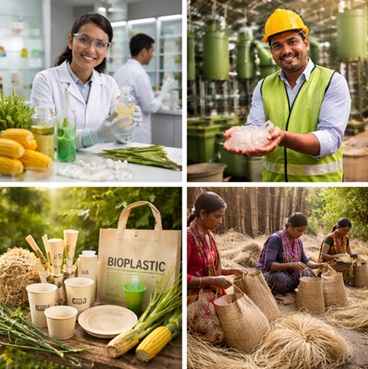
Global manufacturing has long relied on petroleum-based plastics and materials, which are carbon-intensive, non-biodegradable, and environmentally damaging. Rising climate risks, plastic pollution, and stricter environmental regulations have exposed the limitations of this model.
India faces a dual challenge:
Biomaterials emerge at this intersection—offering a pathway that combines climate action, industrial competitiveness, and rural value creation. Their growing relevance aligns with India’s commitments under the Paris Agreement, its ban on single-use plastics, and the broader push for a circular economy.
Biomaterials are materials derived wholly or partly from biological sources, or engineered using biological processes, to replace or complement conventional fossil-based materials.
Unlike petroleum-based materials, biomaterials aim to:
These materials are increasingly used in packaging, textiles, construction, automotive components, and healthcare.
Biomaterials serve multiple national objectives simultaneously:
India’s large agricultural base provides abundant feedstocks:
This creates new income streams for farmers, linking agriculture with industrial value chains and strengthening rural livelihoods.
As export markets increasingly demand low-carbon and sustainable products, biomaterials help Indian manufacturers:
India’s biomaterials sector is nascent but expanding.
Despite strong feedstock availability, India remains dependent on foreign technology, especially in:
Other regions are moving faster:
These trends highlight the competitive urgency for India to scale its biomaterials ecosystem.
FAQs1. How are biomaterials different from biodegradable plastics ? All biodegradable plastics are biomaterials, but not all biomaterials are biodegradable. Some are chemically identical to conventional plastics. 2. Why is PLA important for India’s biomaterials sector ? PLA is a commercially viable bioplastic that can be produced from agricultural feedstocks like sugarcane and maize. 3. Can biomaterials threaten food security ? If poorly managed, yes. Hence, policy must prioritise crop residues and non-food biomass. 4. Which sectors can benefit most from biomaterials in India ? Packaging, textiles, construction, healthcare, and automotive manufacturing. 5. How do biomaterials support India’s climate goals ? They reduce emissions, cut plastic pollution, and enable circular production systems aligned with climate commitments. |



Our support team will be happy to assist you!

 Contact Us
  New Batch : 9555124124/ 7428085757
  Tech Support : 9555124124/ 7428085757