(Preliminary Examination: Current Affairs)
(Main Examination, General Studies Paper 3: Science and Technology—Developments and Applications and Their Impact on Everyday Life.) |
Context
Increasing industrialization, urbanization, and uncontrolled disposal of solid and liquid waste in India have led to serious environmental pollution. Sustainable alternatives are now needed to purify rivers, soil, groundwater, and air, and to move beyond traditional techniques. In this context, bioremediation is emerging as an important solution.
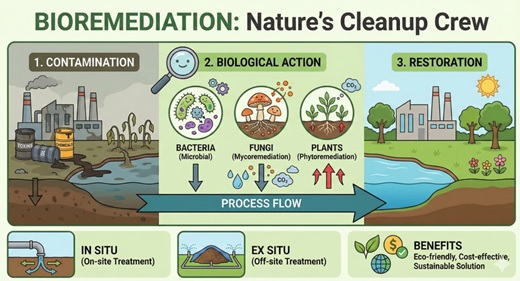
What is Bioremediation?
- Bioremediation means “restoring the environment through biological methods.”
- In this, pollutants are converted into less harmful or inert substances using microorganisms such as bacteria, fungi, algae, and plants.
- These organisms use pollutants as food and convert them into simple products such as water, carbon dioxide, or organic acids.
- Some microorganisms can also convert heavy metals into less hazardous forms.
Types of Bioremediation
1.In-situ Bioremediation
- Treatment is carried out at the contaminated site itself.
- Example: Direct spraying of oil-eating bacteria onto an oil spill in the ocean.
2. Ex-situ Bioremediation
- Contaminated soil/water is removed, treated in a controlled facility, and then returned after being cleaned.
Importance
- Modern technologies enable researchers to gain a deeper understanding of the capabilities of microorganisms and biomolecules
- Genetic modification is creating microbes that can break down even difficult pollutants like plastic, oil, and toxic chemicals.
- Synthetic biology has developed "biosensing" organisms that change color and alert when they detect pollution.
- These technologies are proving useful in sewage treatment plants, agricultural lands, and industrial areas.
Need for Bioremediation in India
- Rapid industrialization and urban expansion in India has led to significant pollution of rivers, soil, and groundwater.
- Large amounts of untreated sewage and industrial waste flow daily into rivers like the Ganga and Yamuna.
- Traditional cleaning technologies are expensive, energy-intensive, and sometimes create new pollutants.
- Bioremediation offers a cost-effective, sustainable, scalable, and environmentally friendly alternative.
- India has a large variety of locally adapted microorganisms that can support effective bioremediation.
Current Status in India
- This technology is currently rapidly emerging in India as a pilot project.
- The Department of Biotechnology (DBT) is supporting several projects through its “Clean Technology Program.”
- CSIR-NEERI is the lead institution for developing and implementing bioremediation programs.
- IITs are conducting research on cotton-based nanocomposites and pollutant-eating bacteria for cleaning oil spills.
- Startups such as BCIL and Econirmal Biotech are providing solutions for soil and wastewater treatment using microbial formulations.
Key Challenges
- Knowledge of technologies specific to individual site conditions is limited.
- Many pollutants are highly complex, and common microbes are ineffective against them.
- Lack of unified national standards.
- Environmental risks from the use of gene-modified microbes.
- Limitations in monitoring, trained human resources, and scientific infrastructure.
Global Applications
- Japan: Extensive use of combining microbial and plant-based technologies in urban waste management.
- European Union: Multinational projects to restore oil spills and mining areas.
- China: Use of genetically modified microbes to clean up industrially polluted areas.
Opportunities for India
- River cleanup, land restoration, industrial waste management.
- Large employment opportunities in biotechnology, environmental consulting, and waste management.
- Can be implemented on a large scale by linking it to the Swachh Bharat Mission, Namami Gange, and green technology initiatives.
Potential Risks
- Genetically modified (GMO) microorganisms can create new problems if they spread unchecked into the environment.
- Impacts on biodiversity due to inadequate testing.
- Low public awareness hinders the adoption of new technologies.
- Need for robust biosafety standards, certification systems, and regular monitoring.
Way Forward
- Developing national bioremediation standards is essential.
- Establish regional bioremediation hubs to understand local needs.
- Encourage startups and community projects through DBT-BIRAC.
- Educate the public that microorganisms can become protectors of the environment, not enemies.
- Strengthen rigorous monitoring and biosafety frameworks for GMO-based technologies.






 Contact Us
  New Batch : 9555124124/ 7428085757
  Tech Support : 9555124124/ 7428085757