
- UPSC Exam
- State PCS
- One Day Exam
- Current Affairs
- PT Quiz
- Downlaods
- About Coaching
- Blog
- Videos

| Prelims: (International Relations + CA) Mains: (GS 2: India and its Neighbourhood, Border Disputes, Regional Security, Geopolitics of South Asia) |
Pakistan and Afghanistan have entered a sharp new phase of hostilities after Pakistan carried out airstrikes in Kabul and other provinces following a cross-border attack on its troops. Pakistan’s Defence Minister described the situation as an “open war” with the Taliban-led Afghan government.
Islamabad has accused Kabul of sheltering militant groups responsible for attacks inside Pakistan. However, the roots of tension between the two neighbours go far deeper, stretching back to 1947 and shaped by history, geopolitics, and unresolved border disputes.
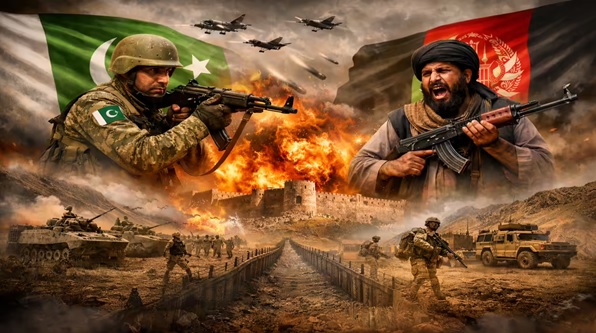
Since Pakistan’s creation in 1947, relations with Afghanistan have been marked by distrust and confrontation.
Major historical phases include:
Throughout these upheavals, Pakistan has played a significant role in Afghan political developments, often backing resistance groups or the Taliban. Despite this involvement, bilateral mistrust has persisted.
End of Monarchy and Communist Rule (1973–1989)
Afghanistan’s monarchy ended in 1973. A nationalist regime was followed by communist rule backed by the Soviet Union.
In 1979, the Soviet Union intervened militarily. Pakistan supported Afghan Mujahideen factions during this period.
After Soviet withdrawal, President Najibullah attempted to stabilise the country. His government collapsed in 1992, triggering civil war.
The Taliban emerged in 1994 and captured Kabul in 1996. Pakistan was one of the few countries to recognise the Taliban regime.
Following the September 11 attacks, the United States invaded Afghanistan, overthrowing the Taliban.
A new Islamic Republic was established but struggled with insurgency and corruption.
After the US withdrawal in August 2021, the Taliban regained full control. Pakistan initially welcomed the development, expecting strategic alignment.
However, tensions resurfaced as cross-border militancy continued.
1. The Durand Line Dispute
The most enduring source of tension is the Durand Line.
The Durand Line: A Historical Flashpoint
The 2,640-km Durand Line was drawn in 1893 by Sir Mortimer Durand between British India and Afghanistan.
Afghanistan has consistently refused to formally recognise the Durand Line as an international border.
It even opposed Pakistan’s admission to the United Nations in 1947 on this issue.
In 2018, Afghanistan objected when Pakistan merged its Tribal Areas into Khyber Pakhtunkhwa, reiterating its rejection of the border’s finality.
The unresolved border dispute fuels recurring clashes and accusations of cross-border militant movement.
2. Cross-Border Militancy
Pakistan accuses the Taliban government of sheltering anti-Pakistan militant groups.
Afghanistan, in turn, accuses Pakistan of interference in its internal affairs.
Militant safe havens and border management remain major security flashpoints.
3. Trade and Transit as Strategic Leverage
Afghanistan is landlocked and dependent on transit routes through Pakistan.
The Karachi port route is economically vital.
Disputes have arisen over:
Afghanistan views such restrictions as political coercion.
4. The India Factor
India’s developmental presence in Afghanistan — infrastructure, education, and humanitarian assistance — has shaped Pakistan’s security concerns.
Pakistan fears strategic encirclement by India and Afghanistan.
Recent Taliban outreach to India has heightened Islamabad’s suspicion.
5. Mutual Resentment
Afghans often resent Pakistan’s historical involvement in their domestic politics.
Pakistan argues it has borne heavy costs:
This mutual distrust continues to define bilateral ties.
India traditionally supports an Afghan-led, Afghan-owned peace process while avoiding direct involvement in internal conflicts.
FAQsQ1. What is the Durand Line? It is the 1893 boundary drawn between British India and Afghanistan, inherited by Pakistan in 1947 but never formally recognised by Afghanistan. Q2. Why are Pakistan and Afghanistan currently in conflict? Pakistan accuses Afghanistan’s Taliban government of harbouring militants responsible for cross-border attacks. Q3. How has the Taliban’s return in 2021 affected relations? While initially seen as favourable for Pakistan, relations deteriorated due to continued militant activity and border tensions. Q4. Why is trade and transit important in this dispute? Afghanistan is landlocked and depends heavily on transit routes through Pakistan, giving Islamabad strategic leverage. Q5. How does this tension affect India? Instability may impact India’s security interests, development projects, and regional connectivity plans in Afghanistan. |



Our support team will be happy to assist you!

 Contact Us
  New Batch : 9555124124/ 7428085757
  Tech Support : 9555124124/ 7428085757