
- UPSC Exam
- State PCS
- One Day Exam
- Current Affairs
- PT Quiz
- Downlaods
- About Coaching
- Blog
- Videos

| Prelims: (Science Technology + CA) Mains: (GS 3: Defence Technology, Air Power Modernisation, Strategic Partnerships) |
During the Prime Minister’s second State visit to Israel, discussions have advanced regarding India’s potential acquisition of the Israeli-origin ‘Sky Sting’ beyond-visual-range air-to-air missile (BVRAAM) for the Indian Air Force (IAF).
The move signals deepening defence cooperation under the India–Israel Special Strategic Partnership framework.
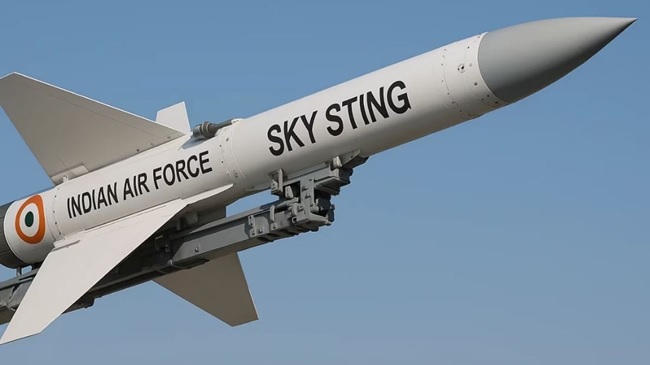
The Sky Sting is a 6th-generation Beyond-Visual-Range Air-to-Air Missile (BVRAAM) being developed by Rafael Advanced Defense Systems.
It is designed to give air forces the ability to engage enemy aircraft from very long distances, beyond the pilot’s visual range, thereby enhancing survivability and air superiority.
1. Long Engagement Range
2. Advanced Propulsion
3. Intelligent Seeker Technology
4. Two-Way Data Link
5. Aircraft Compatibility
1. Evolving Aerial Threats
Modern air combat increasingly relies on long-range precision engagements rather than close dogfights.
2. Regional Security Environment
Neighbouring adversaries are inducting advanced fighter aircraft equipped with long-range air-to-air missiles.
3. Countering Stealth and EW Systems
Sky Sting is designed to engage stealth aircraft and operate in electronically contested environments.
4. Indigenous Platform Enhancement
Equipping Tejas Mk1A with cutting-edge missiles significantly enhances its combat effectiveness.
India and Israel established full diplomatic relations in 1992. Since then, defence cooperation has emerged as a central pillar of bilateral ties.
Israel is among India’s top defence technology partners, supplying:
Past collaborations include advanced missile systems and radar technologies integrated into Indian platforms.
Sky Sting negotiations reflect the next phase — moving towards joint development, advanced technology transfer, and high-end air combat systems.
1. Air Superiority Enhancement
Provides the IAF with long-range engagement dominance.
2. Technological Edge
Incorporates AI-enabled seeker and advanced propulsion — aligning with 6th-generation warfare concepts.
3. Force Multiplication
Enables lighter platforms like Tejas to carry high-impact weaponry.
4. Strengthening Strategic Partnership
Signals deepening India–Israel defence industrial cooperation.
5. Deterrence Signalling
Long-range BVRAAM capability enhances deterrence by complicating adversary air operations.
Modern air warfare increasingly emphasises:
The Sky Sting missile fits within this doctrinal shift, addressing challenges posed by stealth aircraft and advanced countermeasures.
FAQsQ1. What is a Beyond-Visual-Range Air-to-Air Missile (BVRAAM)? A missile capable of engaging targets beyond the pilot’s visual sight, using radar and data-link guidance. Q2. Who is developing the Sky Sting missile? It is being developed by Rafael Advanced Defense Systems of Israel. Q3. What makes Sky Sting a 6th-generation missile? Its AI-enabled seeker, advanced propulsion, electronic counter-countermeasures, and network integration features. Q4. Which Indian aircraft can carry Sky Sting? It is compatible with Tejas Mk1A and Su-30MKI platforms. Q5. Why is long-range missile capability important? It allows aircraft to neutralise threats from safe distances, enhancing survivability and strategic deterrence. |



Our support team will be happy to assist you!

 Contact Us
  New Batch : 9555124124/ 7428085757
  Tech Support : 9555124124/ 7428085757