Prelims: Oceans, Marine Resources, Indian Ocean Region and Oceanographic Features.
Science & Technology - Deep-Sea Exploration, Underwater Vehicles and Indigenous Technology.
Mains: GS Paper III - Science & Technology, Environment and Ecology and Economy
Keywords: Sagar Manthan, GRSE, Ocean Research Vessel, Indigenous Ocean Research Vessel, Deep Ocean Mission, NCPOR, Deep-Sea Exploration, Oceanographic Research, Marine Research, Blue Economy, Indian Ocean, Southern Ocean, Bay of Bengal, Marine Mineral Resources, Manganese Nodules, Polymetallic Sulphides, Profiling, Geophysical Surveys, Seabed Exploration, Ocean Technology, Indigenous Shipbuilding, Marine Scientific Research. |
Why in News?
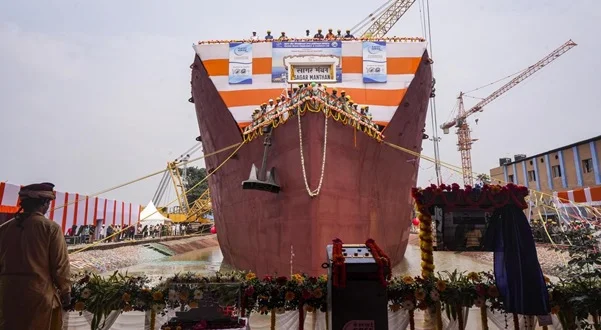
Kolkata-based Garden Reach Shipbuilders and Engineers (GRSE) launched ‘Sagar Manthan’ on September 9, 2026. The indigenous ocean research vessel is being built for the National Centre for Polar and Ocean Research (NCPOR) under the Ministry of Earth Sciences.
Important Points
- ‘Sagar Manthan’ is an indigenous ocean research vessel being constructed by GRSE.
- The vessel is being built for the National Centre for Polar and Ocean Research (NCPOR).
- It is being developed under the government’s Deep Ocean Mission.
- The vessel was launched at GRSE’s Rishi Bankim Shipyard.
- It will have a maximum speed of 14 knots at 90% maximum continuous rating.
- It can conduct swath multibeam and geophysical seismic surveys up to 6 km depth.
- It will support Conductivity, Temperature and Depth (CTD) profiling and water sampling.
- It can launch and recover Autonomous Underwater Vehicles (AUVs) and Remotely Operated Vehicles (ROVs).
- It will operate in the Indian Ocean, Bay of Bengal and Southern Ocean, including waters around Antarctica.
- The vessel is expected to be ready for use by early 2028 and will strengthen India’s capabilities in deep-sea exploration, oceanographic research and marine resource studies.
Scientific Capabilities of ‘Sagar Manthan’
The vessel will be equipped with advanced scientific systems for oceanographic and geophysical research. These include:
- Sub-bottom profilers for studying layers beneath the seabed.
- Seismic equipment for geophysical surveys.
- Advanced oceanographic instruments.
- Doppler weather radar for atmospheric observations.
- Systems for multibeam and geophysical seismic surveys.
- Conductivity, Temperature and Depth (CTD) profiling.
- Facilities for water and biological sampling.
- Equipment for seabed sampling using corers and grabs.
- Facilities for rock dredging.
- Systems for mooring and data buoy operations.
- Instruments for meteorological and ocean-current measurements.
Role in Deep-Sea Research
- ‘Sagar Manthan’ has been designed to conduct research in both coastal and deep-sea areas. It will support scientific studies in the Indian Ocean, Bay of Bengal and Southern Ocean, including waters around Antarctica.
- The vessel will be capable of operating in severe sea conditions, allowing Indian scientists to conduct research in difficult and remote ocean regions.
Role in Deep-Sea Exploration
- ‘Sagar Manthan’ will allow Indian scientists to conduct research in deep and difficult ocean environments.
- It will be capable of undertaking surveys at depths of up to 6 km, helping scientists study the seabed, geological structures, marine ecosystems and other deep-ocean features.
- The vessel’s ability to operate in severe sea conditions will also support research in the Southern Ocean and Antarctic waters.
Support for Underwater Vehicles
- The vessel will also be capable of launching and recovering Autonomous Underwater Vehicles (AUVs) and Remotely Operated Vehicles (ROVs).
- These underwater systems are being developed by the National Institute of Ocean Technology (NIOT) under the Deep Ocean Mission.
Role in Marine Mineral Exploration
- The vessel will strengthen India’s ability to explore marine mineral resources, particularly:
- Manganese nodules
- Polymetallic sulphides
- Other deep-sea mineral resources
- Such exploration is important for understanding India’s marine resource potential and supporting the sustainable use of ocean resources.
Deep Ocean Mission
- The Deep Ocean Mission (DOM) is an Indian government initiative aimed at developing technologies and capabilities for the sustainable exploration of deep-sea resources.
- It focuses on areas such as:
- Deep-sea mining technologies
- Manned submersible technology
- Ocean climate change advisory services
- Biodiversity exploration
- Deep-sea survey and exploration
- Capacity building in marine sciences
- ‘Sagar Manthan’ will complement these efforts by providing a specialised platform for oceanographic and geophysical research.
Importance for India’s Blue Economy
- The vessel is also expected to contribute to India’s Blue Economy objectives.
- Ocean-based scientific research can support sectors such as:
- shipping,
- marine resources,
- Ocean energy,
- logistics,
- tourism,
- fisheries,
- Coastal and deep-sea activities
- Better understanding of the ocean will help India develop marine resources while promoting scientific and sustainable management of ocean ecosystems.
Research and Training Facilities
- ‘Sagar Manthan’ will also function as a floating research platform.
- Scientists will be able to conduct analysis and data processing onboard.
- The vessel will also provide facilities for the training and education of scientists and technical personnel.
Significance for India
The launch of ‘Sagar Manthan’ is significant because it will:
- Strengthen India’s indigenous ocean research capabilities.
- Increase the capacity of India’s scientific research fleet.
- Support deep-sea exploration and oceanographic studies.
- Improve research capabilities in the Indian Ocean Region.
- Support exploration of marine mineral resources.
- Strengthen India’s activities in the Southern Ocean and Antarctic region.
- Contribute to the objectives of the Deep Ocean Mission and Blue Economy.
- Promote indigenous shipbuilding for specialised scientific research.
Challenges
- High Cost: Building and maintaining specialised ocean research vessels and advanced deep-sea equipment requires significant financial investment.
- Technological Complexity: Deep-sea exploration involves extreme pressure, low temperatures and difficult operating conditions, requiring highly advanced technologies.
- Environmental Risks: Exploration and extraction of marine minerals may disturb deep-sea ecosystems and affect marine biodiversity.
- Limited Scientific Infrastructure: India needs more specialised research vessels, underwater technologies and advanced ocean-monitoring systems.
- Skilled Manpower: Deep-sea research requires trained scientists, engineers, technicians and underwater technology experts.
- Harsh Ocean Conditions: Severe weather and rough sea conditions, particularly in the Southern Ocean, can make research operations challenging.
- Data and Knowledge Gaps: Large parts of the deep ocean remain poorly explored, creating challenges in mapping, monitoring and understanding marine ecosystems.
- International Coordination: Research in international waters and the Southern Ocean requires adherence to international maritime and environmental regulations.
Way Forward
- Strengthen Indigenous Technology: Invest in advanced underwater vehicles, sensors, seabed mapping and deep-sea exploration technologies.
- Expand Ocean Research Infrastructure: Increase India’s fleet of specialised research vessels to support regular and comprehensive oceanographic surveys.
- Promote Sustainable Resource Exploration: Explore marine minerals such as manganese nodules and polymetallic sulphides while ensuring environmental sustainability.
- Enhance International Cooperation: Strengthen partnerships with other countries and international organisations for research in the Indian Ocean and Southern Ocean.
- Accelerate the Deep Ocean Mission: Increase investment in deep-sea technologies, scientific research and skilled manpower.
- Promote the Blue Economy: Balance economic opportunities from ocean resources with marine ecosystem conservation and sustainable resource management.
- Build Scientific Capacity: Develop specialised training and research programmes for scientists, engineers and technical personnel.
Conclusion
The launch of ‘Sagar Manthan’ marks an important step in strengthening India’s ocean research infrastructure. With its advanced scientific equipment, deep-sea survey capabilities and ability to operate in challenging waters, the vessel will help Indian scientists undertake research from the Indian Ocean to the Southern Ocean and waters around Antarctica. It is expected to play an important role in India’s Deep Ocean Mission, marine resource exploration and Blue Economy vision.
Prelims practice question
Q. With reference to ‘Sagar Manthan’, consider the following statements:
- It is an indigenous ocean research vessel being built by GRSE.
- It is being built for the National Centre for Polar and Ocean Research.
- It is designed to conduct surveys at depths of up to 6 km.
- It will operate only in the Bay of Bengal.
Which of the statements given above are correct?
A. 1, 2 and 3 only
B. 1 and 2 only
C. 2, 3 and 4 only
D. 1, 2, 3 and 4
Mains practice Question
Q. India’s deep-sea exploration capabilities are important for both scientific research and the development of the Blue Economy. Discuss the significance of indigenous research vessels such as ‘Sagar Manthan’ in strengthening India’s ocean capabilities.
|
FAQs
Q1. What is ‘Sagar Manthan’?
‘Sagar Manthan’ is an indigenous ocean research vessel being built by GRSE for NCPOR.
Q2. What is the cost of ‘Sagar Manthan’?
The vessel is being constructed at an estimated cost of ₹840 crore.
Q3. Who is building ‘Sagar Manthan’?
The vessel is being built by Garden Reach Shipbuilders and Engineers (GRSE) at its Rishi Bankim Shipyard.
Q4. What is the role of NCPOR?
The National Centre for Polar and Ocean Research (NCPOR) will coordinate the vessel’s research activities under the Ministry of Earth Sciences.
Q5. How deep can ‘Sagar Manthan’ conduct surveys?
The vessel will be capable of conducting swath multibeam and geophysical seismic surveys at depths of up to 6 km.
|






 Contact Us
  New Batch : 9555124124/ 7428085757
  Tech Support : 9555124124/ 7428085757