Memory of the World: Rajatarangini, Mahabharata and Arthashastra Receive UNESCO Recognition

Prelims: UNESCO, Memory of the World, MOWCAP, IGNCA, ancient Indian literature.
Mains: GS Paper I: Indian culture, ancient literature, historical traditions and heritage
GS Paper II: International organisations, UNESCO and cultural diplomacy
GS Paper III: Digitisation, preservation technology and scientific conservation

Why in news?

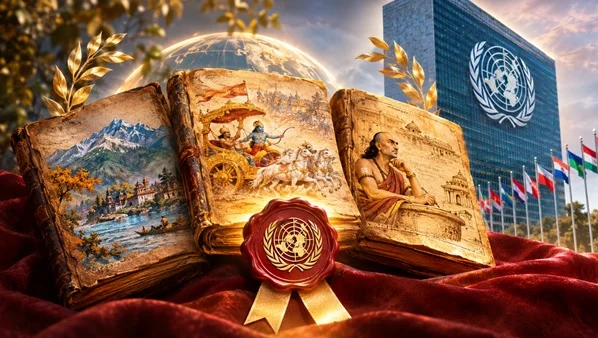
  • On 5 November 2026, UNESCO's Memory of the World Asia-Pacific Regional Register recognised three important Indian documentary heritage works: The Manuscript of Rajatarangini by Kalhana, The Birch-bark Manuscript of Mahabharata and Kautilya's Arthashastra an Ancient Palm leaf Manuscript on Governance and Statecraft.

Key Facts 

Particulars

Details

Recognition

UNESCO Memory of the World Regional Register

Newly recognised works

Rajatarangini, Mahabharata and Arthashastra

Recognition announced

5 November 2026

UNESCO regional programme

Memory of the World: Asia and the Pacific

Committee

Memory of the World Committee for Asia and the Pacific (MOWCAP)

Session

11th Session

Venue

Jakarta, Indonesia

Indian nodal institution

IGNCA

India's total regional inscriptions

6

Main objective

Preservation of documentary heritage

What is UNESCO's Memory of the World Programme?

  • The Memory of the World (MoW) Programme is an international initiative launched by UNESCO in 1992 to preserve the world's documentary heritage and protect historically and culturally significant records from loss, deterioration and destruction.
  • Documentary heritage includes manuscripts, historical documents, archives, books, photographs, films, sound recordings and other important records that preserve human knowledge and collective memory.
  • Major objectives are: 
    • Preservation: Protect valuable historical documents and manuscripts.
    • Accessibility: Improve public access to documentary heritage.
    • Awareness: Promote understanding of the importance of historical records.
    • International Cooperation: Encourage collaboration among countries and institutions.
    • Knowledge Transmission: Ensure that documentary heritage remains available for future generations.

Three levels of the Memory of the World Programme

Register

Coverage

Purpose

International Register

Global

Recognises documentary heritage of outstanding worldwide significance.

Regional Register

Regional

Recognises documentary heritage significant to a particular geographical region.

National Register

Country-specific

Identifies and promotes important documentary heritage within individual countries.

Understanding the Three Newly Recognised Indian Works

A. Rajatarangini: The Historical Chronicle of Kashmir

Particulars

Details

Work

Rajatarangini

Author

Kalhana

Period

12th century CE

Language

Sanskrit

Script of recognised manuscript

Sharada

Preserved at

Oriental Research Library, Srinagar

Historical significance

Chronicle of Kashmir's kings and political history

B. Mahabharata: India's Great Epic of Philosophy and Dharma

  • The Mahabharata, traditionally attributed to Maharishi Ved Vyasa, is one of theworld's longest epic compositions and an important foundation of Indian philosophical, ethical and literary traditions.
  • It narrates the conflict between the Pandavas and Kauravas and explores broader questions relating to Dharma, duty, justice, morality, leadership and human relationships.
  • The Mahabharata is not merely an epic about a war. It is also a vast source of philosophical and ethical discussions.
  • The Bhagavad Gita, which forms part of the Mahabharata, discusses Karma Yoga, Bhakti Yoga and Jnana Yoga, along with the relationship between duty and spiritual understanding.
  • Important features of the Mahabharata are: 
    • Traditionally attributed to Maharishi Ved Vyasa.
    • Written in Sanskrit.
    • Traditionally divided into 18 Parvas (books).
    • Contains approximately 100,000 verses in its commonly described traditional form.
    • Includes the Bhagavad Gita as an important philosophical section.
    • Explores Dharma, Karma, justice, duty and ethical decision-making.

C. Arthashastra: Ancient India's Treatise on Governance and Statecraft

  • The Arthashastra, traditionally attributed to Kautilya (Chanakya or Vishnugupta), is one of the most important ancient Indian texts on political administration, economics, diplomacy and statecraft.
  • It provides a systematic discussion of how a state should be governed, how economic resources should be managed and how a ruler should maintain security and political stability.
  • The Arthashastra is a valuable source for understanding ancient Indian political and economic thought.
  • It discusses the responsibilities of the state, the importance of public finance, administrative efficiency, law enforcement, national security and foreign relations.
  • Its ideas remain relevant to the academic study of political science, economics, international relations and public administration.
  • Important features of Arthashastra are: 
    • Traditionally attributed to Kautilya.
    • Written in Sanskrit.
    • Deals with governance, administration and public finance.
    • Discusses taxation, agriculture, trade and economic management.
    • Explains diplomacy, espionage and military strategy.
    • Includes the Saptanga Theory of the State and Mandala Theory of foreign relations.

Comparison of the Three Newly Recognised Works

Basis

Rajatarangini

Mahabharata

Arthashastra

Author

Kalhana

Ved Vyasa (traditional attribution)

Kautilya

Main subject

History of Kashmir

Epic, philosophy and Dharma

Governance and statecraft

Language

Sanskrit

Sanskrit

Sanskrit

Recognised manuscript

Sharada manuscript

Birch-bark manuscript

Palm-leaf manuscript

Script

Sharada

Sharada

Grantha

Manuscript location

Srinagar

Pune

Mysuru

Main contribution

Historical documentation

Ethical and philosophical thought

Political and economic administration

India's Previous Entries in the UNESCO Asia-Pacific Regional Register

Documentary Heritage

Importance

Illustrated Manuscripts of Ramcharitmanas

Preserves Tulsidas's devotional literary tradition through illustrated manuscripts.

Manuscript of Sahṛdayaloka-Locana

Important work on Sanskrit poetics, aesthetics and literary theory.

15th-Century Manuscript of Panchatantra

Preserves India's traditional animal fables and moral storytelling.

Role of the Indira Gandhi National Centre for the Arts (IGNCA)

  • Facilitates the nomination of India's documentary heritage for UNESCO recognition.
  • Supports the preservation and conservation of rare manuscripts.
  • Promotes research on India's artistic, cultural and intellectual traditions.
  • Organises workshops and awareness programmes related to documentary heritage.
  • Encourages international cooperation for manuscript preservation.

Significance of UNESCO Recognition for India

  • Cultural Heritage: Strengthens international recognition of India's ancient knowledge traditions.
  • Historical Research: Encourages further study of historical records and manuscripts.
  • Literature: Highlights India's contribution to world literature and epic traditions.
  • Political Science: Recognises ancient Indian contributions to governance and diplomacy.
  • Manuscript Conservation: Encourages scientific preservation of rare historical manuscripts.

Difference between UNESCO's Major Heritage Recognition Programmes

Programme

What does it recognise?

Example

World Heritage List

Cultural and natural sites

Taj Mahal, Kaziranga National Park

Intangible Cultural Heritage List

Living traditions and practices

Yoga, Kumbh Mela

Memory of the World Register

Documentary heritage

Rigveda manuscripts, newly recognised Indian manuscripts

Challenges in Preserving India's Manuscript Heritage

  • Physical Deterioration: Palm-leaf and birch-bark manuscripts are vulnerable to humidity, insects, heat and ageing.
  • Lack of Digitisation: Many rare manuscripts are not yet digitally documented or easily accessible.
  • Conservation Infrastructure: Scientific preservation facilities and trained conservators are not uniformly available.
  • Language and Script Barriers: Ancient languages and scripts require specialised expertise for interpretation.
  • Fragmentation of Collections: Historical manuscripts may be distributed across different libraries, archives and institutions.

Prelims MCQ

Q. Rajatarangini, recently recognised by UNESCO, is primarily associated with the history of:

A. Magadha

B. Kashmir

C. Gujarat

D. Bengal

Mains Practice Question

Q. Discuss the significance of India's ancient literary and intellectual traditions in shaping its cultural and historical identity. 

FAQs

What is the latest UNESCO recognition received by India in November 2026?

Three works (Rajatarangini, Mahabharata and Arthashastra) have been included in UNESCO's Memory of the World Asia-Pacific Regional Register.

What is the main subject of Arthashastra?

Governance, administration, economics, diplomacy and statecraft.

Where was the 11th MOWCAP session held?

Jakarta, Indonesia.

When was UNESCO's Memory of the World Programme launched?

1992.

Which organisation coordinates India's participation in the Memory of the World Programme?

The Indira Gandhi National Centre for the Arts (IGNCA).