Why in news?
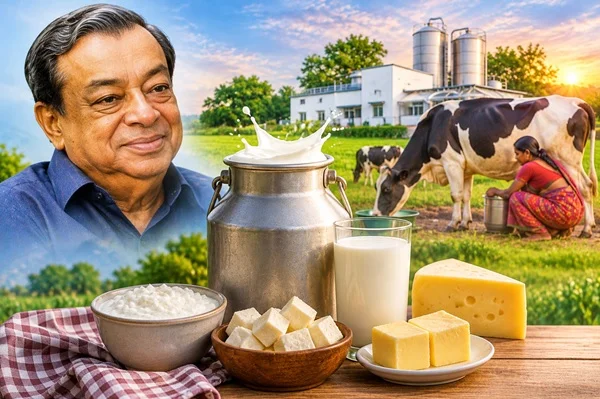
National Milk Day is observed every year on 26 November to commemorate the birth anniversary of Dr. Verghese Kurien, popularly known as the Father of the White Revolution in India.
Key Facts
|
Particular
|
Details
|
|
Occasion
|
National Milk Day
|
|
Observed On
|
26 November
|
|
First Celebrated
|
2014
|
|
Associated Personality
|
Dr. Verghese Kurien
|
|
Popularly Known As
|
Father of the White Revolution
|
|
Date of Birth
|
26 November 1921
|
|
Birthplace
|
Kozhikode, Kerala
|
|
Major Contribution
|
Operation Flood and dairy cooperative movement
|
|
Operation Flood Launched
|
1970
|
|
Important Institution
|
National Dairy Development Board (NDDB)
|
|
NDDB Established
|
1965
|
|
Nodal Ministry
|
Ministry of Fisheries, Animal Husbandry and Dairying
|
|
2026 Celebration Venue
|
Bapu Sabhagar, Patna, Bihar
|
|
India's Global Position
|
World's largest milk producer
|
What is National Milk Day?
- National Milk Day is observed to recognise the importance of milk and the dairy sector in India's nutritional, economic and agricultural development.
- It commemorates the birth anniversary of Dr. Verghese Kurien, whose efforts played a transformative role in India's dairy cooperative movement.
- The day celebrates the achievements of dairy farmers, milk cooperatives, veterinary professionals and institutions involved in milk production and distribution.
- It highlights the contribution of dairy farming towards rural employment, women's economic empowerment and nutritional security.
- It also encourages scientific animal breeding, improved livestock healthcare, better milk processing and sustainable dairy production.
Who Was Dr. Verghese Kurien?
- Dr. Verghese Kurien (1921–2012) was an Indian social entrepreneur, engineer and dairy development pioneer who played a central role in transforming India's dairy industry.
- He is popularly known as the Father of the White Revolution in India and the architect of Operation Flood.
Major Contributions of Dr. Verghese Kurien
- Dairy Cooperative Movement: Helped establish a farmer-owned dairy cooperative model that enabled producers to collectively market their milk.
- Amul: Played a major role in developing Amul into a successful dairy cooperative brand.
- Operation Flood: Led the programme that expanded milk production and connected rural milk producers with urban consumers.
- NDDB: Served as its founding Chairman from 1965 to 1998.
- GCMMF: Helped establish the Gujarat Cooperative Milk Marketing Federation in 1973, which markets Amul products.
- IRMA: Helped establish the Institute of Rural Management Anand in 1979 to develop professional management capabilities in rural institutions.
Major Awards and Recognition
|
Award
|
Year
|
|
Ramon Magsaysay Award
|
1963
|
|
Padma Shri
|
1965
|
|
Padma Bhushan
|
1966
|
|
World Food Prize
|
1989
|
|
Padma Vibhushan
|
1999
|
What is the White Revolution?
- The White Revolution refers to the transformation of India's dairy sector through increased milk production, improved dairy infrastructure and the expansion of cooperative institutions.
- It aimed to make India self-sufficient in milk production and reduce dependence on imported dairy products.
- It was driven primarily by Operation Flood, launched in 1970 by the National Dairy Development Board.
- The programme connected rural milk producers with urban markets through an organised national milk distribution network.
- It helped improve farmers' incomes by providing them with access to organised procurement, processing and marketing facilities.
Operation Flood: The Foundation of India's White Revolution
- Operation Flood was launched in 1970 by the National Dairy Development Board under the leadership of Dr. Verghese Kurien.
- It is regarded as one of the world's largest dairy development programmes.
|
Phase
|
Period
|
Major Achievements
|
|
Phase I
|
1970-1980
|
Connected 18 major milk sheds with four metropolitan cities: Delhi, Mumbai, Kolkata and Chennai
|
|
Phase II
|
1981-1985
|
Expanded milk sheds from 18 to 136 and developed a network of 43,000 village cooperatives
|
|
Phase III
|
1985-1996
|
Strengthened dairy cooperatives, veterinary services, animal feed and milk-processing infrastructure
|
India's Dairy Sector: Latest Statistics and Global Position
- India has emerged as the world's largest milk producer, contributing nearly one-fourth of global milk production.
- The dairy sector is an important component of India's rural economy, providing income and employment to millions of households.
Milk Production in India
- Milk production increased by approximately 69.41% between 2014–15 and 2024–25.
- Per capita availability increased from 319 grams per day to 485 grams per day.
- India contributes nearly 25% of global milk production.
- The dairy sector provides livelihoods to approximately 8.5 crore rural households.
- Women account for nearly 70% of India's dairy farming workforce.
|
Financial Year
|
Milk Production (Million Tonnes)
|
Per Capita Availability (grams/day)
|
|
2014–15
|
146.31
|
319
|
|
2018–19
|
187.7
|
394*
|
|
2019–20
|
198.4
|
406
|
|
2020–21
|
210.0
|
427
|
|
2021–22
|
222.1
|
446
|
|
2022–23
|
230.6
|
459
|
|
2023–24
|
239.3
|
471
|
|
2024–25
|
247.87
|
485
|
Top Milk-Producing States in India
|
Rank
|
State
|
Share in National Production
|
|
1
|
Uttar Pradesh
|
15.66%
|
|
2
|
Rajasthan
|
14.82%
|
|
3
|
Madhya Pradesh
|
9.12%
|
|
4
|
Gujarat
|
7.78%
|
|
5
|
Maharashtra
|
6.71%
|
India's Dairy Cooperative Movement
|
Level
|
Institution
|
Function
|
|
Village Level
|
Dairy Cooperative Society
|
Collects milk from individual farmers
|
|
District Level
|
District Milk Union
|
Processes milk and provides technical services
|
|
State Level
|
State Milk Federation
|
Markets milk and dairy products
|
Important Dairy Institutions
- Amul – Anand Milk Union Limited
- Originated from the Kaira District Cooperative Milk Producers' Union.
- Established in 1946.
- Became a successful model of farmer-owned dairy cooperatives.
- Its products are marketed by the Gujarat Cooperative Milk Marketing Federation (GCMMF).
- National Dairy Development Board (NDDB)
- Established in 1965.
- Headquartered in Anand, Gujarat.
- Supports dairy cooperatives and milk producers.
- Played a central role in implementing Operation Flood.
- Gujarat Cooperative Milk Marketing Federation (GCMMF)
- Established in 1973.
- Responsible for marketing Amul products.
- Provides a common marketing platform for affiliated dairy cooperative unions.
- Institute of Rural Management Anand (IRMA)
- Established in 1979.
- Promotes professional management and research in rural development.
- Supports the development of cooperative and rural institutions.
White Revolution 2.0: A New Phase of Dairy Development
- White Revolution 2.0 is a cooperative-led initiative aimed at strengthening India's dairy network and increasing milk procurement through dairy cooperatives.
- It was formally launched on 25 December 2024, with its Standard Operating Procedure (SOP) introduced on 19 September 2024.
Targets by 2028-29
|
Particular
|
Target
|
|
New Dairy Cooperative Societies
|
75,000
|
|
Existing Societies to be Strengthened
|
46,422
|
|
Increase in Cooperative Milk Procurement
|
50% over five years
|
Progress as of 31 October 2026
|
Particular
|
Achievement
|
|
New Dairy Cooperative Societies Formed
|
24,097
|
|
Existing Societies Strengthened
|
31,394
|
Government Initiatives to Strengthen India's Dairy Sector
- Rashtriya Gokul Mission (RGM)
- Launched in December 2014.
- Aims to conserve and develop indigenous bovine breeds.
- Focuses on genetic improvement and scientific breeding.
- Promotes artificial insemination and improved reproductive technologies.
- Seeks to enhance milk production and productivity of indigenous cattle.
- National Programme for Dairy Development (NPDD)
- Aims to strengthen milk procurement, processing and marketing infrastructure.
- Supports the establishment of village-level milk collection centres.
- Promotes milk chilling facilities and quality-testing laboratories.
- Encourages the formation and strengthening of dairy cooperatives.
- Focuses on improving the income of milk producers.
- Animal Husbandry Infrastructure Development Fund (AHIDF)
- Provides financial support for developing modern infrastructure in the animal husbandry sector.
- Encourages investment in dairy processing and value addition.
- Supports the development of cold-chain infrastructure.
- Promotes private-sector investment and entrepreneurship in dairy infrastructure.
- Dairy Processing and Infrastructure Development Fund (DIDF)
- Introduced to modernise milk processing and chilling infrastructure.
- Supports the expansion and modernisation of dairy cooperative infrastructure.
- Aims to improve milk handling, processing and quality.
- NDDB has played an important role in implementing the programme.
- National Livestock Mission (NLM)
- Focuses on sustainable development of the livestock sector.
- Encourages entrepreneurship in livestock-related activities.
- Supports fodder development and feed-related initiatives.
- Aims to improve productivity and rural livelihoods.
- Kisan Credit Card (KCC) for Animal Husbandry and Dairy Farmers
- Extends institutional credit facilities to eligible dairy and animal husbandry farmers.
- Helps meet working capital requirements.
- Supports expenditure on feed, veterinary care and other recurring livestock-related needs.
- Reduces dependence on informal sources of credit.
National Milk Day 2026: Important Announcements and Initiatives
|
Initiative
|
Purpose
|
|
Basic Animal Husbandry Statistics 2026
|
Release of updated livestock production and availability data
|
|
Climate-Resilient Dairy Roadmap
|
Promote sustainable and climate-resilient livestock development
|
|
Dairy Cooperative Rating and Grading SOP
|
Improve transparency and institutional performance
|
|
Online Rating and Grading Portal
|
Digitise the evaluation process
|
|
Data Processing and Milk Collection Units
|
Strengthen milk procurement and testing
|
|
Mineral Mixture Plants
|
Improve animal nutrition
|
|
Effluent Treatment Plant
|
Promote environmentally sustainable dairy operations
|
|
Namaste India Milk Processing Plant, Bihta
|
Add processing capacity of 2 lakh litres per day
|
|
Sudha Makhana Kheer and Rabri
|
Promote value-added dairy products
|
Significance of India's Dairy Sector
- Nutritional Security
- Milk provides high-quality animal protein, calcium, magnesium and potassium.
- It contributes to nutrition among children and adults.
- Dairy products form an important part of India's food consumption.
- Rural Employment and Income
- Dairy farming provides livelihoods to approximately 8.5 crore rural households.
- It provides an additional source of income to small and marginal farmers.
- It supports rural entrepreneurship and allied industries.
- Women Empowerment
- Women constitute nearly 70% of India's dairy farming workforce.
- Dairy cooperatives provide women with opportunities for financial independence.
- Direct bank payments and collective ownership can strengthen women's economic participation.
- Agricultural Diversification
- Dairy farming provides farmers with an additional income source apart from crop cultivation.
- It reduces dependence on seasonal agricultural income.
- Cattle dung can be used for organic manure and biogas production.
- Economic Contribution
- India contributes nearly one-fourth of global milk production.
- The dairy sector contributes approximately 5% to the national economy.
- It supports industries involved in milk processing, packaging, transportation and food manufacturing.
Challenges Facing India's Dairy Sector
- Low Animal Productivity: Milk productivity per animal remains relatively low compared with several developed dairy-producing countries.
- Animal Diseases: Diseases such as Foot-and-Mouth Disease and Brucellosis affect livestock health and milk production.
- Fodder Shortage: Limited availability of quality green fodder and balanced animal feed affects productivity.
- Fragmented Production: A large proportion of milk production comes from small and marginal farmers with limited resources.
- Cold-Chain Infrastructure: Inadequate chilling, storage and transportation facilities can result in milk spoilage.
- Quality and Adulteration: Maintaining consistent milk quality and preventing adulteration remain important concerns.
- Climate Change: Rising temperatures, water scarcity and extreme weather events affect animal health and milk productivity.
- Market Access: Farmers in remote areas may lack access to organised procurement and processing facilities.
Environmental Concerns Associated with Dairy Farming
|
Environmental Issue
|
Impact
|
|
Methane Emissions
|
Contribute to greenhouse gas emissions
|
|
Water Consumption
|
Dairy farming requires significant water resources
|
|
Manure Management
|
Improper disposal can cause soil and water pollution
|
|
Feed Production
|
Requires land, water and agricultural inputs
|
|
Wastewater
|
Dairy processing generates wastewater requiring treatment
|
|
Climate Stress
|
Heat stress can reduce animal productivity
|
Prelims MCQ
Q. With reference to India's White Revolution and dairy development, consider the following statements:
- Operation Flood was launched in 1970 by the National Dairy Development Board.
- Dr. Verghese Kurien was the founding Chairman of NDDB.
- National Milk Day is observed on 1 June every year.
- India is the world's largest milk-producing country.
Which of the statements given above are correct?
(a) 1 and 2 only
(b) 1, 2 and 4 only
(c) 2, 3 and 4 only
(d) 1, 2, 3 and 4
Mains Practice Question
Q. The White Revolution transformed India from a milk-deficient country into the world's largest milk producer. Examine.
|
FAQs
When is National Milk Day celebrated in India?
26 November every year.
Why is National Milk Day celebrated on 26 November?
It commemorates the birth anniversary of Dr. Verghese Kurien, born on 26 November 1921.
Who is known as the Father of the White Revolution in India?
Dr. Verghese Kurien.
When was Operation Flood launched?
1970.
Which institution implemented Operation Flood?
The National Dairy Development Board (NDDB).
|