Why in news?
On 25 November 2026, the Government of India announced the approval of six brownfield gas-based urea projects involving an estimated investment of ₹54,000 crore.
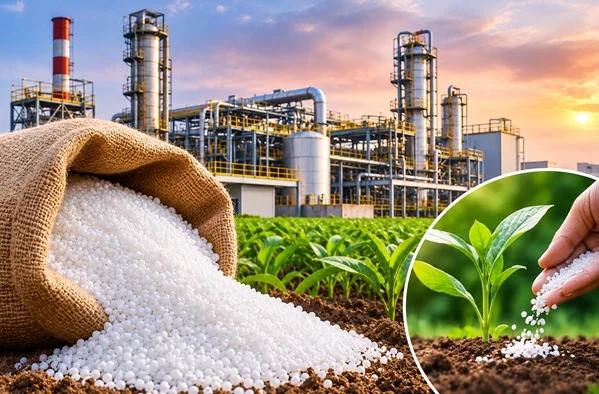
Key Facts
|
Particular
|
Details
|
|
Policy Name
|
National Investment Policy for Urea (NIPU)-2026
|
|
Approved Projects
|
6 brownfield gas-based urea projects
|
|
Total Investment
|
Approximately ₹54,000 crore
|
|
Project Cost
|
Approximately ₹9,000 crore each
|
|
Total Additional Capacity
|
76.2 LMT per annum
|
|
Capacity per Project
|
12.7 LMT per annum
|
|
Approval Date of Policy
|
15 July 2026
|
|
Policy Notification
|
30 July 2026
|
|
Implementing Ministry
|
Ministry of Chemicals and Fertilizers
|
|
Department
|
Department of Fertilizers
|
|
Project Locations
|
Tamil Nadu, Punjab, Uttar Pradesh, West Bengal and Rajasthan
|
|
Major Objective
|
Domestic urea production and import reduction
|
|
Investment Category
|
Public sector, private sector and cooperative sector
|
What are Brownfield Gas-Based Urea Projects?
- Brownfield projects refer to the expansion, modernisation or replacement of existing industrial facilities using already available infrastructure.
- Unlike greenfield projects, which are established on entirely new sites, brownfield projects utilise existing land, utilities, transportation facilities and technical manpower.
- In the fertiliser sector, brownfield expansion involves upgrading existing urea manufacturing complexes or replacing outdated production units with modern facilities.
- These projects use natural gas as the primary feedstock for producing ammonia, which is subsequently used to manufacture urea.
- The approach helps reduce project costs, avoid unnecessary infrastructure duplication and accelerate implementation.
Brownfield vs Greenfield Projects
|
Basis
|
Brownfield Projects
|
Greenfield Projects
|
|
Meaning
|
Expansion or modernisation of existing facilities
|
Establishment of a completely new facility
|
|
Land
|
Uses existing industrial land
|
Generally requires new land
|
|
Infrastructure
|
Utilises existing infrastructure
|
Requires new infrastructure
|
|
Initial Investment
|
Often comparatively lower
|
Generally higher
|
|
Implementation
|
Can be faster
|
May take longer
|
|
Risk
|
Existing operational and infrastructure constraints
|
Land acquisition and infrastructure development risks
|
|
Example
|
Expansion of an existing urea plant
|
Setting up a new urea manufacturing complex
|
Details of the Six Approved Urea Projects
- MFL-Madras Project
- Located in Chennai, Tamil Nadu.
- A public-sector brownfield replacement project.
- Aims to replace an existing unit that is more than 60 years old.
- The older facility faces high production costs, excessive energy consumption and process-safety concerns.
- The proposed modern unit will have an annual installed production capacity of 12.7 LMT.
- NFL-Nangal Project
- Located in Nangal, Punjab.
- A public-sector replacement project.
- The existing plant was established in 1978 and has a present capacity of 4.73 LMT per annum.
- It will be replaced by a modern unit with a capacity of 12.7 LMT per annum.
- The existing facility has relatively high energy consumption and operational inefficiencies.
- KFL-Shahjahanpur Project
- Located in Shahjahanpur, Uttar Pradesh.
- A cooperative-sector brownfield project associated with KRIBHCO.
- Aims to expand the existing unit commissioned in 1995.
- The proposed installed capacity is 12.7 LMT per annum.
- Matix-Panagarh Project
- Located in Panagarh, West Bengal.
- A private-sector brownfield project.
- Builds upon an existing modern fertiliser complex commissioned in 2017.
- The new unit will have an annual installed production capacity of 12.7 LMT.
- It will help support West Bengal's fertiliser requirements, as the state currently has only one urea plant.
- CFCL-Gadepan Project
- Located at Gadepan in Kota, Rajasthan.
- A private-sector expansion project by Chambal Fertilisers and Chemicals Limited.
- Aims to expand the existing complex, which has been operational since 1994.
- The proposed capacity is 12.7 LMT per annum.
- IIPL-Jagdishpur Project
- Located in Jagdishpur, Uttar Pradesh.
- A private-sector brownfield project.
- Proposes an additional installed production capacity of 12.7 LMT per annum.
- The existing plant was established in 1988.
Why does India need more Urea Production?
- Rising Agricultural Demand: Growing agricultural requirements necessitate a reliable supply of fertilisers.
- Import Dependence: Domestic production has not always been sufficient to meet total urea consumption.
- Foreign Exchange Savings: Higher domestic production can reduce expenditure on imported urea.
- Ageing Infrastructure: Several older plants consume more energy and have higher production costs.
- Energy Efficiency: Modern gas-based facilities can improve energy efficiency and operational reliability.
- Fertiliser Security: Domestic manufacturing reduces exposure to international supply disruptions and price fluctuations.
India's Urea Production and Consumption: Important Statistics
Domestic Urea Production:
|
Financial Year
|
Domestic Urea Production
|
|
2014–15
|
225 LMT
|
|
2023–24
|
314.07 LMT
|
|
2025–26
|
293.30 LMT
|
Domestic Urea Capacity
|
Financial Year
|
Indigenous Reassessed Capacity
|
|
2014–15
|
207.54 LMT per annum
|
|
2026–27
|
269.42 LMT per annum
|
Urea Demand and Production Gap
- India's annual urea consumption is approximately 400 LMT.
- Domestic production during 2025–26 stood at 293.30 LMT.
- This indicates a difference of approximately 106.70 LMT between annual consumption and domestic production.
India's annual urea requirement
- Approximate annual consumption: 400 LMT
- Domestic production (2025-26): 293.30 LMT
- Approximate production-consumption difference: 106.70 LMT
What is Gas-Based Urea Manufacturing?
- Natural gas plays a major role in modern urea manufacturing. It serves as both a feedstock and an energy source.
- The production process involves two major stages:
- Stage 1: Production of Ammonia
- Natural gas, primarily methane, is processed to produce hydrogen.
- Hydrogen reacts with nitrogen obtained from air through the Haber-Bosch process.
- This reaction produces ammonia (NH₃).
- Stage 2: Production of Urea
- Ammonia reacts with carbon dioxide under high pressure and temperature.
- The reaction initially forms ammonium carbamate.
- It subsequently dehydrates to produce urea and water.
- The urea solution is concentrated and converted into solid granules or prills.
National Investment Policy for Urea (NIPU)-2026
- Approved by the Cabinet Committee on Economic Affairs (CCEA) on 15 July 2026.
- Notified on 30 July 2026.
- Encourages both greenfield and brownfield urea manufacturing projects.
- Aims to attract investments from public-sector, private-sector and cooperative enterprises.
- Focuses on improving domestic manufacturing capacity and reducing import dependence.
Major Financial Provisions
|
Provision
|
Details
|
|
Estimated investment per project
|
₹9,000 crore
|
|
Total investment
|
₹54,000 crore
|
|
Return on Equity (RoE)
|
12–16%
|
|
Fixed Cost Component
|
Reduced by approximately 8%
|
|
Energy Cost Component
|
Kept unchanged
|
|
Expected Reduction in Concession Price
|
Approximately 14%
|
|
Annual Savings from Brownfield Advantages
|
Approximately ₹225 crore
|
|
Estimated Savings over 8 years
|
Approximately ₹1,800 crore
|
How Does the Policy Improve Investment Viability?
- Return on Equity (RoE) Mechanism
- The policy provides a return on equity range of 12–16%.
- It is designed to improve investor confidence and make new projects financially viable.
- It provides a predictable framework for investment in fertiliser manufacturing.
- Foreign Exchange Rate Mitigation
- The policy includes a foreign exchange rate mitigation mechanism.
- Foreign exchange exposure is normalised and converted into Indian rupees after four years at prevailing exchange rates.
- This provision aims to address foreign exchange-related risks in project financing.
- Reduction in Fixed Costs
- The fixed cost component has been reduced by approximately 8%.
- The energy cost component remains unchanged.
- This is expected to reduce concession prices by approximately 14% for both greenfield and brownfield projects.
- Infrastructure Advantages
- Existing land, utilities, logistics and technical manpower can be utilised.
- This helps reduce duplication of infrastructure.
- It also supports faster project execution and cost efficiency.
Previous Government Policies for Urea Manufacturing
- New Investment Policy (NIP)-2012
- Announced on 2 January 2013.
- Subsequently amended on 7 October 2014.
- Facilitated the commissioning of six new urea manufacturing units.
- Each unit had an annual production capacity of 12.7 LMT.
- Together, these units added 76.2 LMT per annum to domestic urea manufacturing capacity.
- Six units established under NIP-2012:
|
Plant
|
Location
|
Organisation
|
|
Ramagundam
|
Telangana
|
RFCL
|
|
Gorakhpur
|
Uttar Pradesh
|
HURL
|
|
Sindri
|
Jharkhand
|
HURL
|
|
Barauni
|
Bihar
|
HURL
|
|
Panagarh
|
West Bengal
|
Matix Fertilizers
|
|
Gadepan-III
|
Rajasthan
|
Chambal Fertilisers
|
- New Urea Policy (NUP)-2015
- Notified on 25 May 2015.
- Applied to the existing 25 gas-based urea manufacturing units.
- Focused on improving energy efficiency and optimising domestic urea production.
- Generated an additional 20–25 LMT of annual urea production compared with 2014–15.
- Other Urea Projects Under Execution
|
Project
|
Location
|
Technology / Details
|
|
Talcher Fertilizer Project
|
Odisha
|
Coal gasification route; expected completion by December 2027
|
|
Assam Valley Fertilizers & Chemicals Company Ltd.
|
Namrup, Assam
|
New urea project announced on 19 March 2025
|
Significance of the Six Urea Projects
- Atmanirbhar Bharat: Strengthens domestic manufacturing capacity and reduces dependence on imported urea.
- Fertiliser Security: Helps ensure a more reliable supply of fertilisers to farmers.
- Agricultural Productivity: Supports the availability of an essential agricultural input.
- Foreign Exchange Savings: Reduced imports can lower foreign exchange expenditure.
- Industrial Modernisation: Replaces inefficient and ageing manufacturing facilities.
- Energy Efficiency: Encourages the adoption of modern production technologies.
- Employment Generation: Creates direct and indirect employment opportunities.
- Regional Development: Strengthens industrial activity across five states.
Environmental Concerns Associated with Urea
- Natural gas-based urea manufacturing involves carbon dioxide emissions during ammonia production.
- Excessive and inefficient application of nitrogenous fertilisers can contribute to nitrous oxide emissions.
- Overuse of urea can lead to soil nutrient imbalance and water pollution through nitrogen runoff and leaching.
- Excessive nitrogen application can also contribute to ammonia volatilisation.
- Improving energy efficiency and promoting balanced fertiliser use are essential for sustainable agriculture.
Prelims MCQ
Q. With reference to the National Investment Policy for Urea (NIPU)-2026, consider the following statements:
- It aims to encourage both Greenfield and brownfield investments in urea manufacturing.
- The six approved brownfield projects involve an estimated investment of ₹54,000 crore.
- Each of the six projects has a proposed annual installed capacity of approximately 12.7 lakh metric tonnes.
- The policy keeps the energy cost component unchanged while reducing the fixed cost component.
Which of the statements given above are correct?
(a) 1 and 2 only
(b) 1, 2 and 3 only
(c) 2, 3 and 4 only
(d) 1, 2, 3 and 4
Mains Practice Question
Q. India's dependence on imported fertilisers poses challenges to agricultural and economic security. Discuss.
|
FAQs
What is the National Investment Policy for Urea-2026?
It is a government policy aimed at attracting fresh investments in domestic urea manufacturing through greenfield and brownfield projects.
How many brownfield urea projects have been approved?
Six projects.
What is the total investment involved?
Approximately ₹54,000 crore.
What is the combined additional production capacity of the six projects?
76.2 lakh metric tonnes per annum.
What is the capacity of each proposed project?
Approximately 12.7 lakh metric tonnes per annum.
|