
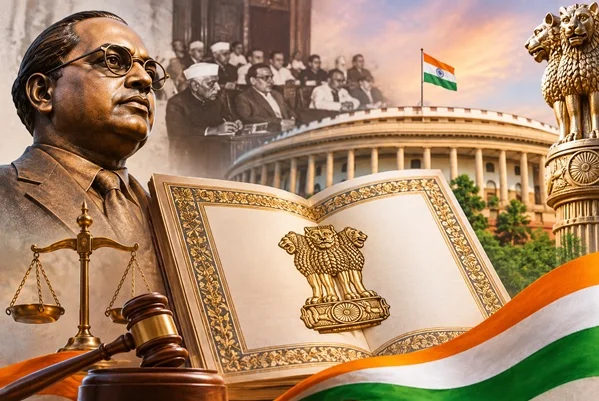
Constitution Day (Samvidhan Diwas) is observed every year on 26 November to commemorate the adoption of the Constitution of India by the Constituent Assembly on 26 November 1949.
|
Particular |
Details |
|
Official Name |
Constitution Day |
|
Hindi Name |
Samvidhan Diwas |
|
Observed On |
26 November |
|
Constitution Adopted |
26 November 1949 |
|
Constitution Came into Force |
26 January 1950 |
|
Constituent Assembly |
Established in 1946 |
|
Drafting Committee |
Established on 29 August 1947 |
|
Chairman of Drafting Committee |
Dr. B.R. Ambedkar |
|
Constitutional Adviser |
B.N. Rau |
|
Total Time Taken |
2 years, 11 months and 17 days |
|
Official Declaration of Constitution Day |
2015 |
|
Nodal Ministry for 2015 Declaration |
Ministry of Social Justice and Empowerment |
|
Present Coordination of 2026 Celebrations |
Ministry of Parliamentary Affairs and Department of Youth Affairs |
|
Member |
Role |
|
Dr. Rajendra Prasad |
President of the Constituent Assembly |
|
Dr. B.R. Ambedkar |
Chairman of the Drafting Committee |
|
Jawaharlal Nehru |
Moved the Objectives Resolution |
|
Sardar Vallabhbhai Patel |
Chairman of several important committees |
|
B.N. Rau |
Constitutional Adviser |
|
Dr. Sachchidananda Sinha |
Temporary Chairman |
|
H.C. Mookherjee |
Vice-President of the Constituent Assembly |
|
K.M. Munshi |
Member of the Drafting Committee |
|
Alladi Krishnaswami Ayyar |
Member of the Drafting Committee |
|
Committee |
Chairman |
|
Drafting Committee |
Dr. B.R. Ambedkar |
|
Union Powers Committee |
Jawaharlal Nehru |
|
Union Constitution Committee |
Jawaharlal Nehru |
|
Provincial Constitution Committee |
Sardar Vallabhbhai Patel |
|
Advisory Committee on Fundamental Rights, Minorities and Tribal Areas |
Sardar Vallabhbhai Patel |
|
Rules of Procedure Committee |
Dr. Rajendra Prasad |
|
Steering Committee |
Dr. Rajendra Prasad |
|
Feature |
Description |
|
Lengthiest Written Constitution |
Comprehensive constitutional document |
|
Parliamentary System |
Based on the British parliamentary model |
|
Federal Structure |
Division of powers between Union and States |
|
Fundamental Rights |
Guarantees essential rights to individuals |
|
Directive Principles |
Guidelines for establishing a welfare state |
|
Fundamental Duties |
Responsibilities of citizens |
|
Independent Judiciary |
Ensures constitutional interpretation and protection |
|
Judicial Review |
Courts can examine the constitutionality of laws |
|
Universal Adult Franchise |
Equal voting rights for eligible adult citizens |
|
Secular State |
Equal constitutional respect and protection for religions |
|
Single Citizenship |
Indian citizenship for the entire country |
|
Emergency Provisions |
Special provisions for extraordinary situations |
|
Independent Constitutional Bodies |
Institutions such as the Election Commission and CAG |
|
Term |
Meaning |
|
Sovereign |
India is internally and externally independent |
|
Socialist |
Commitment to social and economic justice |
|
Secular |
Equal constitutional respect and protection for all religions |
|
Democratic |
Government derives authority from the people |
|
Republic |
The head of the State is elected, not hereditary |
|
Justice |
Social, economic and political justice |
|
Liberty |
Freedom of thought, expression, belief, faith and worship |
|
Equality |
Equality of status and opportunity |
|
Fraternity |
Dignity of the individual and unity and integrity of the nation |
|
Country |
Features Borrowed |
|
United Kingdom |
Parliamentary system, Rule of Law, Cabinet system |
|
United States |
Fundamental Rights, Judicial Review, Impeachment of President |
|
Ireland |
Directive Principles of State Policy |
|
Canada |
Strong Centre, Residuary Powers with Centre |
|
Australia |
Concurrent List, Joint Sitting of Parliament |
|
Germany (Weimar Constitution) |
Emergency provisions |
|
France |
Republic and ideals of Liberty, Equality and Fraternity |
|
South Africa |
Procedure for Constitutional Amendment and election of Rajya Sabha members |
|
Japan |
Procedure established by law |
|
Former USSR |
Fundamental Duties and ideals of social, economic and political justice |
|
Part |
Subject |
|
Part I |
Union and its Territory |
|
Part II |
Citizenship |
|
Part III |
Fundamental Rights |
|
Part IV |
Directive Principles of State Policy |
|
Part IVA |
Fundamental Duties |
|
Part V |
The Union |
|
Part VI |
The States |
|
Part IX |
Panchayats |
|
Part IXA |
Municipalities |
|
Part X |
Scheduled and Tribal Areas |
|
Part XI |
Relations between Union and States |
|
Part XV |
Elections |
|
Part XVIII |
Emergency Provisions |
|
Part XX |
Amendment of the Constitution |
|
Fundamental Right |
Articles |
|
Right to Equality |
Articles 14-18 |
|
Right to Freedom |
Articles 19-22 |
|
Right against Exploitation |
Articles 23-24 |
|
Right to Freedom of Religion |
Articles 25-28 |
|
Cultural and Educational Rights |
Articles 29-30 |
|
Right to Constitutional Remedies |
Article 32 |
|
Amendment |
Year |
Major Provision |
|
1st Amendment |
1951 |
Changes relating to freedom of speech and land reforms |
|
7th Amendment |
1956 |
Reorganisation of States |
|
42nd Amendment |
1976 |
Added Socialist, Secular and Integrity to the Preamble; added Fundamental Duties |
|
44th Amendment |
1978 |
Reversed several Emergency-era changes; removed Right to Property from Fundamental Rights |
|
52nd Amendment |
1985 |
Anti-Defection Law |
|
61st Amendment |
1988 |
Reduced voting age from 21 to 18 years |
|
73rd Amendment |
1992 |
Constitutional status to Panchayati Raj Institutions |
|
74th Amendment |
1992 |
Constitutional status to Urban Local Bodies |
|
86th Amendment |
2002 |
Right to Education under Article 21A |
|
101st Amendment |
2016 |
Introduced GST framework |
|
103rd Amendment |
2019 |
Provided for 10% EWS reservation, subject to constitutional provisions |
|
106th Amendment |
2023 |
Provided for reservation of one-third of seats for women in Lok Sabha and State Legislative Assemblies, subject to its implementation conditions |
Prelims MCQQ. With reference to the Constitution of India, consider the following statements:
Which of the statements given above are correct? (a) 1 and 2 only (b) 1, 2 and 4 only (c) 2, 3 and 4 only (d) 1, 2, 3 and 4 Mains Practice QuestionQ. The Indian Constitution is not merely a legal document but a reflection of the collective aspirations of its people. Discuss |
.
When is Constitution Day observed in India?26 November every year. When did the Indian Constitution come into force?26 January 1950. Who was the Chairman of the Drafting Committee?Dr. B.R. Ambedkar. When was Constitution Day officially declared?In 2015. How many Articles, Parts and Schedules were present in the original Constitution?395 Articles, 22 Parts and 8 Schedules. |