Why in news?
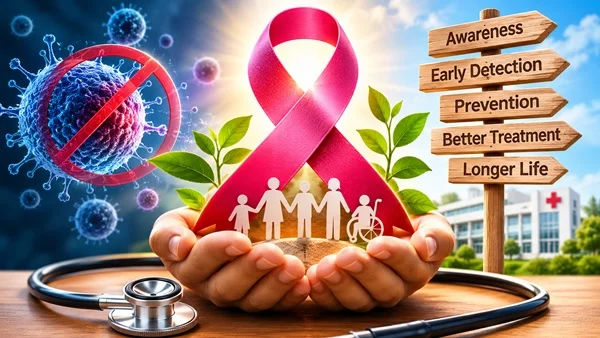
National Cancer Awareness Day is observed on 7 November 2026 in India to highlight the growing burden of cancer and the importance of early detection, prevention and timely treatment.
Key Facts
|
Particulars
|
Details
|
|
Observance
|
National Cancer Awareness Day
|
|
Date
|
7 November
|
|
Country
|
India
|
|
First observed
|
2014
|
|
Announced by
|
Union Ministry of Health and Family Welfare
|
|
Objective
|
Cancer prevention, awareness and early detection
|
|
Associated personality
|
Marie Curie
|
|
Marie Curie's birth anniversary
|
7 November 1867
|
|
Major focus
|
Prevention, screening, diagnosis and treatment
|
Historical Background
- National Cancer Awareness Day was first observed in India in 2014.
- It was announced by the Union Health Minister, Dr Harsh Vardhan.
- The date, 7 November, was selected because it marks the birth anniversary of Marie Curie, who was born on 7 November 1867.
- Marie Curie was a pioneering physicist and chemist known for her ground breaking research on radioactivity.
- Her discoveries of polonium and radium contributed significantly to the development of radiation-based medical applications, including cancer treatment.
What is Cancer?
- Cancer is a group of diseases characterised by the uncontrolled growth and spread of abnormal cells in the body.
- Normally, cells grow, divide and die in a controlled manner. However, when genetic changes disrupt this process, abnormal cells may multiply uncontrollably and form a mass known as a tumour.
- Some cancers, such as leukaemia, do not generally form solid tumours.
Major Types of Cancer
|
Type
|
Description
|
|
Breast Cancer
|
Develops in breast tissue; predominantly affects women but can also occur in men.
|
|
Lung Cancer
|
Develops in lung tissues and is strongly associated with tobacco smoking.
|
|
Oral Cancer
|
Affects the mouth and oral cavity; tobacco and alcohol are important risk factors.
|
|
Cervical Cancer
|
Develops in the cervix and is largely associated with persistent high-risk HPV infection.
|
|
Colorectal Cancer
|
Develops in the colon or rectum.
|
|
Blood Cancer
|
Includes leukaemia, lymphoma and multiple myeloma.
|
|
Prostate Cancer
|
Develops in the prostate gland in men.
|
Major Causes and Risk Factors of Cancer
- Tobacco consumption: Oral, lung, throat and other cancers
- Alcohol consumption: Liver, breast, oral and colorectal cancers
- Unhealthy diet: Increased risk of colorectal and other cancers
- Physical inactivity: Increases the risk of certain cancers
- Obesity: Associated with several types of cancer
- HPV infection: Major cause of cervical cancer
- Hepatitis B and C: Associated with liver cancer
- Air pollution: Increases the risk of lung cancer
- Excessive UV radiation: Increases the risk of skin cancer
- Genetic factors: Can increase susceptibility to certain cancers
Cancer Burden in India
- According to the Indian Council of Medical Research (ICMR)-National Cancer Registry Programme:
|
Year
|
Estimated Cancer Cases in India
|
|
2020
|
13,92,179
|
|
2021
|
14,26,447
|
|
2022
|
14,61,427
|
- Breast cancer is the most common cancer among women in India.
- Oral cancer is a major concern, particularly because of tobacco consumption.
- Lung cancer is strongly associated with smoking and other environmental exposures.
- Cervical cancer remains an important public health concern among women.
- Delayed diagnosis and unequal access to treatment contribute to the cancer burden.
Importance of Early Detection and Screening
- Awareness: Recognising early symptoms and understanding risk factors
- Screening: Identifying possible cancer or precancerous changes before symptoms appear
- Diagnosis: Confirming the disease through appropriate medical investigations
Common cancer screening methods
- Breast Cancer: Clinical breast examination and mammography, where appropriate
- Cervical Cancer: HPV testing, Pap smear and other recommended screening methods
- Oral Cancer: Visual examination of the oral cavity
- Colorectal Cancer: Stool-based tests and colonoscopy, depending on risk and guidelines
- Lung Cancer: Low-dose CT screening for eligible high-risk individuals
Government Initiatives for Cancer Prevention and Control in India
A. National Programme for Prevention and Control of Non-Communicable Diseases (NP-NCD)
- Implemented under the National Health Mission (NHM).
- Focuses on the prevention and control of major non-communicable diseases.
- Promotes population-based screening for common cancers.
- Individuals aged 30 years and above are targeted for screening for oral, breast and cervical cancers.
- Encourages health education, early diagnosis and timely referral.
B. National Programme for Cancer Control
- The National Cancer Control Programme was launched in 1975.
- It was subsequently integrated into the broader programme for prevention and control of non-communicable diseases.
- Its objective has been to strengthen cancer prevention, diagnosis and treatment infrastructure.
C. Tertiary Care Cancer Centre Scheme
- Aims to strengthen specialised cancer treatment facilities.
- Supports the development of State Cancer Institutes (SCIs) and Tertiary Care Cancer Centres (TCCCs).
- Focuses on improving access to advanced cancer diagnosis and treatment.
D. Ayushman Bharat – Pradhan Mantri Jan Arogya Yojana (PM-JAY)
- Provides health coverage to eligible beneficiaries for secondary and tertiary hospitalisation.
- Helps reduce the financial burden of hospital-based treatment.
- Covers eligible cancer-related treatment packages under the scheme.
E. Ayushman Arogya Mandirs
- Strengthen primary healthcare services.
- Promote preventive healthcare and community-level awareness.
- Facilitate screening, early identification and referral for common cancers.
F. National Cancer Grid (NCG)
- Established in 2012.
- Brings together cancer centres, research institutions and healthcare organisations.
- Promotes uniform standards of cancer care, research, education and training.
- Aims to improve the quality and accessibility of cancer treatment across India.
Major Challenges in Cancer Control in India
- Late Diagnosis: Many patients approach healthcare facilities at advanced stages.
- High Treatment Costs: Cancer treatment can impose a substantial financial burden on families.
- Lack of Awareness: People may ignore early symptoms or avoid medical consultation.
- Unequal Healthcare Access: Rural and remote areas often have limited specialised facilities.
- Tobacco Consumption: Smoking and smokeless tobacco contribute significantly to cancer risk.
- Shortage of Specialists: Unequal distribution of oncologists and trained healthcare professionals.
International Perspective: Global Cancer Control
|
Organisation / Initiative
|
Role
|
|
WHO
|
Provides global guidance on cancer prevention and control.
|
|
International Agency for Research on Cancer (IARC)
|
Conducts research on cancer causes and prevention.
|
|
International Atomic Energy Agency (IAEA)
|
Supports the safe and effective use of radiation medicine and radiotherapy.
|
|
WHO Global Breast Cancer Initiative
|
Works to reduce breast cancer mortality through health promotion, timely diagnosis and comprehensive treatment.
|
|
WHO Global Initiative for Childhood Cancer
|
Aims to improve survival rates among children with cancer.
|
Prelims MCQs
Q. National Cancer Awareness Day is associated with the birth anniversary of which scientist?
A. Rosalind Franklin
B. Marie Curie
C. Dorothy Hodgkin
D. Jane Goodall
Mains Practice Question
Q. Cancer has emerged as a major public health challenge in India. Discuss.
|
FAQs
When is National Cancer Awareness Day observed?
7 November
When National Cancer Awareness Day was first observed?
2014.
Who announced National Cancer Awareness Day in India?
The then Union Health Minister, Dr Harsh Vardhan.
What are the three major cancers covered under India's population-based screening programme?
Oral, breast and cervical cancer.
Which organisation maintains India's National Cancer Registry Programme?
The Indian Council of Medical Research (ICMR).
|