Why in news?
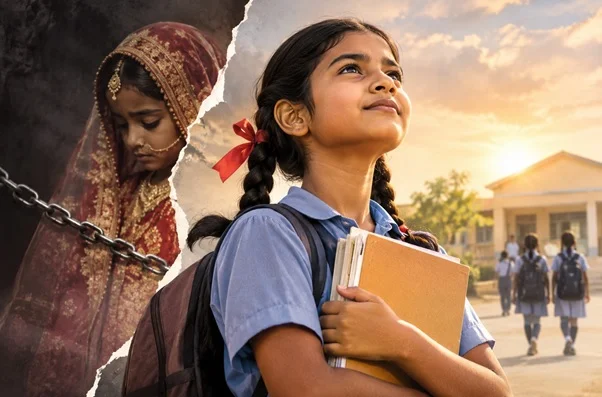
The United Nations General Assembly (UNGA) has proclaimed 27 November as the International Day for the Elimination of Child, Early and Forced Marriage through Resolution A/RES/80/309, adopted on 4 September 2026.
Key facts
|
Particulars
|
Fact
|
|
International Day
|
27 November
|
|
First observance
|
2026
|
|
Established by
|
UN General Assembly
|
|
Resolution
|
A/RES/80/309
|
|
Resolution date
|
4 September 2026
|
|
Theme 2026
|
Keep the Promise: Accelerating Action to End Child Marriage by 2030
|
|
Proposing country
|
Sierra Leone
|
|
Relevant target
|
5.3
|
|
Global child brides
|
Approximately 650 million
|
|
Girls married annually
|
Approximately 12 million
|
|
India's latest prevalence
|
20.1% (NFHS-6)
|
|
Indian law
|
PCMA, 2006
|
|
Male minimum marriage age
|
21 years
|
|
Female minimum marriage age
|
18 years
|
|
Child marriage campaign
|
Bal Vivah Mukt Bharat
|
|
Campaign launch
|
27 November 2024
|
|
National target
|
Child-marriage-free India by 2030
|
|
Ministry
|
Ministry of Women and Child Development
|
What is the International Day for the Elimination of Child, Early and Forced Marriage?
- It is a United Nations international observance dedicated to ending marriages involving children, early marriages and marriages conducted without the free and full consent of individuals.
- The day highlights that marriage should be based on free consent, equality, dignity and individual choice.
Why was this day established?
- Child, early and forced marriage continues to be a major human rights concern, particularly affecting girls and young women.
- The UN General Assembly recognised the need for a dedicated international platform to:
- Renew political commitment.
- Strengthen advocacy and awareness.
- Promote accountability.
- Share successful practices.
- Accelerate action to eliminate these harmful practices.
- The resolution also calls for comprehensive national strategies, investment in girls' education and support for married girls and young women to continue or return to education.
Understanding Child, Early and Forced Marriage
|
Term
|
Meaning
|
|
Child Marriage
|
Any formal marriage or informal union involving a person below 18 years of age
|
|
Early Marriage
|
Marriage occurring before an individual is physically, emotionally or psychologically ready
|
|
Forced Marriage
|
Marriage in which one or both individuals have not given their free and full consent
|
Global Status of Child Marriage: Important Statistics
- Women and girls alive in 2026 who were married during childhood: 650 million
- Girls married before 18 every year: 12 million
- Approximate proportion of young women married during childhood globally: 1 in 5
- People estimated to be living in situations of forced marriage: 22 million
- South Asia: Has the largest number of women and girls who experienced child marriage, accounting for approximately 44% of the global total.
- Sub-Saharan Africa: Has the second-largest regional concentration.
- Global progress: The prevalence of child marriage has declined, but progress remains too slow to achieve the 2030 target.
- Approximately 285 million women and girls in South Asia were married during childhood.
- Around 115 million are in Sub-Saharan Africa.
- At the current rate of progress, eliminating child marriage could take approximately 300 years.
Impact of Child and Forced Marriage
- Education: Discontinuation of schooling and reduced learning opportunities.
- Health: Early pregnancy and increased maternal health risks.
- Mental Health: Psychological stress, anxiety and emotional trauma.
- Economic: Financial dependency and reduced employment opportunities.
- Gender Equality: Reinforces discrimination and gender inequality.
- Human Rights: Restricts personal freedom, dignity and individual choice.
- Society: Perpetuates intergenerational poverty and social inequality.
India's Position: Child Marriage Scenario
- Child marriage prevalence in India: 20.1%
- According to UNICEF's 2024 India Country Profile, approximately 222.4 million women and girls in India had been married before the age of 18.
- India accounts for approximately one-third of the world's child brides.
- Uttar Pradesh has the largest absolute number of women and girls who experienced child marriage, according to the UNICEF profile.
- The latest NFHS-6 figure shows a decline from 23.3% to 20.1%.
Legal Framework against Child Marriage in India
- Prohibition of Child Marriage Act (PCMA), 2006: The Prohibition of Child Marriage Act, 2006 replaced the Child Marriage Restraint Act, 1929, popularly known as the Sarda Act.
|
Particulars
|
Details
|
|
Act
|
Prohibition of Child Marriage Act
|
|
Year
|
2006
|
|
Came into force
|
1 November 2007
|
|
Earlier legislation
|
Child Marriage Restraint Act, 1929
|
|
Male minimum age
|
21 years
|
|
Female minimum age
|
18 years
|
|
Implementing officers
|
Child Marriage Prohibition Officers
|
- Child Marriage Prohibition Officers (CMPOs): Under Section 16 of the PCMA, 2006, State Governments appoint Child Marriage Prohibition Officers. Its function is to :
- Prevent child marriages.
- Collect evidence against those violating the law.
- Create awareness about the harmful effects of child marriage.
- Advise and counsel communities.
- Assist in legal proceedings.
- Other Important Legal Frameworks
|
Law / Convention
|
Relevance
|
|
Protection of Children from Sexual Offences (POCSO) Act, 2012
|
Protects children below 18 against sexual offences
|
|
Juvenile Justice (Care and Protection of Children) Act, 2015
|
Protection and rehabilitation of children in need of care
|
|
Article 14
|
Equality before law
|
|
Article 15(3)
|
Special provisions for women and children
|
|
Article 21
|
Protection of life and personal liberty
|
|
Article 21A
|
Right to free and compulsory education for children aged 6–14
|
|
Article 39(f)
|
Protection of children against exploitation and moral and material abandonment
|
Government Initiatives in India
- Bal Vivah Mukt Bharat Campaign
- Launched: 27 November 2024
- Launched by the Ministry of Women and Child Development.
- Aims to make India free from child marriage by 2030.
- Follows a whole-of-government and whole-of-society approach.
- Promotes community participation, awareness and legal enforcement.
- Beti Bachao Beti Padhao (BBBP)
- Launched in 2015.
- Promotes the survival, protection and education of the girl child.
- Addresses gender discrimination and encourages girls' empowerment.
- Sukanya Samriddhi Yojana
- Launched in 2015 under the Beti Bachao Beti Padhao initiative.
- Encourages savings for the education and future of girl children.
- Supports financial security for girls.
- Kasturba Gandhi Balika Vidyalaya (KGBV)
- Provides residential schooling facilities to girls from disadvantaged groups.
- Promotes access to education in educationally backward areas.
International Initiatives and Frameworks
|
Organisation / Framework
|
Role
|
|
UNICEF
|
Protects children's rights and works to end child marriage
|
|
UNFPA
|
Promotes reproductive health and girls' empowerment
|
|
UN Women
|
Works towards gender equality and women's rights
|
|
WHO
|
Addresses health consequences of early marriage and adolescent pregnancy
|
|
UNFPA–UNICEF Global Programme to End Child Marriage
|
Supports prevention programmes in countries with high child-marriage prevalence
|
Important International Conventions
- Convention on the Rights of the Child (CRC), 1989
- Recognises the rights of every child.
- Protects children from exploitation and harmful practices.
- Emphasises the best interests of the child.
- Convention on the Elimination of All Forms of Discrimination Against Women (CEDAW), 1979
- Promotes gender equality.
- Article 16 addresses equality in marriage and family relations.
- Calls for free and full consent to marriage.
Major Challenges in Eliminating Child Marriage
- Poverty: Families sometimes consider early marriage an economic necessity.
- Gender Inequality: Preference for boys and discrimination against girls reinforce the practice.
- Lack of Education: School dropout rates increase the vulnerability of girls.
- Social Customs: Traditional beliefs and social pressure contribute to early marriages.
- Weak Implementation: Inadequate enforcement and delayed intervention allow child marriages to continue.
Prelims MCQs
Q. The Prohibition of Child Marriage Act was enacted in which year?
A. 1929
B. 1956
C. 2006
D. 2012
Mains Practice Question
Q. Child marriage is not merely a social evil but a major obstacle to women's empowerment and gender equality. Discuss.
|
FAQs
When is the International Day for the Elimination of Child, Early and Forced Marriage observed?
27 November every year
Which UN resolution established this International Day?
UN General Assembly Resolution A/RES/80/309, adopted on 4 September 2026.
Which country proposed the establishment of this International Day?
Sierra Leone.
What percentage of women aged 20–24 were married before 18 in India according to NFHS-6?
20.1% according to NFHS-6 (2023–24).
Which international organisations jointly implement the Global Programme to End Child Marriage?
UNICEF and UNFPA.
|