GS Paper III Science & Technology, Defence Technology, Indigenisation of Technology and Internal Security
Keywords: Pralay Missile, DRDO, Quasi-Ballistic Missile, Short-Range Ballistic Missile, Research Centre Imarat, Bharat Dynamics Limited, Solid Propellant, Integrated Test Range, Conventional Deterrence, Atmanirbhar Bharat |
Why in News?
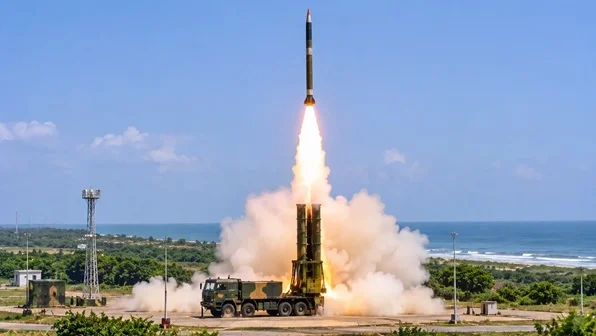
- On 5 November 2026, the Defence Research and Development Organisation (DRDO) successfully conducted a flight test of the indigenously developed Pralay quasi-ballistic missile.
- The test was conducted as part of user evaluation trials, and all stipulated objectives were successfully achieved, as confirmed by data collected through the Integrated Test Range (ITR), Chandipur.
- The Ministry of Defence stated that the successful trial has brought the missile system closer to induction into the Indian Armed Forces.
About Pralay Missile
- Pralay is an indigenously developed, short-range, surface-to-surface quasi-ballistic missile designed to strike strategically important targets with high precision.
- The missile combines the speed and striking power of a ballistic missile with limited trajectory manoeuvrability, making it an important component of India's conventional precision-strike capability.
Key Facts at a Glance
|
Particulars
|
Details
|
|
Missile name
|
Pralay
|
|
Developed by
|
DRDO
|
|
Lead development laboratory
|
Research Centre Imarat (RCI), Hyderabad
|
|
Production partner
|
Bharat Dynamics Limited (BDL)
|
|
Missile category
|
Short-range, surface-to-surface quasi-ballistic missile
|
|
Operational range
|
150–500 km
|
|
Payload capacity
|
500–1,000 kg
|
|
Propulsion system
|
Solid propellant
|
|
Warhead
|
Conventional; multiple warhead categories
|
|
Guidance
|
Advanced guidance and navigation systems
|
|
First flight test
|
December 2021
|
|
Latest flight test
|
5 November 2026
|
|
Launch site
|
Dr APJ Abdul Kalam Island, Odisha
|
|
Testing and monitoring
|
Integrated Test Range, Chandipur
|
|
Present status
|
User evaluation; induction imminent, not yet confirmed
|
Key Features of Pralay Missile
- Quasi-Ballistic Trajectory: Pralay follows a ballistic-like trajectory but possesses the ability to manoeuvre during flight. This provides greater trajectory flexibility than a conventional ballistic missile following a largely predictable path.
- High-Precision Strike Capability: The missile employs advanced guidance and navigation systems to improve accuracy against designated targets and support precision conventional operations.
- Solid-Fuel Propulsion: Pralay uses a solid-propellant propulsion system, which facilitates storage and reduces launch preparation requirements compared with many liquid-fuel missile systems.
- Multiple Warhead Configurations: The system is designed to accommodate different conventional warhead configurations suitable for different target categories.
- Short-Range Tactical Operations: With a reported range of 150–500 km, Pralay is intended to support precision strikes within a regional theatre of operations rather than long-range strategic missions.
What is a Quasi-Ballistic Missile?
- A quasi-ballistic missile is a missile that follows a trajectory resembling that of a ballistic missile but can incorporate manoeuvres that alter its flight path.
- Unlike a conventional ballistic missile, whose trajectory is comparatively predictable after the boost phase, a quasi-ballistic missile can use trajectory adjustments to complicate interception.
|
Feature
|
Conventional Ballistic Missile
|
Quasi-Ballistic Missile
|
|
Flight trajectory
|
Largely ballistic
|
Ballistic-like with manoeuvrability
|
|
Flight-path predictability
|
Relatively predictable
|
Potentially less predictable
|
|
Manoeuvring
|
Limited in basic designs
|
Designed with manoeuvring capability
|
|
Interception
|
Can be tracked and intercepted
|
Manoeuvres may complicate interception
|
|
Example
|
Agni series
|
Pralay
|
Strategic Significance for India
- Strengthening Conventional Deterrence: Pralay can enhance India's ability to respond to conventional military threats through precise, stand-off strikes without necessarily relying on nuclear weapons.
- Enhancing Border Defence: Its range and mobility could support military preparedness in strategically sensitive border regions, including the northern and western sectors.
- Countering Emerging Threats: The missile's manoeuvring capability may complicate adversary air and missile defence planning, thereby improving India's operational flexibility.
- Promoting Defence Indigenisation: The involvement of DRDO, RCI and BDL demonstrates cooperation between domestic research organisations and the defence manufacturing industry.
- Supporting Multi-Domain Operations: Pralay can potentially complement air power, artillery and other precision-strike systems in coordinated military operations.
Role of Major Organisations
|
Organisation
|
Role
|
|
DRDO
|
Overall missile research and development
|
|
Research Centre Imarat (RCI)
|
Lead indigenous development laboratory
|
|
Bharat Dynamics Limited (BDL)
|
Development-cum-production partner
|
|
Integrated Test Range (ITR), Chandipur
|
Tracking, instrumentation and evaluation of flight-test performance
|
|
Indian Armed Forces
|
User evaluation and prospective operational deployment
|
Challenges
- Operational Integration: Incorporating the missile into existing command, control, targeting and military logistics networks.
- Targeting Intelligence: Ensuring reliable, timely intelligence for effective precision-strike operations.
- Air and Missile Defence: Maintaining effectiveness against evolving interception technologies.
- Cost and Production: Balancing high-performance missile production with affordability and scalability.
- Regional Security: Managing the implications of advanced conventional missile capabilities for strategic stability.
Way Forward
- Complete the remaining user evaluation, acceptance and operational integration processes.
- Strengthen indigenous manufacturing capabilities and reliable supply chains.
- Invest in advanced guidance, navigation and electronic warfare resilience.
- Improve coordination between the Army, Air Force and other defence agencies.
- Maintain credible conventional deterrence alongside responsible strategic communication.
Conclusion
- The successful flight test of the Pralay quasi-ballistic missile on 5 November 2026 marks an important achievement in India's indigenous missile development programme.
- Its precision-strike potential, solid-propellant propulsion and manoeuvring capability could enhance the operational preparedness of the Indian Armed Forces. With induction approaching, Pralay represents progress towards defence self-reliance and stronger conventional deterrence.
Prelims Practice Question
Q. With reference to the Pralay missile, consider the following statements:
- It is an indigenously developed surface-to-surface quasi-ballistic missile.
- It has an operational range of approximately 150–500 kilometres.
- It uses a liquid-propellant propulsion system.
- Research Centre Imarat, Hyderabad, has played a major role in its development.
Which of the statements given above are correct?
A. 1 and 2 only
B. 1, 2 and 4 only
C. 2, 3 and 4 only
D. 1, 2, 3 and 4
Mains Practice Question
“The development of indigenous precision-strike missile systems is crucial for strengthening India's conventional deterrence and strategic autonomy.” Discuss with reference to the Pralay quasi-ballistic missile.
|
FAQs
1. What is the Pralay missile?
Pralay is India's indigenously developed short-range quasi-ballistic missile.
2. What is the range of the Pralay missile?
Pralay has a reported range of 150–500 kilometres.
3. Which organisation developed the Pralay missile?
DRDO developed Pralay, led by Research Centre Imarat, Hyderabad.
4. What type of missile is Pralay?
Pralay is a solid-fuelled, surface-to-surface, short-range quasi-ballistic missile.
5. Where was Pralay tested in November 2026?
It was tested from Dr APJ Abdul Kalam Island.
|