Prelims: Aadhaar, UIDAI, Face Authentication, AI/ML, e-KYC, Digital Identity, Cybersecurity, Data Privacy.
GS Paper II – e-Governance, Government Policies & Interventions, GS Paper III – Science & Technology, Cybersecurity and Digital Technology.
Keywords : Aadhaar Face Authentication, UIDAI, Aadhaar Authentication, Aadhaar SDK, Aadhaar Sandbox, Face Authentication SDK, Artificial Intelligence, Machine Learning, Liveness Detection, Anti-Spoofing, Digital Onboarding, Digital Identity, Digital Public Infrastructure, BFSI, Fintech, e-KYC, Digital Financial Inclusion, Cybersecurity, Data Privacy, Aadhaar Act 2016 |
Why in News?
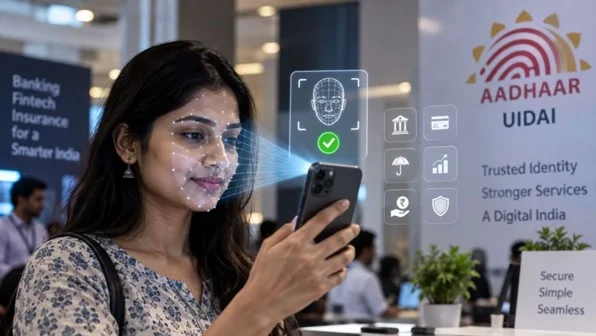
The Unique Identification Authority of India (UIDAI) has launched a new Aadhaar Face Authentication Software Development Kit (SDK) and a dedicated Sandbox at the Global Fintech Fest 2026.
Important Points
- UIDAI launched the Aadhaar Face Authentication SDK and Sandbox.
- Enables integration with Android and iOS apps.
- Uses AI/ML-based liveness detection and anti-spoofing.
- Simplifies digital onboarding for banks, fintech and insurance firms.
- Sandbox enables authentication testing before deployment.
- Data privacy and cybersecurity remain key concerns.
- The initiative aims to make digital onboarding easier, faster and more secure by allowing banks, fintech companies, insurance firms and other eligible entities to integrate Aadhaar Face Authentication directly into their mobile applications.
What is Aadhaar Face Authentication?
- Aadhaar Face Authentication is a biometric authentication method that uses a person's face to verify their identity against Aadhaar records.
- UIDAI's Face Authentication technology uses Artificial Intelligence (AI) and Machine Learning (ML)-based capabilities, including liveness detection and anti-spoofing mechanisms.
- It was developed by UIDAI and has been used across government and private-sector services.
What is the New Aadhaar Face Authentication SDK?
- The Software Development Kit (SDK) is a technology package that allows eligible organisations to integrate Aadhaar Face Authentication into their own Android and iOS applications.
- For example, a customer using a bank or insurance application can complete Aadhaar face authentication within the same application instead of being redirected to a separate application.
Key Features of the New SDK
The Aadhaar Face Authentication SDK includes several security features:
- AI and Machine Learning-based liveness detection to check whether the person is physically present.
- Anti-spoofing technology to help prevent fraudulent attempts.
- Secure handling and encryption of authentication data.
- Support for Android and iOS applications.
- Integration with consumer smartphones without requiring external biometric hardware.
The SDK can be used by government departments, banks, Non-Banking Financial Companies (NBFCs), fintech companies, insurance firms and other organisations.
What is the Aadhaar Face Authentication Sandbox?
- The Sandbox is a controlled testing environment that allows organisations to integrate and test Aadhaar authentication services before deploying them in a live environment.
- UIDAI's developer ecosystem already uses sandbox environments to help eligible entities integrate and test Aadhaar authentication services.
- The new facility can help developers and Quality Assurance (QA) teams test:
- User provisioning and consent
- Face capture
- Liveness checks
- Authentication
- Error handling
- Response validation
- Network interruptions and timeouts
- Spoofing attempts
- Invalid digital signatures
The testing process does not require external biometric hardware.
Why is it Important for the BFSI Sector?
- The Banking, Financial Services and Insurance (BFSI) sector increasingly relies on digital identity verification for customer onboarding.
- The new SDK can help these organisations provide a seamless authentication experience within their existing applications.
- It can:
- Reduce the number of steps involved in digital onboarding.
- Improve customer convenience.
- Support remote identity verification.
- Facilitate faster integration of Aadhaar authentication.
- Strengthen security through liveness detection and anti-spoofing.
Growing Aadhaar Authentication Ecosystem
- Aadhaar authentication is increasingly being used as an identity layer for digital services.
- According to recent statements by UIDAI Chairman Neelkanth Mishra, Aadhaar authentication volumes have reached around 10 crore transactions per day, while UIDAI is preparing its infrastructure to handle 25–30 crore authentications per day. More than 600 entities currently use Aadhaar.
- UIDAI has also been working on strengthening its technology infrastructure, including the use of Artificial Intelligence for fraud detection and post-quantum cryptography as part of its technology roadmap.
Applications of Aadhaar Face Authentication
Aadhaar Face Authentication has applications across several sectors.
It is used for:
- Jeevan Pramaan and Digital Life Certificates for pensioners.
- Beneficiary authentication under Ayushman Bharat.
- Direct Benefit Transfer (DBT)-related services.
- Aadhaar-enabled payment services.
- SIM activation through e-KYC.
- Beneficiary authentication under government schemes.
UIDAI has also demonstrated Face Authentication use cases in areas such as government attendance systems and bank customer acquisition.
Playbook on Ease of Onboarding
- UIDAI also unveiled a Playbook on Ease of Onboarding at the Global Fintech Fest 2026.
- The playbook is intended to guide organisations in the banking, financial services and insurance sectors on joining and using the UIDAI authentication ecosystem.
- It can support identity verification for:
- Customers
- Employees
- Business partners
- Other eligible users
Significance for India
- The initiative is important in the context of India's growing Digital Public Infrastructure (DPI) ecosystem.
- Aadhaar provides a digital identity layer, while platforms such as UPI provide digital payment infrastructure. Integrating Aadhaar Face Authentication directly into financial applications can further reduce friction in digital service delivery.
- The initiative can contribute to:
- Digital financial inclusion: Easier identity verification can support access to digital financial services.
- Ease of doing business: Organisations can integrate authentication directly into their applications.
- User convenience: Customers may not need to switch between multiple applications.
- Security: AI-based liveness detection and anti-spoofing mechanisms can help address fraudulent authentication attempts.
Challenges and Concerns
Despite its potential benefits, wider use of biometric authentication also requires strong safeguards.
1. Data Privacy
Biometric information is highly sensitive. Organisations must ensure that authentication data is handled securely and only for legitimate purposes.
2. Cybersecurity
As authentication systems become more widely used, they may become attractive targets for cyberattacks.
3. Spoofing and Deepfakes
Advances in AI-generated images and videos could create new forms of identity fraud. Continuous improvement of liveness detection and anti-spoofing systems is therefore necessary.
4. Digital Exclusion
People with limited access to smartphones, internet connectivity or digital services may face difficulties in accessing technology-driven authentication systems.
5. Reliability
Authentication systems need to work effectively across different devices, lighting conditions, network environments and user groups.
Way Forward
- India should focus on a security-by-design approach while expanding Aadhaar-based digital authentication.
- This requires:
- Strong encryption and privacy safeguards.
- Continuous improvement of anti-spoofing technology.
- Regular security audits and testing.
- Clear consent mechanisms.
- Robust grievance- redressal systems.
- Alternative authentication mechanisms for users facing technological difficulties.
- Greater awareness among users about safe digital authentication practices.
UIDAI (Unique Identification Authority of India)
- UIDAI is the statutory authority responsible for issuing and managing Aadhaar numbers in India.
- Established: 2009
- Ministry: Ministry of Electronics and Information Technology (MeitY)
- Aadhaar: A 12-digit unique identification number for residents of India.
- Key Functions: Aadhaar enrolment, authentication and identity verification.
- Legal Status: UIDAI is a statutory authority under the Aadhaar Act, 2016.
Conclusion
The launch of the Aadhaar Face Authentication SDK and Sandbox represents an important step in strengthening India's digital identity ecosystem. By allowing Aadhaar Face Authentication to be integrated directly into banking, fintech and insurance applications, UIDAI aims to make digital onboarding simpler, faster and more secure. At the same time, strong privacy, cybersecurity and inclusion safeguards will be essential for ensuring public trust in biometric digital infrastructure.
Prelims Practice Question
Q. With reference to Aadhaar Face Authentication, consider the following statements:
- It uses Artificial Intelligence and Machine Learning-based technologies.
- The Aadhaar Face Authentication SDK can be integrated into mobile applications.
- The Aadhaar Face Authentication Sandbox provides a controlled environment for testing authentication services.
- Face Authentication requires external biometric hardware in every case.
Which of the statements given above is/are correct?
A. 1, 2 and 3 only
B. 1 and 4 only
C. 2 and 3 only
D. 1, 2, 3 and 4
Mains Practice Question
“Aadhaar Face Authentication can simplify digital onboarding, but it also raises concerns related to data privacy and cybersecurity. Discuss.”
|
FAQs
Q1. What is Aadhaar Face Authentication?
Aadhaar Face Authentication is a biometric authentication method that uses facial features to verify an individual's identity against Aadhaar records.
Q2. What is the Aadhaar Face Authentication SDK?
It is a Software Development Kit that allows eligible organisations to integrate Aadhaar Face Authentication directly into their Android and iOS applications.
Q3. What is the Aadhaar Face Authentication Sandbox?
It is a controlled testing environment that allows organisations to test and validate Aadhaar Face Authentication integration before deploying it in a live environment.
Q4. Which sectors can benefit from the new SDK?
The facility is particularly relevant to the banking, financial services and insurance (BFSI) sector. Government departments, fintech firms and other eligible organisations can also benefit.
Q5. What technologies are used in Aadhaar Face Authentication?
The system uses Artificial Intelligence (AI), Machine Learning (ML), liveness detection and anti-spoofing technologies.
|






 Contact Us
  New Batch : 9555124124/ 7428085757
  Tech Support : 9555124124/ 7428085757