Prelims: Project Zorawar, Light Battle Tank, DRDO, Tata Advanced Systems Limited, Make-I Category, High-Altitude Warfare
Mains: GS Paper III: Defence Technology, Indigenisation of Defence Manufacturing, Border Security and Atmanirbhar Bharat
Keywords: Project Zorawar, Tata Advanced Systems Limited, TASL, DRDO, CVRDE, Larsen & Toubro, Mahindra Defence Systems, Light Battle Tank, Make-I Category, High-Altitude Warfare, LAC, Type-15 Tank, Active Protection System, Atmanirbhar Bharat, Defence Indigenisation |
Why in News?
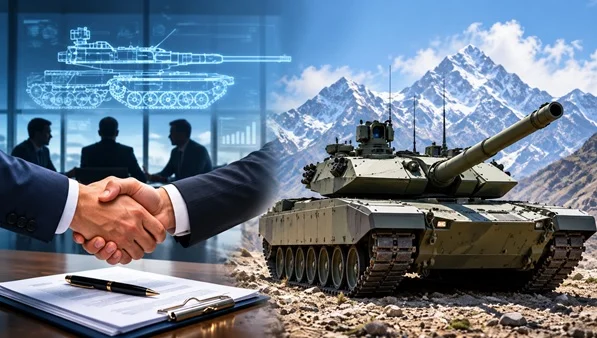
Tata Advanced Systems Limited (TASL), a Tata Group company, has reportedly emerged as the lowest bidder (L1) in the competition to develop the next-generation Zorawar light battle tank for the Indian Army.
Background
- Project Zorawar was initiated to meet the Indian Army's requirement for a lightweight battle tank capable of operating effectively in high-altitude areas, particularly along India's northern borders.
- The requirement gained greater strategic importance after the India-China military standoff in eastern Ladakh in 2020, where difficult mountainous terrain highlighted the limitations of deploying heavier main battle tanks.
- The Zorawar light tank has been designed and developed by the Combat Vehicles Research and Development Establishment (CVRDE) of the Defence Research and Development Organisation (DRDO), in collaboration with Larsen & Toubro (L&T). Several Indian industries and MSMEs have also participated in the development of its subsystems.
- The Indian Army plans to acquire a total of 354 light tanks. Of these, an initial 59 tanks are associated with the DRDO-L&T development programme, while the remaining 295 tanks are planned under the Make-I route.
What is the Zorawar Light Tank?
- Zorawar is an indigenously developed 25-tonne-class light battle tank specifically designed for high-altitude warfare.
- Unlike heavier main battle tanks, Zorawar places greater emphasis on mobility, rapid deployment and operation over difficult mountainous terrain while retaining considerable firepower and protection.
- The government has officially confirmed that the tank has been designed as a 25-tonne-class armoured fighting vehicle for high-altitude applications.
- The tank is named after General Zorawar Singh, the 19th-century military commander known for his campaigns across the Himalayan region.
Why Does India Need a Light Tank?
- India's T-72 and T-90 main battle tanks provide substantial firepower and protection, but their heavier weight creates additional logistical and mobility challenges in high-altitude terrain.
- Mountain roads, bridges, narrow passes, extreme temperatures and low oxygen levels make the movement and operation of heavy armoured vehicles more difficult.
- China's deployment of lighter armoured vehicles, particularly the Type-15 light tank, during the Ladakh tensions also strengthened the operational case for India to develop its own high-altitude light tank. DRDO-related material has specifically linked the Zorawar requirement with the need for greater mobility in extreme-altitude areas.
- Zorawar is therefore intended to provide the Indian Army with a combination of high mobility, significant firepower, rapid deployment and greater operational flexibility in mountainous regions.
Major Features of Zorawar
- Lightweight Design: The maximum combat weight of Zorawar is around 25 tonnes, making it substantially lighter than conventional main battle tanks.
- High-Altitude Capability: Zorawar has been specifically developed for operations in high-altitude regions such as Ladakh.
- Firepower: The Zorawar is equipped with a 105 mm gun system. DRDO material has identified the John Cockerill 105 mm gun as part of the tank's configuration.
- Engine and Mobility: According to the latest report, Zorawar is powered by a 760 horsepower diesel engine coupled with a Renk HMPT-800 transmission. It is reported to achieve a maximum road speed of around 70 km/h, while its cross-country speed is approximately 35-40 km/h.
- Air Transportability: One of Zorawar's major advantages is its ability to be transported by military transport aircraft.
- Protection: A light tank faces the difficult challenge of maintaining adequate battlefield protection without increasing its weight excessively.
- Amphibious Capability: Zorawar has also been designed with amphibious capability, increasing its usefulness in areas containing rivers, lakes and other water obstacles.
What is TASL's Role in the Project?
- Tata Advanced Systems has reportedly emerged as the L1 bidder for the competitive Make-I portion of the Zorawar programme.
- The company is expected to develop two prototypes and demonstrate their capabilities within approximately 130 weeks. Mahindra Defence Systems has reportedly emerged as the L2 bidder.
- However, TASL becoming the lowest bidder should not be interpreted as the company having already received the entire order for 295 tanks.
- The prototypes must first satisfy the required technical and operational standards. According to the report, once the prototypes are cleared, the eventual production order is expected to be divided between qualifying L1 and L2 vendors, although the final ratio has not yet been disclosed.
What is the Make-I Category?
- The Make-I category is an important part of India's defence procurement framework aimed at promoting indigenous development of strategically important military equipment.
- Under the Zorawar programme, the government is reported to provide up to 70% funding for prototype development.
- The model encourages Indian defence companies to acquire the technological, engineering and manufacturing capabilities required to develop complex military systems domestically.
- It also reduces dependence on imported finished platforms and creates opportunities for private companies, MSMEs and specialised technology firms to participate in India's defence industrial ecosystem.
Strengthening India's Private Defence Sector
- The competitive participation of Tata Advanced Systems and Mahindra Defence Systems represents a significant development for India's private defence manufacturing industry.
- Complex armoured vehicles require expertise in propulsion, armour, weapons, electronics, sensors, communication systems, fire-control systems and advanced manufacturing.
- Developing these capabilities within Indian private industry could generate long-term benefits extending well beyond the Zorawar programme.
Significance for Atmanirbhar Bharat
- Project Zorawar represents an important example of India's attempt to create a broader indigenous defence manufacturing ecosystem.
- DRDO has confirmed that Larsen & Toubro and numerous Indian industries, including MSMEs, have already participated in the development of the light tank and its subsystems.
- Greater private-sector participation can reduce India's dependence on imported defence platforms while improving domestic design capability, manufacturing capacity and supply-chain resilience.
- If successfully developed and produced at scale, the Zorawar programme could also enhance India's ability to offer specialised light armoured vehicles to international markets.
Way Forward
- India should use Project Zorawar not merely as a tank procurement programme but as an opportunity to create an indigenous ecosystem for next-generation armoured warfare.
- Greater focus will be required on indigenous power packs, active protection systems, counter-drone technologies, advanced ammunition, battlefield networking, artificial intelligence and manned-unmanned teaming.
- Rigorous trials in high-altitude, desert and amphibious environments will also remain essential before large-scale induction.
Prelims MCQs
Q. Consider the following statements regarding the Zorawar Light Tank:
- It belongs to the approximately 25-tonne class.
- It has been designed for high-altitude applications.
- Its airlift capability has been demonstrated by the Indian Air Force.
Which of the statements given above are correct?
A. 1 only
B. 1 and 2 only
C. 2 and 3 only
D. 1, 2 and 3
Mains Question
“Project Zorawar represents both an operational response to India's high-altitude security challenges and a significant step towards defence indigenisation.” Discuss.
|
FAQs
What is Project Zorawar?
Project Zorawar is India's programme to develop a lightweight battle tank capable of operating effectively in high-altitude and difficult terrain. The platform has been designed by DRDO's CVRDE in collaboration with Larsen & Toubro.
What is the weight of the Zorawar tank?
Zorawar is designed as a 25-tonne-class armoured fighting vehicle, making it significantly lighter than conventional main battle tanks.
Why does India need Zorawar?
The tank is intended to provide greater mobility, rapid deployment and effective firepower in mountainous regions, particularly along India's northern borders.
How many Zorawar light tanks does the Indian Army plan to acquire?
The reported overall requirement is 354 light tanks, including 59 associated with the initial DRDO-L&T programme and another 295 planned through the Make-I route.
Has Tata Advanced Systems received the order for 295 tanks?
No final production order for all 295 tanks has been announced. TASL has reportedly emerged as the lowest bidder and is expected to move to the prototype-development stage.
|






 Contact Us
  New Batch : 9555124124/ 7428085757
  Tech Support : 9555124124/ 7428085757