
- UPSC Exam
- State PCS
- One Day Exam
- Current Affairs
- PT Quiz
- Downlaods
- About Coaching
- Blog
- Videos

| Prelims: (Science & Technology + CA) Mains: (GS 3: Science & Technology, Innovation, Start-ups, Regional Development; GS 2: Governance & Cooperative Federalism) |
The Atal Innovation Mission (AIM) under NITI Aayog has launched India’s first State Innovation Mission (SIM) in Tripura.
This marks a significant step toward decentralising India’s innovation policy and strengthening state-level innovation ecosystems.
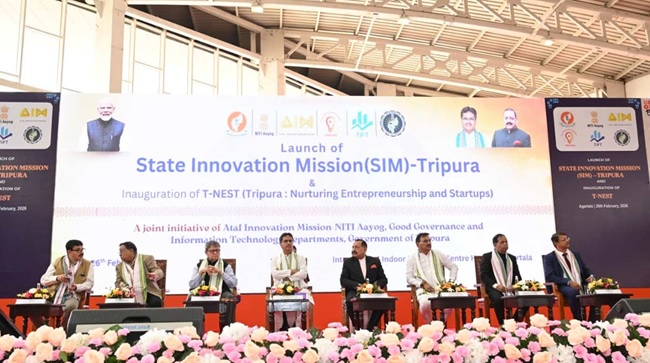
The State Innovation Mission (SIM) is part of the approved AIM 2.0 programme under the State Support Mission (SSM) framework of NITI Aayog.
It is conceived as a long-term institutional mechanism to support States and Union Territories in:
Tripura has become the first state to operationalise this model.
Under SIM, AIM will collaborate closely with the Government of Tripura to:
1. Design a Long-Term Innovation Strategy
Creating a roadmap tailored to the state’s economic structure, demographic profile, and sectoral strengths.
2. Strengthen Policy & Regulatory Frameworks
Ensuring conducive policies for startups, MSMEs, and research-driven enterprises.
3. Promote Multi-Stakeholder Partnerships
Facilitating collaboration between:
4. Enable Peer Learning
Creating platforms for cross-state knowledge exchange and best-practice adoption.
5. Support Startups
Providing:
The Mission spans the entire innovation lifecycle — from school-level creativity to advanced entrepreneurship.
The Atal Innovation Mission was established in 2016 as a flagship initiative under NITI Aayog.
Core Objective: To promote innovation and entrepreneurship across schools, universities, research institutions, industries, and MSMEs.
1. Promoting Entrepreneurship
Encouraging innovators to convert ideas into viable enterprises through funding and mentorship.
2. Promoting Innovation
Creating platforms that nurture creative problem-solving and technological solutions.
SIM represents the next phase — shifting from centralised innovation support to state-driven innovation governance.
1. Regional Diversity
India’s states differ widely in economic structures, resource bases, and innovation capacities.
2. Decentralised Governance
Innovation ecosystems function best when tailored to local industries and demographic realities.
3. Balanced Development
Bridging regional disparities, particularly in Northeast and aspirational districts.
4. Strengthening Startup India
State-level innovation missions complement national startup initiatives.
5. Capacity Building
Building institutional capacity within state governments to manage innovation policy effectively.
1. Deepening Cooperative Federalism
SIM embodies Centre-State collaboration in innovation governance.
2. Empowering Smaller States
Tripura’s selection signals attention to Northeast India’s development.
3. Institutionalising Innovation
Moves beyond ad-hoc grants toward structured, long-term ecosystem development.
4. Inclusive Growth
Emphasises regional balance, youth empowerment, and local entrepreneurship.
5. Strengthening India’s Innovation Ranking
Robust state ecosystems contribute to improved performance in global innovation indices.
FAQsQ1. What is the State Innovation Mission (SIM)? It is a state-level institutional mechanism under AIM 2.0 to build and strengthen innovation ecosystems tailored to local needs. Q2. Why was Tripura chosen first? Tripura’s selection highlights the focus on regional balance and strengthening innovation in the Northeast. Q3. How is SIM different from existing AIM programmes? While AIM supports institutions like schools and incubators, SIM works at the state governance level to design systemic innovation strategies. Q4. What sectors can benefit from SIM? Startups, MSMEs, education institutions, research organisations, and local industries. Q5. How does SIM support cooperative federalism? It promotes structured collaboration between the Centre and States in innovation policy planning and execution. |

Our support team will be happy to assist you!

 Contact Us
  New Batch : 9555124124/ 7428085757
  Tech Support : 9555124124/ 7428085757