
- UPSC Exam
- State PCS
- One Day Exam
- Current Affairs
- PT Quiz
- Downlaods
- About Coaching
- Blog
- Videos

|
Keywords: BOHR Satellite, SpaceX Falcon 9, Nuclear-Powered Commercial Satellite, City Labs BOHR Satellite, Betavoltaic Battery, NanoTritium Battery, Space Nuclear Technology, SpaceX Transporter-17, Commercial Space Technology, UPSC Science and Technology. Focus Areas Prelims: Science & Technology, Space Technology, Nuclear Energy, Mains (GS Paper III): Science & Technology—Developments and Applications, Space Technology, Emerging Technologies, Commercial Space Sector, Nuclear Technology in Space Exploration. |
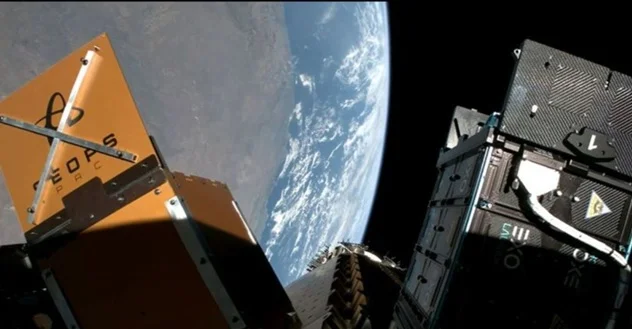
The world's first commercially built nuclear-powered satellite, BOHR (Betavoltaic Orbital High-Reliability), has successfully entered orbit aboard a SpaceX Falcon 9 rocket during the Transporter-17 rideshare mission. Developed by City Labs, a Florida-based aerospace company, BOHR demonstrates betavoltaic nuclear battery technology, which generates electricity from the radioactive decay of tritium.
|
Particular |
Details |
|---|---|
|
Satellite Name |
BOHR (Betavoltaic Orbital High-Reliability) |
|
Developed By |
City Labs, Florida, USA |
|
Launch Vehicle |
SpaceX Falcon 9 |
|
Mission |
Transporter-17 |
|
Launch Site |
Vandenberg Space Force Base, California |
|
Technology |
Betavoltaic Nuclear Battery |
|
Objective |
Demonstrate long-life nuclear power technology in orbit |
Betavoltaic technology is a type of nuclear battery that converts the energy released during the radioactive decay of tritium into electrical power.
Unlike a nuclear reactor, no chain reaction takes place.
The BOHR satellite uses Nano Tritium battery technology, developed by City Labs.
It is the first commercially built satellite designed to demonstrate betavoltaic nuclear battery technology in orbit.
Nuclear batteries can continue producing electricity for years without depending on sunlight.
Such technology could power spacecraft operating far beyond Earth where solar energy becomes weak.
The mission opens new opportunities for private companies developing advanced space power systems.
|
Feature |
Beta voltaic Battery |
Nuclear Reactor |
|---|---|---|
|
Energy Source |
Tritium decay |
Nuclear fission |
|
Chain Reaction |
No |
Yes |
|
Power Output |
Low |
Very High |
|
Safety |
Higher |
More complex |
|
Best Use |
Small satellites |
Large spacecraft or future lunar bases |
Although India currently relies mainly on solar-powered spacecraft, future long-duration missions such as:
Could benefit from advanced nuclear power technologies.
The successful launch of BOHR aboard SpaceX's Falcon 9 marks an important milestone in commercial space technology. By demonstrating betavoltaic nuclear battery technology in orbit, the mission highlights an alternative to conventional solar-powered systems for long-duration and deep-space applications. Although BOHR does not use a nuclear reactor, its innovative power source could influence the future design of commercial satellites, scientific missions, and next-generation space infrastructure, making it a noteworthy development from both technological and UPSC perspectives.
|
Topic |
Fact |
|---|---|
|
Satellite |
BOHR |
|
Full Form |
Betavoltaic Orbital High-Reliability |
|
Developer |
City Labs |
|
Launch Vehicle |
SpaceX Falcon 9 |
|
Mission |
Transporter-17 |
|
Launch Site |
Vandenberg Space Force Base |
|
Technology |
Betavoltaic Nuclear Battery |
|
Fuel |
Tritium |
|
Power Source |
NanoTritium Battery |
Prelims Practice QuestionQ. The recently launched BOHR Satellite, seen in the news, is significant because it: A. Is the world's first satellite powered by a nuclear fusion reactor Mains Practice Question"Discuss the significance of nuclear-based power systems for future commercial satellites and deep-space exploration. Examine the opportunities and challenges associated with their use." |
Q.1. What is BOHR?BOHR is the world's first commercially built satellite designed to demonstrate betavoltaic nuclear battery technology in space. Q.2. Who developed BOHR?BOHR was developed by City Labs, a Florida-based aerospace company. Q.3. Did SpaceX build the satellite?No. SpaceX provided the launch vehicle (Falcon 9), while the satellite was developed by City Labs. Q.4. How does the BOHR satellite generate electricity?It uses a NanoTritium betavoltaic battery, which converts energy from the radioactive decay of tritium into electricity. Q.5. Why is BOHR important?It demonstrates a new commercial approach to long-life space power systems that could support future satellites and deep-space missions. |



Our support team will be happy to assist you!

 Contact Us
  New Batch : 9555124124/ 7428085757
  Tech Support : 9555124124/ 7428085757